

Selecting the right automation system components is one of the most consequential decisions an operations manager will make. The market is saturated with tools that promise scalability, but most organizations struggle to match those promises against measurable performance outcomes. Without a structured selection framework, businesses risk investing in components that look impressive in demos but fail under real-world conditions. This article walks you through the seven core components of a scalable, AI-driven automation architecture, the criteria that should govern your choices, and the hard benchmarks that separate effective deployments from costly experiments.
Table of Contents
- Criteria for selecting automation system components
- 1. Sensors and actuators: The foundation of data-driven automation
- 2. Controllers: Orchestrating process logic and integration
- 3. Networks and protocols: Ensuring secure communication
- 4. Edge computing and AI: Real-time analysis for improved outcomes
- 5. Exception and self-healing mechanisms: Handling the unpredictable
- Comparison summary: Which components deliver the most impact?
- Our perspective: The uncomfortable truth about scaling AI-driven automation
- Next steps: Streamline automation with Starks Global Group
- Frequently asked questions
Key Takeaways
| Point | Details |
|---|---|
| Prioritize real-world KPIs | Evaluate automation systems based on measurable, evidence-backed performance indicators. |
| Hybrid controls boost safety | Combining AI and deterministic architectures provides reliable, scalable automation for critical operations. |
| Exception handling is essential | Robust exception and self-healing mechanisms ensure resilience to unpredictable disruptions. |
| AI and edge computing drive efficiency | Integrating edge intelligence enables faster insights, predictive maintenance, and operational gains. |
| Component comparison guides investment | Reviewing each system component's impact helps leaders prioritize the most effective upgrades. |
Criteria for selecting automation system components
To set the stage for a meaningful evaluation, every business needs a consistent set of selection criteria applied before any component enters the architecture.
The most effective criteria span three dimensions: scalability, interoperability, and safety-critical requirements. Scalability means the component can handle growing data volumes, additional nodes, and expanded workflows without requiring a complete rebuild. Interoperability means it communicates cleanly with existing systems using standardized protocols. Safety-critical requirements mean the component performs reliably under failure conditions, not just optimal ones.
Beyond those fundamentals, selection should be driven by measurable KPIs. According to industrial automation decarbonization benchmarks, integrating edge computing, OPC UA protocols, and predictive maintenance can achieve 15-25% uptime gains alongside carbon intensity reductions of 15-30%. These are the kinds of numbers your selection criteria should be built around.
Key criteria to apply during component evaluation:
- AI integration readiness: Can the component accept model outputs, trigger AI-driven decisions, and log data for continuous learning?
- Protocol compatibility: Does it support OPC UA, MQTT, or REST APIs natively?
- Failure behavior: What happens when the component loses connectivity or receives corrupted data?
- Vendor support and update cadence: Is the component actively maintained with security patches?
- Real-world benchmark availability: Has it been tested in field conditions, not just controlled simulations?
For a broader view of how these criteria fit into a layered system, our automation infrastructure overview explains how tool, system, workflow, and deployment layers interact.
Pro Tip: Always request field-tested performance data from vendors. Simulation benchmarks routinely overstate reliability by 30-40% compared to actual deployment results.
1. Sensors and actuators: The foundation of data-driven automation
With criteria established, sensors and actuators are the logical starting point. They are the physical interface between your automation system and the real world.
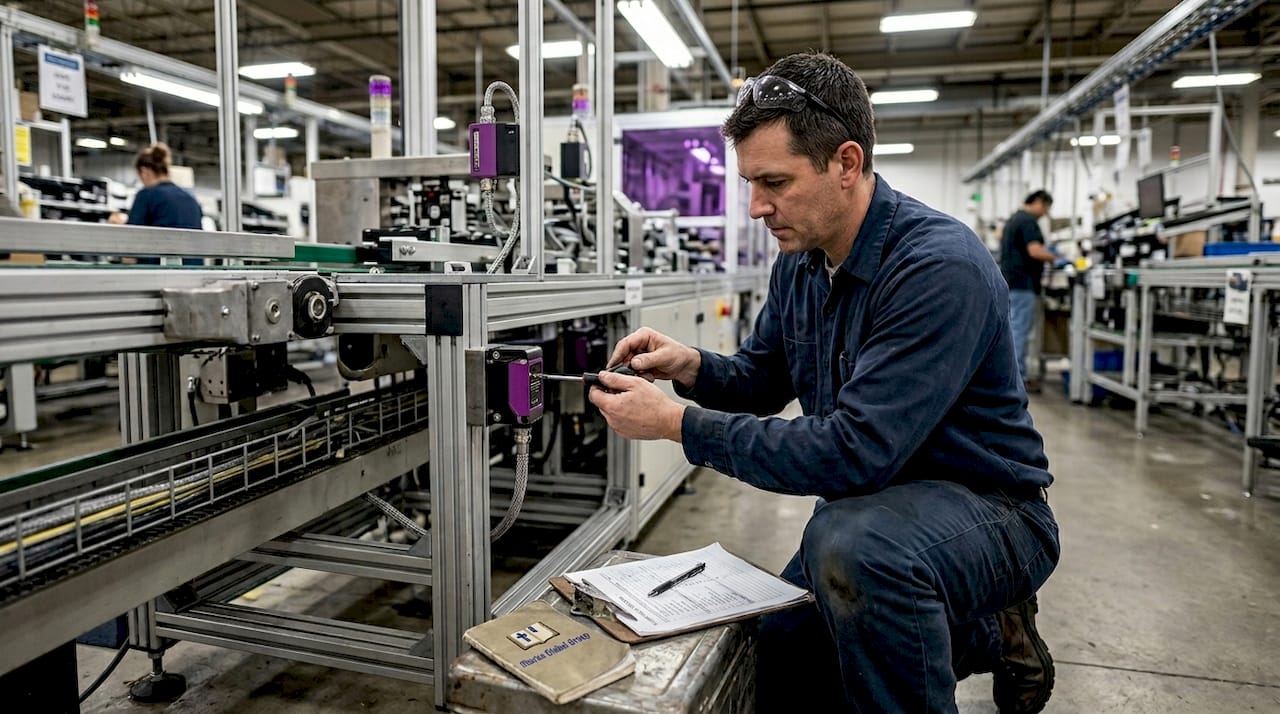
Sensors collect real-time data: temperature, pressure, position, flow rate, vibration, and more. Without accurate sensor data, every downstream decision in your automation stack is built on guesswork. Actuators receive commands from controllers and execute physical actions, opening valves, adjusting motor speeds, triggering conveyors. Together, they form the closed-loop feedback cycle that makes automation precise and responsive.
The distinction between open-loop and closed-loop systems is critical here. As automation system methodology explains, open-loop systems execute commands without feedback, while closed-loop systems use sensor data to continuously verify and correct outputs. For any safety-critical operation, closed-loop is non-negotiable.
Core considerations for sensors and actuators:
- Accuracy and resolution: A sensor that drifts by 2% in a temperature-sensitive process can trigger cascading failures.
- Environmental tolerance: Industrial sensors must withstand dust, moisture, vibration, and temperature extremes.
- Response latency: Actuators in high-speed processes need sub-millisecond response times.
- Redundancy: Critical control points should have backup sensors to prevent single-point failures.
- Data output format: Sensors should output structured, timestamped data compatible with your data pipeline.
"Hybrid AI-deterministic architectures are recommended for safety-critical operations, blending the adaptability of AI with the predictability of rule-based logic."
This hybrid approach is where modern automation design is heading. AI handles pattern recognition and optimization, while deterministic logic handles safety interlocks and fail-safe responses. The combination delivers both flexibility and reliability. You can explore how these hardware and software elements integrate within a full automation architecture on our platform.
Pro Tip: For high-stakes environments, deploy redundant sensor pairs with automatic cross-validation. If readings diverge beyond a set threshold, the system flags the anomaly and triggers a human review before acting.
2. Controllers: Orchestrating process logic and integration
Sensors feed data upward, and controllers are where that data becomes action. Controllers are the decision-making layer of your automation architecture.
A controller receives inputs from sensors, applies programmed logic (or AI-generated logic), and sends commands to actuators. In modern deployments, controllers range from traditional PLCs (programmable logic controllers) to edge-based AI inference engines. The choice depends on your process complexity, latency requirements, and integration needs.
One of the most underappreciated challenges in controller design is exception handling. Research shows that edge cases represent 20-40% of all operations and are responsible for 80% of operational issues. That means the vast majority of your system failures will come from scenarios your initial design did not fully anticipate.
Key controller capabilities to prioritize:
- Exception and edge-case management: The controller must handle unexpected inputs gracefully, not crash or freeze.
- Human-in-the-loop integration: For mission-critical decisions, the controller should escalate to a human operator rather than defaulting to a potentially harmful automated response.
- Self-healing routines: Controllers should detect anomalies and attempt corrective actions before escalating.
- Audit logging: Every decision should be logged with timestamps and input states for post-incident analysis.
The following table compares real-world controller performance benchmarks across common deployment types:
| Controller type | Latency | Exception handling | AI integration | Scalability |
|---|---|---|---|---|
| Traditional PLC | Very low | Rule-based only | Limited | Moderate |
| Edge AI controller | Low | Adaptive + rules | Native | High |
| Cloud-based controller | Moderate to high | Adaptive | Native | Very high |
| Hybrid PLC + AI | Low | Adaptive + rules | Partial | High |
For organizations building layered automation stacks, understanding key infrastructure features at the controller level is essential before adding higher-order AI capabilities.
3. Networks and protocols: Ensuring secure communication
Once controllers are in place, efficient and secure communication between all components becomes the next critical layer. Networks and protocols are the connective tissue of your automation architecture.
Without reliable communication, even the best sensors and controllers cannot deliver consistent results. A network failure in a manufacturing line can halt production entirely. In a logistics operation, it can cause inventory mismatches that take days to reconcile.
OPC UA (Open Platform Communications Unified Architecture) has emerged as the industry standard for industrial communication. It provides platform-independent, secure, and scalable data exchange. Compared to legacy protocols like Modbus or proprietary vendor formats, OPC UA offers built-in security, semantic data modeling, and cloud connectivity.
The same uptime benchmark data that supports edge computing adoption also validates OPC UA's role in achieving 15-25% uptime improvements when combined with predictive maintenance strategies.
| Feature | OPC UA | Legacy Modbus | Proprietary protocols |
|---|---|---|---|
| Security | Built-in encryption | None | Varies |
| Interoperability | High | Limited | Very limited |
| Cloud readiness | Yes | No | Rarely |
| Semantic data modeling | Yes | No | No |
| Scalability | High | Low | Low |
Network reliability considerations:
- Redundant pathways: Critical communication links should have failover routes.
- Latency monitoring: Spikes in network latency can desynchronize controllers and sensors.
- Cybersecurity posture: Industrial networks are increasingly targeted; zero-trust architectures are becoming standard.
- Bandwidth planning: AI-driven systems generate significantly more data than traditional automation.
Our resources on protocols and communication standards provide structured guidance on selecting and deploying the right protocol stack for your environment.
4. Edge computing and AI: Real-time analysis for improved outcomes
For businesses aiming to scale, edge computing and AI represent the highest-leverage layer in the automation stack. They transform raw data into actionable intelligence, in real time, at the point of collection.
Edge computing processes data locally, on-site or near the device, rather than routing everything to a central cloud. This reduces latency from seconds to milliseconds, which is critical for time-sensitive control decisions. It also reduces bandwidth costs and keeps sensitive operational data within your network perimeter.
AI adds predictive and adaptive capabilities that rule-based systems cannot match. Predictive maintenance is the most proven use case: AI models analyze vibration, temperature, and cycle data to predict equipment failures before they occur, often with 85-95% accuracy in well-trained deployments.
The performance data here is striking. Industrial automation benchmarks show 10-25% energy savings and 20-40% waste reduction as achievable outcomes. In smart-factory environments, NF-MORL (a multi-objective reinforcement learning framework) reduced makespan by 46% compared to baseline scheduling approaches. Makespan refers to the total time to complete a set of production tasks, so a 46% reduction is a substantial throughput gain.
However, AI has real limitations in industrial settings. The same research notes that large language models achieve only 22.73% success on industrial GUI tasks, with GPT-4 performing best among tested models. This is a clear signal: AI augments human operators, it does not replace them in complex industrial contexts.
Key capabilities delivered by edge AI:
- Anomaly detection: Identifies deviations from normal operating patterns before they escalate.
- Predictive maintenance scheduling: Reduces unplanned downtime by flagging components approaching failure thresholds.
- Real-time optimization: Adjusts process parameters dynamically to maximize throughput or minimize energy use.
- Local inference: Runs AI models on-site without cloud dependency, maintaining performance during connectivity interruptions.
Explore how AI and edge computing applications are structured within scalable automation architectures on our platform.
5. Exception and self-healing mechanisms: Handling the unpredictable
As automation scales, the volume and variety of unexpected events grows proportionally. Exception and self-healing mechanisms are what separate robust production systems from fragile ones.
The core problem is well-documented. Edge cases cause 80% of issues in automated operations, yet most system designs focus on the "happy path," the ideal sequence of events where everything works as expected. Real-world automation encounters contamination, human interference, unexpected sensor readings, network drops, and equipment wear that no simulation fully replicates.
Effective exception handling components:
- Structured error taxonomies: Categorize exceptions by severity and required response, from automatic retry to full system halt.
- Self-healing routines: Automated scripts that attempt to restore normal operation without human intervention, such as restarting a failed service or switching to a backup sensor.
- Escalation protocols: Clear rules for when the system should alert a human operator and what information to provide.
- Post-incident logging: Every exception should generate a detailed log entry for root cause analysis.
- Chaos testing: Deliberately introduce failures in staging environments to verify that self-healing routines actually work.
Human-in-the-loop design is not a weakness in your automation architecture. It is a deliberate engineering choice that improves overall system resilience. Operators bring contextual judgment that no current AI system can fully replicate, especially in novel failure scenarios.
Our resources on exception handling solutions outline how to build these mechanisms into your automation stack from the ground up.
Pro Tip: Run quarterly failure injection exercises in your staging environment. Simulations miss real-world chaos like contamination and human interference, so field-testing your exception handling is the only reliable validation method.
Comparison summary: Which components deliver the most impact?
With each component detailed, the following table helps you prioritize investments based on measurable impact across key performance dimensions.
| Component | KPI impact | Scalability | Resilience | Efficiency gain |
|---|---|---|---|---|
| Sensors and actuators | High (data accuracy) | Moderate | High with redundancy | Foundational |
| Controllers | High (decision quality) | High | High with self-healing | Core |
| Networks and protocols | High (uptime) | High | High with redundancy | 15-25% uptime gain |
| Edge computing and AI | Very high | Very high | Moderate (needs human-in-loop) | 10-25% energy savings |
| Exception handling | Critical | High | Very high | Prevents 80% of issue impact |
The data points to a clear pattern: no single component delivers results in isolation. Sensors without reliable controllers produce noise. Controllers without exception handling fail under real conditions. AI without edge infrastructure cannot respond fast enough for time-sensitive processes. The architecture must be built as a connected, validated system, not as a collection of individual tools.
For structured guidance on component comparison insights, our platform provides detailed blueprints that map each component to specific business outcomes.
Our perspective: The uncomfortable truth about scaling AI-driven automation
Here is what we see consistently across organizations attempting to scale automation: they over-invest in AI capabilities and under-invest in the operational infrastructure that makes AI reliable.
The pattern is predictable. A business deploys a sophisticated AI model for predictive maintenance or process optimization. The pilot results are impressive. Then the system hits production at scale, and real-world chaos arrives: a sensor gets contaminated, a worker bypasses a safety gate, a network packet arrives out of sequence. The AI model, trained on clean data, produces unreliable outputs. The organization loses confidence in the entire initiative.
The fix is not a better AI model. It is better infrastructure around the model.
Hybrid control architectures, where AI handles optimization and deterministic logic handles safety, are not a compromise. They are the correct engineering approach for any operation where failures have real consequences. Human-in-the-loop design is not a sign that your AI is immature. It is a sign that your architecture is honest about what AI can and cannot do today.
We are also direct about simulation-based validation: it is overrated as a final test. Simulations are valuable for initial design and regression testing. But simulation misses real-world chaos like contamination, human interference, and cascading failures that only emerge under actual operating conditions. Field data beats models every time when it comes to validating resilience.
The organizations that scale automation successfully are not the ones with the most advanced AI. They are the ones with the most rigorous field-testing practices, the clearest KPI frameworks, and the most honest assessment of where human judgment still outperforms automated logic. Our expert perspective on automation is grounded in that reality.
Next steps: Streamline automation with Starks Global Group
The framework in this article gives you a structured way to evaluate, select, and deploy automation system components that actually perform at scale. Applying it requires more than a checklist. It requires verified tools, tested architectures, and deployment logic that has been validated in real-world conditions.

At Starks Global Group, we build and document exactly that. Our platform provides layered automation blueprints covering sensors, controllers, networks, edge AI, and exception handling, all structured around measurable KPIs and real-world performance data. Whether you are designing your first automation workflow or scaling an existing system, Starks Global automation solutions give you the infrastructure blueprints and verified tool recommendations to move from concept to production with confidence. Explore our platform and start building automation that holds up under real operating conditions.
Frequently asked questions
How do sensors and actuators improve automation system reliability?
Sensors provide accurate real-time data while actuators execute precise control commands, creating closed-loop feedback that continuously corrects process deviations and improves operational safety. Without this feedback loop, systems operate on assumptions rather than verified conditions.
Why are exception handling mechanisms critical for industrial automation?
Edge cases cause 80% of issues in automated operations, making structured exception handling the primary defense against unplanned downtime and cascading failures. Systems without it will eventually fail in ways that no simulation predicted.
How do AI and edge computing enhance workflow efficiency?
Edge computing enables real-time local processing while AI delivers predictive maintenance and anomaly detection, with 10-25% energy savings documented in industrial deployments. Together they reduce both downtime and operational waste at scale.
What KPIs should be tracked to evaluate automation system performance?
Track uptime, energy consumption, waste reduction, and carbon intensity reduction as your core performance indicators, with target ranges of 15-30% improvement across each metric for well-implemented systems. These KPIs give you an objective basis for comparing components and justifying continued investment.