

Enterprise operations generate enormous process complexity. Approval chains stall, data moves between systems manually, and skilled teams spend hours on work that should run automatically. For mid to large enterprises, these bottlenecks compound fast, eroding margins and slowing growth. AI-driven process automation offers a structured path out. Not through isolated tools or one-off fixes, but through layered, validated architectures that scale with your business. This guide walks you through a practical, step-by-step method for implementing AI-driven automation, from foundational concepts to governance, measurement, and scale.
Table of Contents
- Understanding AI-driven process automation fundamentals
- Step 1: Assess readiness and identify high-ROI processes
- Step 2: Select and configure the right automation approach
- Step 3: Governance and oversight for sustainable automation
- Step 4: Measure, iterate, and scale AI-driven automation
- Why most AI-driven automation projects fail (and how leaders can win))
- Leverage the right partner for your automation journey
- Frequently asked questions
Key Takeaways
| Point | Details |
|---|---|
| Prioritize process discovery | Start by mapping and scoring processes to identify those best suited for automation. |
| Choose hybrid and flexible solutions | Combine RPA with agentic AI to handle a wider range of enterprise tasks and reduce failure risks. |
| Build in oversight and governance | Create frameworks with human-in-the-loop controls and regular audits to minimize errors and ensure compliance. |
| Iterate using real metrics | Use clear measurements to validate automation success and drive continuous improvement. |
Understanding AI-driven process automation fundamentals
Before you deploy anything, you need a clear model of what you are actually building. AI-driven process automation is not a single technology. It is a category that spans several distinct approaches, each suited to different process types.
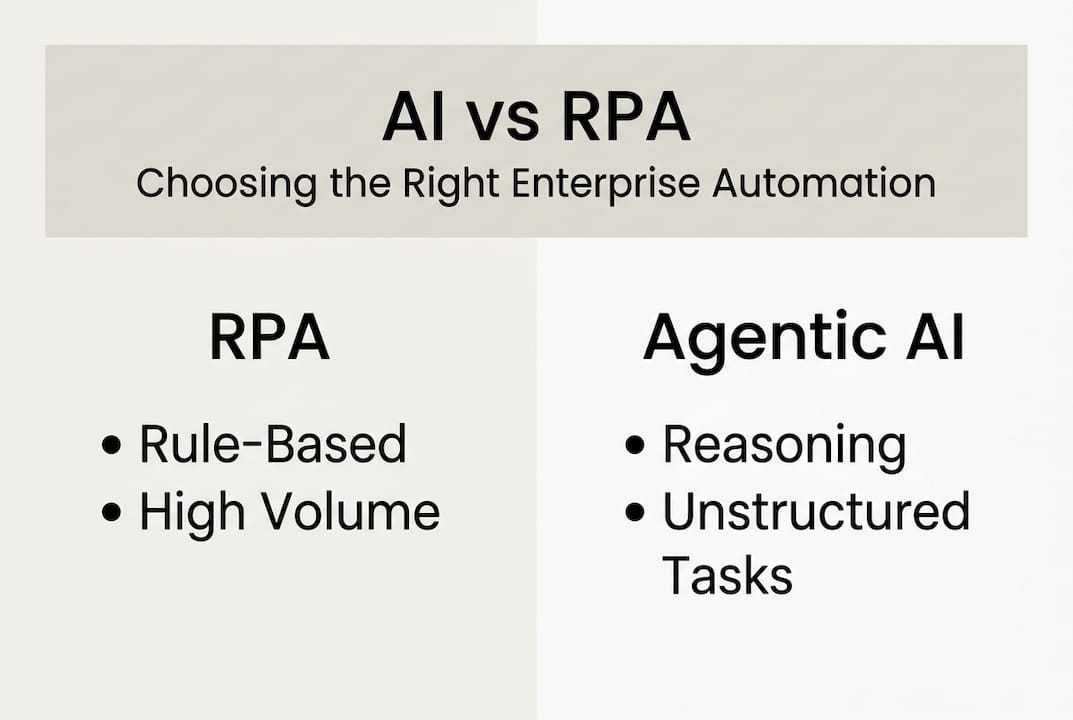
Robotic Process Automation (RPA) handles deterministic, rule-based tasks. Think invoice processing, data entry, and report generation. These are high-volume, low-variability workflows where the steps never change. RPA bots follow fixed scripts and deliver consistent output.
Agentic AI operates differently. These systems reason, plan, and make decisions across variable, unstructured processes. They can handle exceptions, interpret context, and adapt their behavior based on new information. The tradeoff is complexity and risk.
Hybrid stacks combine both. Automation and AI integration at the enterprise level almost always involves layering RPA for stable, repetitive tasks with agentic AI for processes that require judgment.
| Approach | Best for | Key risk |
|---|---|---|
| RPA | Deterministic, high-volume tasks | Brittle on process change |
| Agentic AI | Variable, unstructured workflows | Planning errors, memory drift |
| Hybrid stack | Mixed process environments | Integration complexity |
Choosing the wrong approach for your process type is one of the most common failure points. Implementation methodologies include process assessment, identifying high-ROI candidates, hybrid RPA-AI stacks, incremental migration from RPA to agentic AI, and governance frameworks with human-in-loop oversight.
The strategic benefits are real. Faster cycle times, lower error rates, reduced FTE costs, and improved compliance. But the risks are equally real. Agentic AI risks include tool misuse, cascading failures, and overgeneralization. Many projects fail not because the technology is wrong, but because 20 companies studied showed failures tied to undocumented processes, poor data quality, and weak change management.
Key strategic benefits of AI-driven automation platforms:
- Reduced manual processing time across high-volume workflows
- Improved data accuracy through structured validation layers
- Scalable throughput without proportional headcount growth
- Faster compliance reporting with built-in auditability
Step 1: Assess readiness and identify high-ROI processes
With a grasp of core concepts, the next step is evaluating your company's automation readiness. Most enterprises underestimate how much preparation this requires.
Three prerequisites must be in place before you automate anything:
- Data readiness. Your source data must be clean, structured, and accessible. Automating against inconsistent or incomplete data produces unreliable outputs at scale.
- Governance infrastructure. You need auditability, compliance controls, and defined accountability for automated decisions.
- Talent alignment. Your team needs both process knowledge and enough AI literacy to configure, monitor, and adjust automation systems.
Once prerequisites are confirmed, move to process discovery. Process mining tools analyze event logs from your existing systems to map actual process flows, not the idealized versions in your documentation. This reveals where work actually gets stuck.

Score each candidate process using these four dimensions:
| Dimension | Low score | High score |
|---|---|---|
| Volume | Fewer than 100 instances/month | Thousands of instances/month |
| Variability | Highly variable, unstructured | Consistent, rule-based |
| Risk | High compliance exposure | Low risk if error occurs |
| ROI potential | Low FTE savings | High FTE savings or cycle time gain |
Prioritizing process discovery before automation, scoring processes by variability, risk, and volume, and measuring ROI via FTE savings and cycle time are the methods enterprise leaders use to build a defensible automation roadmap.
The most common mistake at this stage is selecting processes based on executive preference rather than objective scoring. High-profile processes are not always high-ROI. Starting with undocumented processes is a fast path to failure.
Pro Tip: Before you automate any process, document it end-to-end and run it manually for two to four weeks with consistent tracking. If you cannot describe every step, every exception, and every decision point in writing, the process is not ready for automation.
Step 2: Select and configure the right automation approach
After selecting high-ROI processes, you need to match them to the right automation solutions. This is where architecture decisions become critical.
The choice between RPA, agentic AI, and hybrid stacks is not about preference. It is about process fit.
- Use RPA when the process is fully documented, rule-based, and changes infrequently. Payroll processing, compliance reporting, and data migration between systems are strong candidates.
- Use agentic AI when the process involves judgment, variable inputs, or natural language. Customer escalation routing, contract review, and dynamic pricing analysis benefit from agentic systems.
- Use hybrid stacks when a process has both stable and variable components. Most enterprise workflows fall here.
Hybrid RPA-AI stacks and incremental migration from RPA to agentic AI are the recommended approach for flexibility and future-proofing. You do not need to replace existing RPA infrastructure. You extend it.
Configuration steps for a hybrid deployment:
- Map the stable, rule-based segments of the process to RPA bots.
- Identify the variable or exception-handling segments that need AI reasoning.
- Define the handoff points between RPA and agentic components.
- Set confidence thresholds. If the AI system falls below a set confidence level, it routes to human review.
- Build logging into every layer from day one.
For enterprises already running legacy RPA, combining RPA with agentic AI means treating your existing bots as the stable foundation and layering AI decision-making on top, rather than rebuilding from scratch.
Pro Tip: Never skip the confidence threshold configuration. This single setting determines how often your system escalates to human review versus proceeding autonomously. Set it too high and you create bottlenecks. Set it too low and errors accumulate silently.
Step 3: Governance and oversight for sustainable automation
With technical tools chosen and configured, focus shifts to sustaining control and scale. Governance is not a compliance checkbox. It is the architecture layer that keeps your automation systems reliable as they grow.
Human-in-the-loop (HITL) controls are non-negotiable for enterprise AI automation. They serve three functions: catching edge cases before they cause downstream errors, maintaining accountability for automated decisions, and providing the feedback data your systems need to improve.
Core governance components:
- Audit trails. Every automated action must be logged with timestamps, inputs, outputs, and the system or agent that executed it.
- Exception routing. Define clear escalation paths for cases the system cannot resolve with sufficient confidence.
- Compliance mapping. Map each automated workflow to the regulatory requirements it touches. This is especially critical in finance, healthcare, and logistics.
- Role-based access controls. Limit who can modify automation logic, approve exceptions, or access sensitive process data.
"80% of AI failures stem from edge cases, and exceptions often represent 60% or more of actual work volume."
This is the statistic most enterprise leaders do not expect. The processes you automate will surface edge cases at a rate that surprises you. RPA systems are brittle when they encounter variability. Agentic AI systems face oversight challenges including planning errors, tool misuse, memory drift, and cascading failures.
Ongoing monitoring practices that work:
- Weekly review of exception logs to identify recurring failure patterns
- Monthly accuracy audits comparing automated outputs against manual spot checks
- Quarterly governance reviews to update compliance mappings as regulations change
- Continuous feedback loops where human reviewers tag and categorize exceptions for model retraining
Step 4: Measure, iterate, and scale AI-driven automation
Having set up governance, you are now ready to drive continuous improvement and scale outcomes. Measurement is not the end of the process. It is the engine that powers iteration.
Start with a controlled pilot. Select one process from your high-ROI list, run the automation in parallel with your existing manual process for four to six weeks, and compare outputs directly. This validates the system before you remove the manual fallback.
Key metrics to track from day one:
| Metric | What it measures | Target benchmark |
|---|---|---|
| FTE savings | Labor hours recovered per week | Positive within 90 days |
| Cycle time reduction | Time from trigger to completion | 30-60% reduction |
| Error rate | Automated errors vs. manual baseline | Equal or lower than manual |
| Throughput | Volume processed per time period | Scales with demand |
| Exception rate | Cases routed to human review | Declining trend over time |
Leaders measure ROI via FTE savings and cycle time, start small, and iterate with monitoring before scaling. This sequencing protects your investment.
Scaling follows a structured path:
- Validate the pilot against all five metrics for a minimum of six weeks.
- Document the configuration, exceptions encountered, and governance decisions made.
- Identify the next two to three processes from your prioritized list.
- Replicate the architecture with adjustments based on pilot learnings.
- Build a cross-functional adoption team that includes operations, IT, and compliance stakeholders.
Change management is where many technically successful pilots fail to scale. Automation changes roles, not just tasks. Communicate clearly what changes, what stays the same, and how team members will be supported through the transition.
Why most AI-driven automation projects fail (and how leaders can win)
We have reviewed a significant number of enterprise automation programs. The pattern is consistent. The technology rarely fails first. The organization does.
The uncomfortable truth is that process clarity and change management determine outcomes far more than tool selection. Teams spend months evaluating platforms and almost no time documenting the processes they plan to automate. Then they automate chaos and wonder why the system produces chaotic outputs.
Failures from automating undocumented processes are the leading cause of AI automation project collapse, alongside weak data governance and absent change management. These are organizational problems, not technical ones.
What successful leaders do differently is counterintuitive. They slow down at the start. They invest in process documentation, data audits, and stakeholder alignment before a single bot is configured. They treat automation as an infrastructure build, not a software purchase. And they measure relentlessly from the first pilot day, using real data to make every subsequent decision.
Leverage the right partner for your automation journey
As you prepare to act on these recommendations, choosing the right platform and partnership is critical. Building scalable AI-driven automation requires more than tools. It requires a structured architecture, verified integrations, and governance built into the foundation.
At Starks Global Group, we build and document enterprise automation platforms designed for exactly this kind of deployment. Our blueprints cover every layer, from tool selection and workflow logic to deployment and oversight models. We test and verify every recommended component before it enters our architecture documentation. If you are ready to move from planning to execution, explore our platform to access the frameworks, tool stacks, and deployment guides built for serious enterprise builders.
Frequently asked questions
How is AI-driven process automation different from traditional RPA?
AI-driven automation can handle variable, unstructured processes using reasoning and decision-making, while traditional RPA is best suited for deterministic, high-volume, rule-based tasks. Hybrid stacks combine both for most enterprise environments.
What is the biggest reason AI automation projects fail?
Most failures come from attempting to automate processes that are undocumented, variable, or poorly governed. Starting with undocumented workflows and skipping change management are the two most consistent failure patterns across enterprise programs.
What metrics should I track to measure automation success?
Track FTE savings, cycle time reductions, throughput, error rates, and exception rates. Measuring ROI via FTE savings and cycle time gives you the clearest signal of whether automation is delivering real operational value.
How can I ensure compliance and minimize risk in AI automation?
Establish governance frameworks with full audit trails, maintain human-in-the-loop controls for exception handling, and map each workflow to its regulatory requirements. Governance and auditability are foundational, not optional, for compliant enterprise automation.