

Most enterprise leaders assume automation means taking what you already do and making it faster. That assumption is expensive. Automation system design is actually the structured process of architecting scalable solutions that optimize operational workflows, often reimagining processes from the ground up rather than simply digitizing existing manual ones. For medium and large enterprises deploying AI-driven technologies, this distinction is not semantic. It is the difference between compounding efficiency gains year over year and locking in operational debt that grows harder to unwind.
Table of Contents
- What is automation system design?
- Core components and methodologies
- Comparing traditional, RPA, and agentic AI approaches
- The agentic AI paradigm: Outcome-driven system design
- Best practices and pitfalls in automation system design
- Why workflow redesign, not just automation, unlocks true value
- Implement automation system design with Starks Global Group
- Frequently asked questions
Key Takeaways
| Point | Details |
|---|---|
| Rethink, then automate | True automation system design starts by redesigning workflows for efficiency before digitizing them. |
| Agentic AI drives resilience | AI-powered agentic automation is more adaptable and robust than legacy rule-based methods. |
| Use data-driven frameworks | Follow structured methodologies: analysis, simulation, and phased rollout ensure scalable, successful deployments. |
| Avoid maintaining inefficiency | Automating existing processes without redesign preserves inefficiencies and increases long-term costs. |
| Enterprise expertise matters | Partnering with experts and leveraging robust platforms increases automation ROI and reduces risk. |
What is automation system design?
Automation system design is a holistic, intentional discipline. It is not the same as buying an RPA license or connecting a few APIs. At the enterprise level, it means architecting a system where every component, from data inputs to decision logic to output actions, is purposefully structured to scale, recover from failure, and adapt to changing business conditions.
The distinction matters because most organizations approach automation reactively. A team identifies a repetitive task, someone builds a script or workflow, and the result gets deployed without a broader architecture in mind. This works at small scale. At enterprise scale, it creates fragile, disconnected systems that require constant maintenance and resist meaningful growth.
"Automation system design is the structured process of architecting scalable automation solutions that optimize operational workflows, often reimagining processes from the ground up rather than automating existing manual ones, particularly for enterprise environments using AI-driven technologies."
What separates enterprise-grade automation system design from basic automation includes:
- Scalability planning: Designing for 10x volume from day one, not retrofitting later
- Resilience architecture: Building failure recovery, fallback logic, and alerting into the system structure
- Oversight and governance: Embedding audit trails, access controls, and compliance checkpoints at the workflow layer
- Process reimagination: Questioning whether the current process should exist at all before automating it
- Integration depth: Connecting systems through verified APIs rather than surface-level UI interactions
The largest efficiency gains in enterprise automation do not come from automating what already exists. They come from redesigning workflows before a single line of code or configuration is written. That is where automation system design earns its value.
Core components and methodologies
Structured methodology is what separates a successful enterprise automation program from a collection of disconnected tools. Core methodologies include data-driven analysis of current operations, defining measurable requirements, technology evaluation, workflow definition, simulation validation, and phased deployment roadmaps. Each stage builds on the previous one, and skipping steps is where projects fail.
Here is how a rigorous methodology unfolds in practice:
- Data-driven operational analysis: Map current workflows using process mining or structured observation. Identify bottlenecks, error rates, cycle times, and exception handling volumes. This data drives every decision that follows.
- Define measurable requirements: Translate business goals into specific, testable system requirements. "Reduce invoice processing time" becomes "process 95% of invoices within 4 hours with less than 0.5% error rate."
- Technology assessment: Evaluate tools against your defined requirements. Use your tools and systems marketplace to compare verified options rather than relying on vendor claims alone.
- Workflow definition: Design the target-state workflow, not the current-state workflow. This is where process reimagination happens. Remove redundant steps, consolidate handoffs, and define clear exception paths.
- Financial modeling: Build a realistic cost model that includes implementation, integration, licensing, and ongoing maintenance. Many projects underestimate maintenance by a factor of three.
- Simulation and pilot testing: Run the designed workflow in a controlled environment before full deployment. Use your research and testing lab to validate assumptions against real data patterns.
- Phased deployment roadmap: Roll out in stages with defined success criteria for each phase. This limits risk and creates natural checkpoints for course correction.
| Methodology stage | Primary output | Common failure point |
|---|---|---|
| Operational analysis | Process map with metrics | Incomplete data collection |
| Requirements definition | Measurable acceptance criteria | Vague or unmeasurable goals |
| Technology assessment | Shortlist of validated tools | Vendor bias, skipping pilots |
| Workflow definition | Target-state process design | Replicating current inefficiencies |
| Financial modeling | Total cost of ownership model | Underestimating maintenance costs |
| Simulation and pilot | Validated workflow prototype | Skipping this stage entirely |
| Phased deployment | Staged rollout with milestones | Big-bang deployment without checkpoints |
Pro Tip: Before selecting any automation technology, run a structured QA automation strategy review on your target workflows. Teams that validate automation logic before deployment catch 60 to 80 percent of integration failures before they reach production.
The methodology is not linear in practice. Findings from simulation often send teams back to workflow definition. That iteration is healthy. It is far cheaper to redesign a workflow on paper than to rearchitect a deployed system.
Comparing traditional, RPA, and agentic AI approaches
Understanding the differences between automation approaches is essential for making sound architecture decisions. Not all automation is equal, and the wrong approach for your context creates technical debt that compounds over time.
Traditional automation refers to scripted, rule-based systems. These work well for highly stable, structured processes where inputs and outputs are predictable. They break when the environment changes.
Robotic Process Automation (RPA) operates by mimicking human UI interactions. It reads screens, clicks buttons, and enters data. RPA can be deployed quickly without API access, which made it popular. However, RPA maintenance costs run approximately $0.40 per year for every $1.00 invested, because any UI change in a source system breaks the bot. At enterprise scale, this creates a maintenance burden that consumes most of the efficiency gains.
Agentic AI systems represent a fundamentally different architecture. Agentic designs feature iterative loops of observation, reasoning, action, and memory management, contrasting with traditional linear pipelines. They are API-native, goal-driven, and capable of handling exceptions through reasoning rather than hard-coded rules.
| Dimension | Traditional automation | RPA | Agentic AI |
|---|---|---|---|
| Integration method | Direct code/API | UI scraping | API-native |
| Adaptability | Low | Very low | High |
| Maintenance cost | Moderate | High (~$0.40/$1) | Lower long-term |
| Exception handling | Rule-based | Rule-based | Reasoning-based |
| Scalability | Limited | Fragile at scale | Designed for scale |
| Setup complexity | Low to moderate | Low | Higher upfront |
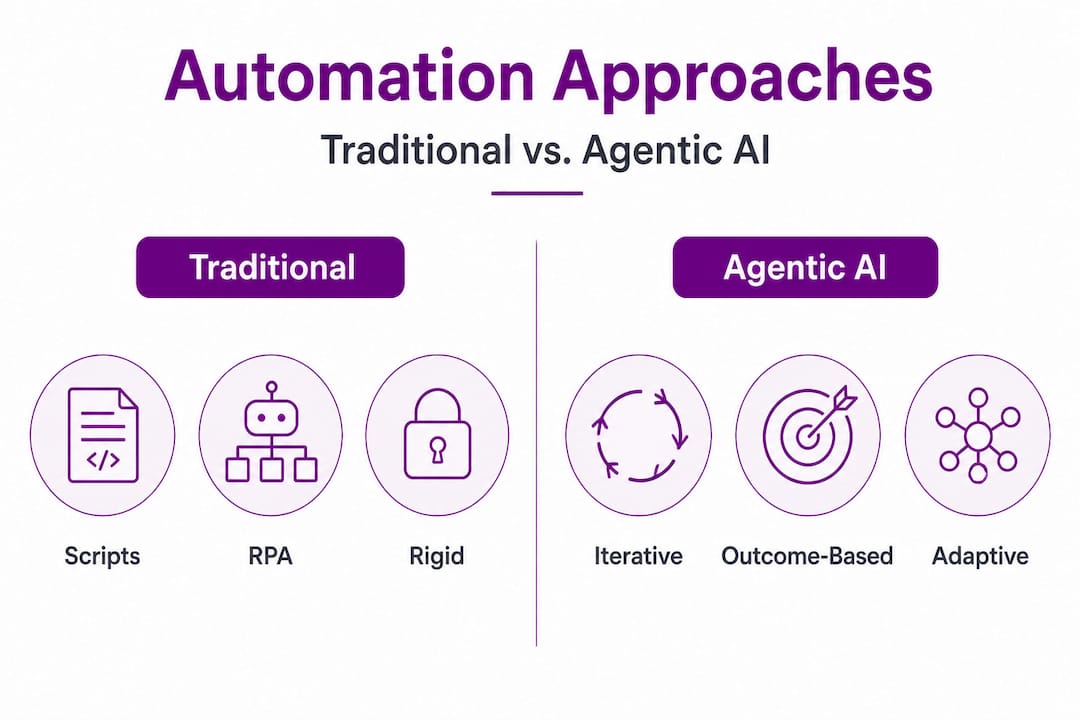
The critical insight here is that RPA and traditional automation do not eliminate inefficiency. They preserve it in digital form. When you automate a broken process, you get a faster broken process. This is what practitioners call "paving cowpaths," and it is one of the most common and costly mistakes in enterprise automation programs.
Agentic AI, deployed through a structured automation infrastructure platform, forces a different conversation. Because agentic systems require you to define goals and outcomes rather than steps, they naturally surface the question: is this process worth automating as-is, or should it be redesigned first? That question, asked consistently, is where competitive advantage is built.
Explore pre-validated system blueprints to see how layered agentic architectures are structured in practice, including how tool, system, workflow, and deployment layers connect into a coherent whole. Understanding how AI drives business growth at the architectural level also helps leaders frame the investment case internally.
The agentic AI paradigm: Outcome-driven system design
The shift from task-based to outcome-based automation is not just a technical change. It is a management change. In traditional automation, you specify every step. In agentic AI design, you specify the goal and provide the agent with the tools, memory, and context it needs to achieve that goal autonomously.

Agentic AI shifts from task execution to outcome management, requiring explicit goals, tools, memory, and trust-building user interfaces for business leaders to delegate effectively. This has direct implications for how you design and govern these systems.
Key requirements for effective agentic system design include:
- Explicit goal definition: The agent must know what success looks like. Vague goals produce unpredictable behavior. Define outcomes in measurable terms.
- Tool provisioning: Agents need access to verified, reliable tools. Every tool in the stack should be tested and documented. Unverified tools introduce failure points that are hard to diagnose.
- Memory architecture: Short-term context, long-term knowledge, and episodic memory serve different functions. Design each layer intentionally based on the agent's operational requirements.
- Oversight interfaces: Leaders need dashboards and audit logs that show what the agent did, why it made each decision, and where it encountered uncertainty. Transparency is not optional at enterprise scale.
- Escalation logic: Define clearly when the agent should escalate to a human. Agents that never escalate create invisible failure modes. Agents that escalate too often negate the efficiency gain.
The management implication is significant. Business leaders must shift from micromanaging steps to designing systems with clear boundaries, measurable outcomes, and structured oversight. This is a different skill set, and organizations that develop it early will move faster than those that do not.
Pro Tip: When designing agentic systems, write your goal statements in the same format you would use to brief a senior analyst: context, objective, constraints, and success criteria. Agents that receive this level of clarity perform measurably better than those given open-ended instructions.
Best practices and pitfalls in automation system design
The gap between automation projects that deliver and those that disappoint is almost always methodological, not technological. The tools available today are capable. The failure points are in how organizations plan, validate, and govern their automation programs.
Here are the practices that consistently separate successful enterprise automation programs from costly failures:
- Start with workflow analysis, not tool selection. Selecting a platform before understanding your workflows is one of the most common and expensive mistakes. Data-driven analysis of current operations must precede any technology decision.
- Redesign before you automate. Every workflow you plan to automate should be challenged. Ask whether the process is necessary, whether steps can be eliminated, and whether the sequence is optimal. Automating an inefficient process locks in that inefficiency.
- Simulate before you deploy. Pilot testing in a controlled environment is not optional for enterprise deployments. It is the only reliable way to surface integration failures, edge cases, and performance issues before they affect production operations.
- Build cross-functional teams. Automation system design requires operations expertise, technical architecture knowledge, and business leadership input. Teams that lack any of these perspectives make predictable mistakes.
- Model the full cost of ownership. Include implementation, integration, licensing, training, and ongoing maintenance in your financial model. The maintenance cost reality of fragile automation architectures is consistently underestimated.
- Define metrics before deployment. Establish your success criteria before the system goes live. Post-hoc metric selection leads to confirmation bias and prevents honest evaluation.
"The organizations that capture the most value from automation are those that treat it as a design discipline, not a deployment task. The architecture decisions made before a single workflow runs determine most of the long-term outcome."
Always validate automation tools against your specific operational requirements before committing to a stack. Vendor demonstrations are optimized for ideal conditions. Your production environment is not ideal.
The hidden cost that most enterprises miss is change management. Automation changes how people work. Without structured change management, adoption fails even when the technology succeeds. Budget for it explicitly.
Why workflow redesign, not just automation, unlocks true value
We have reviewed hundreds of enterprise automation programs. The pattern in failed projects is remarkably consistent. Organizations selected tools first, mapped their current processes, and automated them faithfully. The result was a digital replica of an inefficient process, delivered faster, at higher cost, with more complexity to maintain.
The uncomfortable truth is that most processes in large organizations were never designed. They evolved. They accumulated steps, approvals, and handoffs over years of organizational change. Automating them without redesign is not transformation. It is preservation.
What we have seen work is the opposite approach. Start by questioning whether the process should exist in its current form at all. Use data to identify where value is actually created versus where effort is consumed without output. Then design the target-state workflow before selecting a single tool.
Agentic AI makes this discipline more important, not less. Because agentic systems require you to define goals rather than steps, they force the redesign conversation. Leaders who engage with that conversation seriously, who are willing to challenge assumptions about how work should flow, consistently achieve better outcomes than those who treat automation as a technical project.
The competitive advantage is not in the technology. It is in the organizational willingness to redesign. Technology is accessible to everyone. The discipline to rethink workflows before automating them is rare. Explore system blueprint strategies to see how structured redesign is embedded into layered automation architectures from the foundation up.
Implement automation system design with Starks Global Group
If this article has clarified what structured automation system design requires, the next step is applying it within your own organization.

Starks Global Group's automation infrastructure platform is built specifically for enterprises that need more than a collection of tools. We provide structured blueprints, verified technology stacks, and layered architectures that connect tool, system, workflow, and deployment layers into scalable, production-ready systems. Browse our tools and systems marketplace to find pre-tested solutions evaluated against real operational requirements, not vendor claims. Access our system blueprints to see how enterprise-grade automation architectures are structured, documented, and deployed at scale. Start building with a foundation that is designed to grow with your operations.
Frequently asked questions
How does automation system design differ from traditional process automation?
Automation system design emphasizes rethinking workflows and optimizing them from the ground up, while traditional process automation typically digitizes existing manual tasks without questioning whether those tasks are structured efficiently.
What are the biggest mistakes enterprises make in automation system design?
The most costly mistake is automating broken processes without redesign, which preserves inefficiencies in digital form. Underestimating maintenance costs and skipping pilot testing are the next most common failure points.
What makes agentic AI systems more resilient than traditional RPA?
Agentic AI systems use iterative reasoning loops and are API-native, which means they adapt to system changes without breaking, unlike RPA bots that depend on fragile UI interactions.
How do leaders define success metrics for automation system design?
Success metrics should be defined before deployment and tied to measurable business outcomes such as cycle time reduction, error rate improvement, throughput increase, and total cost of ownership reduction relative to baseline.
How can enterprises select the right technologies for automation system design?
Assess operational requirements first, then evaluate technologies against those specific requirements. Data-driven validation through pilot testing before full rollout is the most reliable method for confirming solution fit in your actual environment.
Recommended
- Marketplace - Tools & Systems | Starks Global Group
- Starks Global Group - Automation Infrastructure Platform
- System Blueprints | Starks Global Group
- Affiliate Disclosure | Starks Global Group
- AI networking best practices for secure, scalable systems
- Step-by-step AI onboarding guide for smooth adoption