

Most commercial buildings waste between 10% and 30% of their energy budget on systems that run without any real coordination. Building automation systems change that equation by connecting HVAC, lighting, security, and energy management into a single, controllable architecture. For business decision-makers and technology managers, the value is not just in energy savings. It is in labor reduction, compliance readiness, and the ability to make data-driven decisions about how your facility actually operates. This article gives you the structured implementation path you need, without the generalities.
Table of Contents
- Key takeaways
- What building automation systems actually require before you start
- Selecting and installing a BAS step by step
- Common challenges during BAS implementation and operation
- Measuring and verifying BAS performance after implementation
- My perspective on futureproofing your BAS investment
- How Starksglobalgroup supports your automation infrastructure
- FAQ
Key takeaways
| Point | Details |
|---|---|
| Plan before you procure | Assess infrastructure readiness and define operational goals before selecting any BAS platform. |
| Integration depth drives savings | Connecting HVAC, lighting, and energy systems together yields far greater returns than siloed automation. |
| AI elevates beyond rule-based control | AI-driven optimization adds 20–30% more savings on top of traditional BAS performance. |
| Underutilization is the real risk | Most BAS failures stem from poor adoption, not technology defects. Staff training is non-negotiable. |
| Measure continuously, not once | Post-implementation dashboards and fault detection tools are what turn a good install into a high-performing system. |
What building automation systems actually require before you start
Skipping the pre-implementation phase is the single most costly mistake technology managers make. A BAS is not a plug-and-play product. It is a layered architecture that must fit your building's physical systems, your team's operational capacity, and your organization's strategic goals.
Start with a structured audit of your existing infrastructure. Ask three questions: What systems are already networked? What communication protocols do your HVAC, lighting, and access control systems use? And where do your current energy losses actually occur? Without honest answers here, even a well-spec'd BAS will underperform.
Stakeholder alignment matters just as much as technical readiness. Smart building success requires a guiding vision developed collaboratively before any technology is procured. This means facilities managers, IT leadership, finance, and operations need to agree on what "improved performance" looks like in measurable terms before you issue a single RFP.
Here is a pre-implementation checklist that covers the four critical readiness areas:
- Infrastructure audit: Document all existing building systems, their age, communication protocols (BACnet, Modbus, LonWorks), and network connectivity.
- Operational goals: Define specific KPIs, such as a 20% reduction in HVAC runtime during off-peak hours or sub-15-minute fault response time.
- Budget and ROI modeling: Factor in hardware, installation labor, software licensing, and training costs against projected energy savings and maintenance reductions.
- Compliance requirements: Review local energy codes, data privacy regulations, and cybersecurity standards relevant to your building class.
| Readiness Area | Key Question | Common Gap |
|---|---|---|
| Physical infrastructure | Are systems networkable? | Legacy equipment with no IP connectivity |
| Data architecture | Do systems share a common protocol? | Proprietary silos with no interoperability |
| Workforce capacity | Who will operate the system daily? | No dedicated BAS operator on staff |
| Budget alignment | Is ROI modeled over 3 to 5 years? | Short-term budget view ignoring lifecycle savings |
Pro Tip: Map your building's energy consumption by zone and system type before engaging any vendor. This data gives you negotiating leverage and ensures the vendor's proposed architecture targets your actual inefficiencies, not a generic solution.
Selecting and installing a BAS step by step
Once your pre-implementation groundwork is complete, the selection and installation phase follows a clear sequence. Deviating from this order is where most projects lose time and budget.
-
Select your BAS platform based on building scale and type. A 50,000 square foot office building has different requirements than a 500,000 square foot mixed-use campus. Evaluate platforms on protocol support, scalability, vendor ecosystem, and cloud connectivity. Open-protocol platforms (BACnet/IP is the current standard) give you the most flexibility for future integrations.
-
Map your core system integrations. Your BAS should connect at minimum to HVAC automation solutions, intelligent lighting systems, access control, and your energy management system. Each integration point requires a defined data handshake, whether through native APIs, middleware, or protocol gateways.
-
Follow structured wiring and communication installation practices. Commission each subsystem independently before integrating. Label every physical connection. Document the network topology. These steps seem obvious and are routinely skipped under schedule pressure, which creates months of troubleshooting downstream.
-
Configure automation rules, schedules, and AI-driven optimization. Start with simple time-based scheduling for HVAC and lighting before adding occupancy-responsive or AI-predictive controls. AI-driven orchestration delivers 20% to 30% additional savings beyond what traditional rule-based controls achieve, but those rules need to be stable first.
-
Calibrate and test every sensor and actuator. Sensor drift is one of the most common and most ignored sources of BAS underperformance. Calibrate temperature, CO2, occupancy, and flow sensors at commissioning and schedule recalibration annually.
| BAS Component | Integration Method | Performance Metric |
|---|---|---|
| HVAC controls | BACnet/IP native or gateway | Zone temperature variance within ±1°F |
| Lighting | DALI or 0-10V with occupancy sensors | Lighting energy per occupied hour |
| Energy metering | Modbus TCP to energy management system | Real-time kWh per zone |
| Access control | API or OPC-UA bridge | Occupancy data latency under 5 seconds |
Pro Tip: Do not wait until full installation is complete to test. Run a phased commissioning approach, testing each subsystem in isolation, then in integration. This catches protocol conflicts and configuration errors before they compound.
Understanding the key components of automation systems gives you a clearer picture of where each layer fits and which dependencies to sequence first.
Common challenges during BAS implementation and operation
No BAS implementation goes perfectly. Knowing where the breakdowns typically occur lets you address them before they become costly delays.
The workforce adoption problem is larger than most technology managers expect. The largest implementation barrier is not the technology itself. It is the absence of integrated design, training, and ongoing operational coordination. A BAS that no one knows how to operate defaults to manual overrides and scheduled restarts, which erases most of the efficiency gains.
Legacy system integration is the other major friction point. Older HVAC and lighting equipment often runs on proprietary protocols with no open API. In these cases, protocol gateways or direct sensor retrofits are your options. For HVAC specifically, low Delta T syndrome (where supply and return temperatures are too close together, indicating poor distribution efficiency) is a documented and costly problem. Balanced Cooling retrofits reduce pumping energy by up to 40% and are designed for integration into existing building management infrastructure without full system replacement.
Additional challenges to plan for:
- Cybersecurity exposure: BAS platforms connected to IP networks are attack surfaces. Segment your BAS network from corporate IT, enforce role-based access controls, and apply firmware updates on a defined schedule.
- Sensor drift and calibration gaps: Uncalibrated sensors generate bad data, which drives bad automation decisions. Build sensor recalibration into your annual maintenance contract.
- Underutilization of installed capability: Many smart-ready systems operate as if they are not smart at all because operators never configure advanced features. Schedule a quarterly automation audit to identify unused rules and dormant optimization features.
"Technology-ready does not mean operationally ready. The gap between installation and full utilization is where most BAS ROI disappears. Close that gap with structured training and defined operational ownership from day one."
Measuring and verifying BAS performance after implementation
Getting the system running is the starting point, not the finish line. Post-implementation measurement is where you confirm that your investment is delivering and where you identify the next layer of optimization.
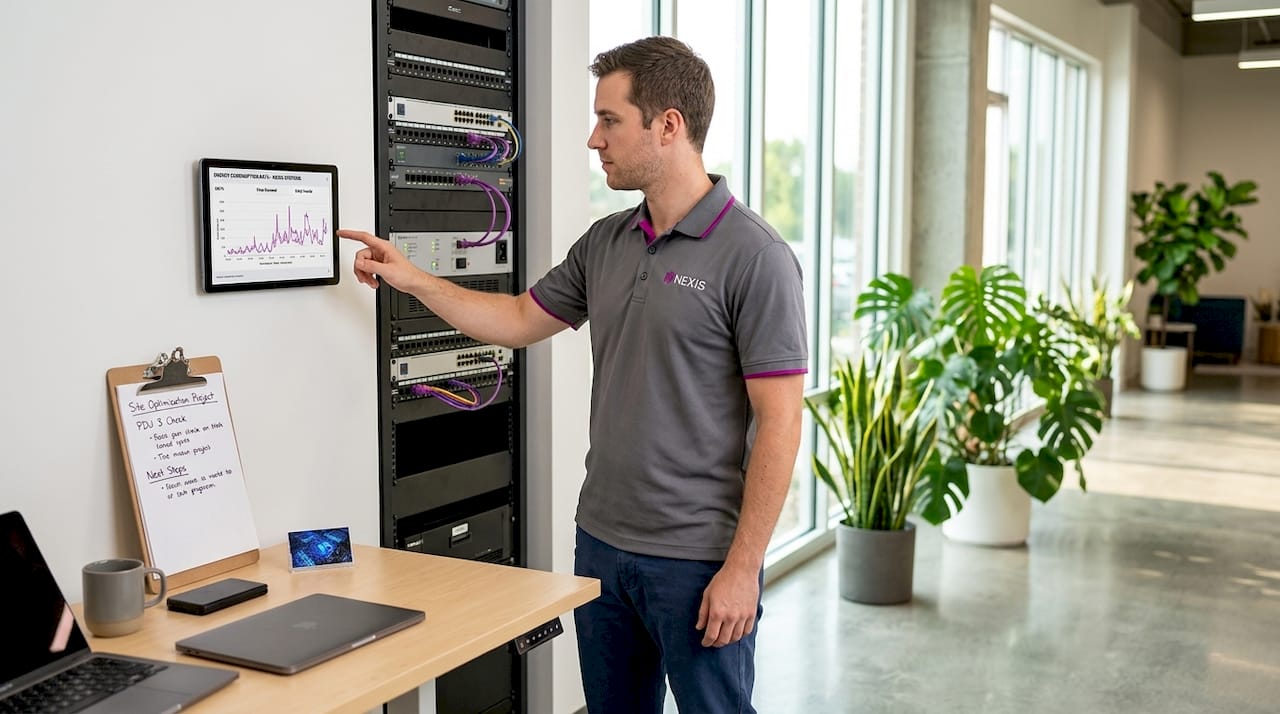
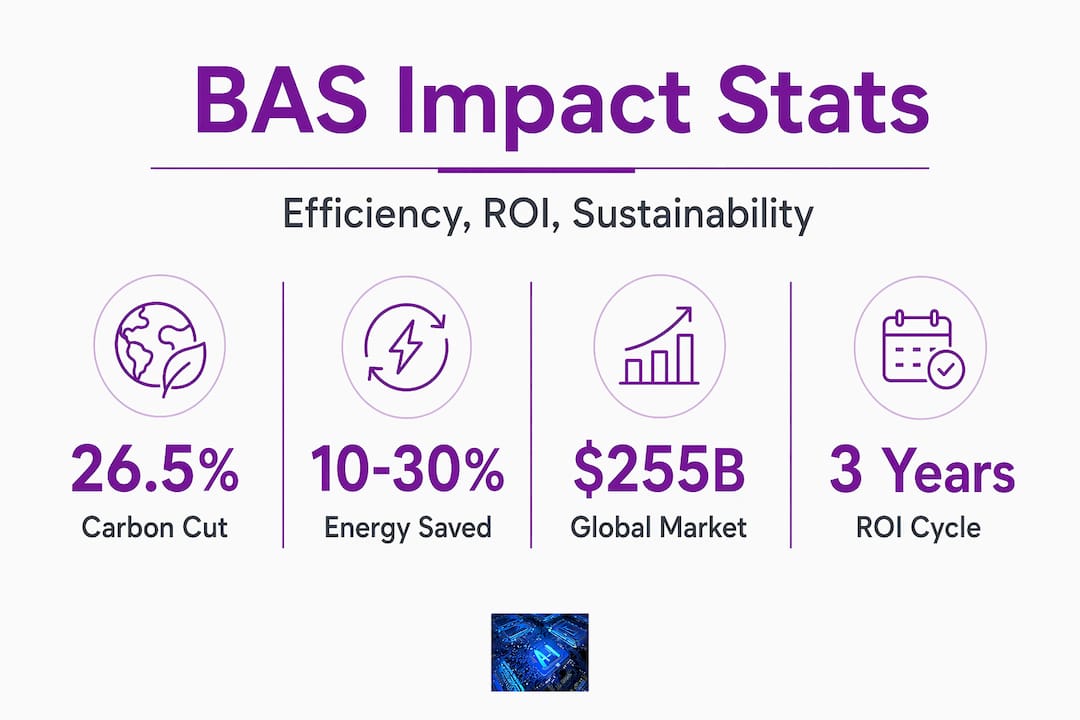
Properly configured BAS reduces commercial building energy usage by 10% to 30%, but those numbers only materialize with active monitoring. Set up a real-time dashboard that tracks energy consumption by zone and by system type. Most modern BAS platforms include built-in analytics. If yours does not, a dedicated energy management system layer can aggregate and visualize the data.
AI-powered fault detection and diagnostics add a significant capability layer here. Digital twins simulate and predict building conditions, flag sensor deviations automatically, and generate maintenance work orders without manual inspection. This moves your team from reactive maintenance to predictive operations. The time and cost savings compound quickly in facilities with complex HVAC or large equipment inventories.
| Performance Metric | Measurement Method | Target Benchmark |
|---|---|---|
| Energy savings | Monthly utility comparison vs. baseline | 10–30% reduction |
| HVAC runtime efficiency | BAS runtime logs vs. occupancy schedule | Less than 5% unoccupied runtime |
| Fault response time | Work order timestamps from fault detection | Under 4 hours for critical faults |
| Occupant comfort score | Quarterly survey tied to zone temperature logs | Above 85% satisfaction rating |
An integrated BIM-IoT-AI framework deployed in a large office environment achieved a 26.5% reduction in carbon emissions with a 1.7-year payback period and a 42% internal rate of return. That is not a theoretical projection. It is a verified outcome from a system built on the same measurement and verification discipline outlined here.
For technology managers tracking ROI, use a 3-year rolling calculation that accounts for energy savings, reduced maintenance labor, avoided equipment failures, and any sustainability credits or compliance cost reductions your BAS generates.
My perspective on futureproofing your BAS investment
I have worked through enough automation implementations to say this with confidence: the organizations that extract the most value from building automation systems are not the ones with the most expensive platforms. They are the ones that treat the BAS as a living operational system rather than a capital project with a completion date.
The global building automation market is projected to reach $255.5 billion by 2033, driven largely by AI-powered infrastructure. That growth signal tells you where the technology is heading. But I have seen too many organizations chase the AI headline without getting the fundamentals right first. You cannot layer autonomous optimization on top of poorly calibrated sensors and untrained staff. The architecture has to be solid before the intelligence layer adds value.
What I keep coming back to is the workforce dimension. Future-ready platforms are designed with intuitive interfaces that reduce learning curves and automate routine tasks to offset workforce shortages. That is the right direction. But the interface is not a substitute for operational ownership. Someone on your team needs to be accountable for BAS performance as a defined part of their role.
My honest advice: build for scalable AI from the start. Choose open-protocol platforms, prioritize integration depth over feature count, and invest in training at the same budget level you invest in hardware. The buildings that will lead on efficiency and sustainability in the next decade are being configured correctly right now.
— Tyler
How Starksglobalgroup supports your automation infrastructure
If you are building or optimizing an automation architecture, the structured frameworks at Starksglobalgroup are worth your time. We design layered automation systems using verified AI tools, and our approach maps directly to the kind of coordinated, scalable infrastructure that makes building automation actually work at an operational level.

Our AI Automation Agency System blueprint gives you a documented architecture for deploying AI-driven workflows across complex environments, including the integration logic and deployment sequencing that most implementation guides skip. For technology managers who want a tested framework rather than a starting-from-scratch build, the Starksglobalgroup platform provides the blueprints, tool recommendations, and validation standards to get your automation infrastructure performing at scale.
FAQ
What do building automation systems actually control?
Building automation systems integrate and control HVAC, lighting, access control, energy metering, and sometimes fire and security systems through a centralized software platform. The level of control ranges from basic scheduling to AI-driven predictive optimization depending on the configuration.
How much energy can a BAS realistically save?
A properly configured BAS reduces commercial building energy usage by 10% to 30%, with AI-enhanced systems delivering an additional 20% to 30% on top of that baseline through real-time predictive adjustments.
What is the biggest reason BAS implementations fail?
The most common failure mode is underutilization. Systems are installed but never fully configured, and operators default to manual overrides. Structured training and defined operational ownership from day one are what prevent this outcome.
How long does BAS implementation typically take?
Implementation timelines vary by building size and system complexity, but a mid-sized commercial facility should budget three to six months for full commissioning, including subsystem testing, integration, and staff training.
What communication protocol should a BAS use?
BACnet/IP is the current industry standard for open-protocol building automation and gives you the most flexibility for integrating third-party systems and future upgrades. Avoid proprietary-only platforms unless there is a specific performance justification.