

Selecting the wrong automation strategy doesn't just slow operations—it relocates the problem. Enterprise leaders face a compounding challenge: AI-driven automation tools are maturing fast, vendor promises are loud, and the cost of a misaligned deployment can ripple across entire business units. Most organizations discover too late that automating a single task without redesigning the surrounding process simply shifts the bottleneck downstream. This article gives you a structured framework for evaluating, comparing, and selecting scalable automation strategies—built on criteria that reflect real operational outcomes, not just feature checklists.
Table of Contents
- How to evaluate enterprise automation strategies
- Top scalable automation strategies for enterprises
- Comparing automation strategies: Major approaches side by side
- Choosing the right strategy for your enterprise
- A new imperative: Rethinking automation impact
- Next steps: Build your scalable automation platform
- Frequently asked questions
Key Takeaways
| Point | Details |
|---|---|
| End-to-end evaluation | Effective automation strategies require measuring business outcomes across the entire process, not just individual tasks. |
| Address shifted bottlenecks | AI-driven automation can move, not eliminate, process issues—making ongoing refinement essential. |
| Blend strategies wisely | Combining process automation tools with process-aware monitoring delivers sustainable, scalable gains. |
| Prioritize organizational fit | The best strategy fits your unique processes and integrates with people, not just technology. |
How to evaluate enterprise automation strategies
Building a robust evaluation framework is the first line of defense against costly automation missteps. Most leaders jump to tool selection before they've defined what success actually looks like at the process level. That sequencing error is expensive.
A solid evaluation framework starts with four core criteria:
- Scalability: Can the solution handle growing transaction volumes, new process variants, and additional business units without architectural rework?
- Process integration: Does the tool connect cleanly with existing systems, or does it create isolated automation islands that require manual handoffs?
- Measurable KPIs: Are you tracking end-to-end cycle time, throughput, and quality—not just task completion rates?
- Organizational readiness: Does your team have the change management capacity and technical skills to sustain the deployment?
The distinction between task-level and process-level evaluation is critical. Process-aware evaluation uses methodologies like process mining and object-centric analytics to map how work actually flows across systems and teams. This approach surfaces hidden dependencies that single-task automation will never reveal. As arXiv research confirms, bottlenecks can be moved rather than eliminated by automation, which demands robust evaluation methodologies before any deployment begins.
End-to-end impact measurement is non-negotiable. A claims processing team that automates document intake may see local throughput double—while the underwriting queue behind it collapses under the increased load. That's a real scenario, not a hypothetical. Measuring only the automated step masks the system-wide failure.
When evaluating automation infrastructure platforms, prioritize those that offer built-in monitoring dashboards, process-level analytics, and structured change management support. These capabilities determine whether you can detect and correct bottleneck shifts before they become operational crises.
Pro Tip: Before issuing an RFP or starting a pilot, document your current process flows using a process mining tool. You'll identify the real constraints—and avoid automating around them instead of through them.
Top scalable automation strategies for enterprises
With evaluation criteria established, the next step is understanding which automation approaches are actually built to scale. Each class of strategy has a distinct profile of strengths, limitations, and typical failure modes.
Robotic Process Automation (RPA) with AI/ML layers remains the most widely deployed approach. Traditional RPA handles structured, rule-based tasks with high reliability. Adding AI and machine learning layers extends that capability to semi-structured data, exception handling, and pattern recognition. The strength is rapid deployment on existing systems. The typical bottleneck: RPA bots are brittle when process logic changes, and AI process automation can improve capacity while also requiring continuous refinement to avoid generating new downstream constraints.
Workflow orchestration platforms coordinate multi-step processes across systems, teams, and tools. They provide visibility into handoffs and dependencies that point solutions miss entirely. Strength: end-to-end process control. Bottleneck: orchestration logic can become complex and hard to maintain without dedicated process architects.
AI-driven decision support embeds machine learning models into approval workflows, risk scoring, and resource allocation. Strength: reduces human decision latency on high-volume, repeatable decisions. Bottleneck: model drift and explainability requirements create ongoing governance overhead.
Intelligent document processing (IDP) uses natural language processing and computer vision to extract, classify, and route information from unstructured documents. Strength: eliminates manual data entry at scale. Bottleneck: accuracy thresholds for exception handling must be carefully calibrated or downstream errors multiply.
"Measuring automation success at the task level without examining process-wide throughput is like measuring a relay race by the speed of one runner. The team's finish time is what matters."
Here's a quick pros and cons summary:
- RPA + AI/ML: Fast deployment, brittle to change, strong for structured tasks
- Workflow orchestration: High visibility, complex to maintain, best for multi-system processes
- AI decision support: Reduces latency, requires governance, ideal for high-volume approvals
- IDP: Eliminates manual entry, needs calibration, strong for document-heavy industries
You can also explore real-world automation case studies to see how these strategies perform across industries before committing to a direction.
Pro Tip: Blending IDP with workflow orchestration often delivers the highest ROI in document-intensive industries like insurance, finance, and healthcare—because it addresses both data capture and process routing in a single architecture.
Comparing automation strategies: Major approaches side by side
Now that we know the core strategies, let's see how they perform side by side using criteria that matter to enterprise decision-makers.
| Strategy | Scalability | Integration complexity | Typical bottleneck | Monitoring capability |
|---|---|---|---|---|
| RPA + AI/ML | Medium | Low to medium | Brittle logic at scale | Moderate |
| Workflow orchestration | High | High | Maintenance complexity | Strong |
| AI decision support | High | Medium | Model governance | Moderate to strong |
| Intelligent document processing | High | Medium | Exception calibration | Moderate |
The table reveals a consistent pattern: strategies with the highest scalability also carry the highest integration or governance complexity. There's no free lunch in enterprise automation architecture.
A key finding from empirical research: end-to-end throughput can only be accurately assessed using process-oriented metrics, not by measuring the automation of individual steps in isolation. This is where most enterprise deployments fail their own ROI projections.

Consider the insurance claims example. Large language model (LLM) automation applied to claims intake dramatically increased processing speed at the front end. But it shifted the volume burden to human adjusters downstream who lacked the capacity to absorb it. The local metric looked excellent. The business outcome was worse than the baseline.
How each strategy matches enterprise maturity:
- Early-stage automation maturity: Start with RPA plus AI on well-defined, high-volume tasks. Limit scope and measure rigorously.
- Intermediate maturity: Layer in workflow orchestration to connect existing automations and gain process visibility.
- Advanced maturity: Deploy AI decision support and IDP as part of a unified architecture, managed through a centralized automation platforms comparison framework.
The maturity-matching principle prevents overreach. Deploying orchestration-heavy architectures in organizations without process governance infrastructure is a reliable path to failed implementations.
Choosing the right strategy for your enterprise
Comparison data is only useful if it translates into a decision. Here's a practical, step-by-step process for moving from insight to action.
- Assess process maturity. Map your current workflows using process mining. Identify where manual handoffs, rework loops, and wait times concentrate. These are your highest-impact automation targets.
- Prioritize by impact and feasibility. Score candidate processes on two axes: business value of improvement and technical feasibility of automation. Start where both scores are high.
- Select the strategy class. Match the process profile to the right automation approach using the comparison table above. Don't default to RPA just because it's familiar.
- Design the pilot. Scope a pilot that covers the full process segment, not just the automated step. Define your KPIs before you start: cycle time, throughput, error rate, and downstream queue depth.
- Measure end-to-end, not locally. As confirmed by arXiv case analysis, choosing based on end-to-end process improvement rather than local gains produces the highest ROI.
- Iterate with governance. Build a review cadence into the deployment plan. Automation systems drift. Processes change. Governance keeps the system aligned with business reality.
Change management is not optional. Cross-team collaboration between process owners, IT architects, and operations leaders determines whether automation sustains or stalls. The technical layer is rarely the failure point. Culture and ownership are.
Pro Tip: Involve process owners in the pilot design phase, not just the rollout. Their operational knowledge will surface constraints that no process map captures.
The most common mistake we see is naive local optimization: automating a single step because it's technically straightforward, without analyzing what happens to the work before and after it. That approach consistently underdelivers.
A new imperative: Rethinking automation impact
Here's what most automation frameworks won't tell you directly: the industry still rewards the wrong metrics. Vendor case studies celebrate task accuracy. Analyst reports highlight deployment speed. But the organizations that generate real, sustained returns from automation are measuring something different entirely.
They're measuring business outcomes. Not bot performance.
Conventional wisdom overrates local task wins because they're easy to measure and easy to sell. Downstream bottlenecks are harder to attribute and slower to surface. Most organizations invest heavily in what we'd call "island automation"—isolated deployments that optimize one step while leaving the surrounding process unchanged. The result is a patchwork of efficient tasks inside an inefficient system.
True automation success requires treating every deployment as part of a connected architecture. As operational research confirms, leaders must shift focus from isolated task accuracy to systemic process improvement. That shift is harder than it sounds because it requires process redesign, not just tool deployment.
We believe most vendors and frameworks still promote local maximums because that's what's measurable in a sales cycle. Your job as a technology leader is to hold the system-level standard. Explore process-wide automation insights to see what that standard looks like in practice.
Next steps: Build your scalable automation platform
If you're ready to move beyond isolated automation and build a structured, scalable architecture, we're here to support that process. At Starks Global Group, we've built a platform designed specifically for enterprise teams that need more than tool recommendations—they need verified, integrated systems that perform at scale.
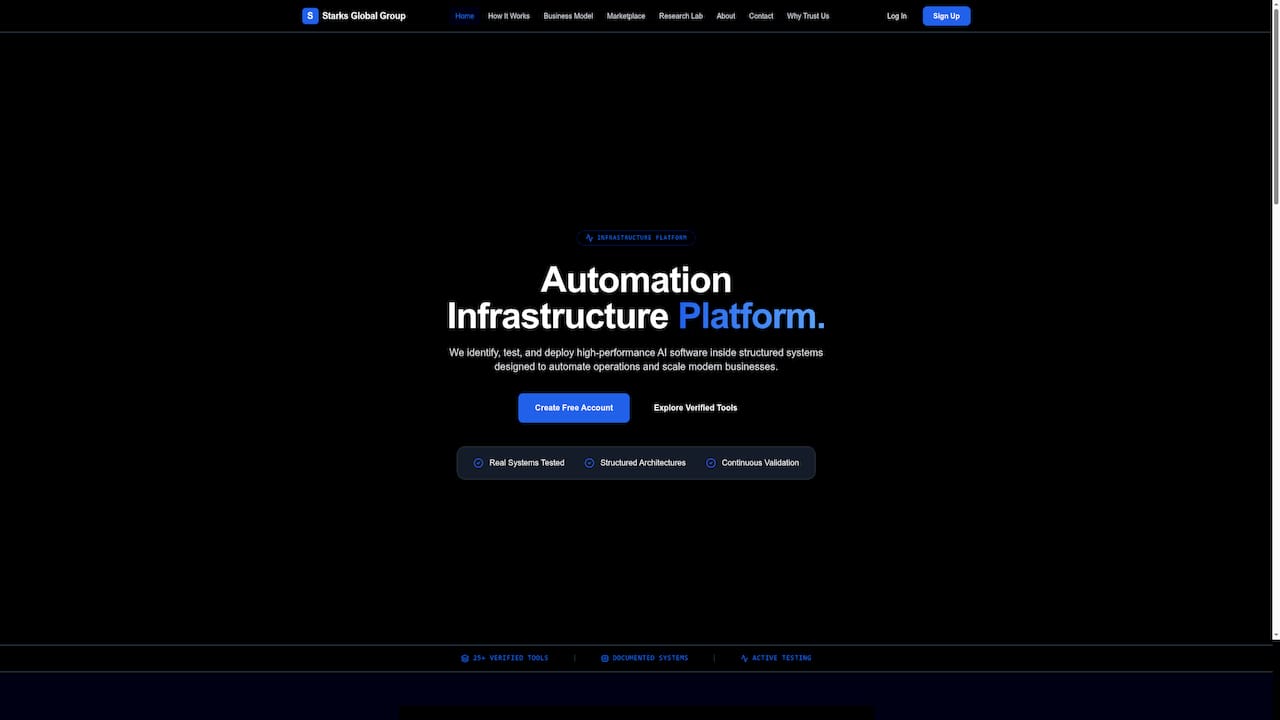
Our Starks Global Group platform provides layered automation blueprints, tested tool integrations, and deployment frameworks built on engineering principles. Whether you're piloting your first AI-driven workflow or scaling an existing architecture, we can help you design for end-to-end outcomes. Explore the platform to see how structured automation infrastructure translates strategy into measurable results.
Frequently asked questions
What is process-aware evaluation in enterprise automation?
Process-aware evaluation measures automation impact across the full workflow rather than individual tasks, ensuring genuine throughput gains. Object-centric process mining identifies true improvements and flags bottlenecks that shift rather than disappear.
How do AI-driven automation strategies avoid creating new bottlenecks?
Successful strategies assess and refine entire processes before and after automation deployment, not just the automated step itself. LLM automation research shows that increasing upstream capacity without managing downstream load reliably creates new constraints.
Which KPIs matter most when evaluating enterprise automation?
End-to-end cycle time, throughput, and process quality are the metrics that reflect real business impact. Empirical enterprise studies consistently show that task-level accuracy alone fails to capture true operational gains.
What is the biggest mistake in enterprise automation deployments?
Automating individual tasks without analyzing the full process context shifts problems rather than solving them. Process-wide impact monitoring is essential to avoid this pattern and ensure deployments deliver on their business case.