

Most teams treat deployment as the final step. Push the code, watch the monitors, hope nothing breaks. That framing is exactly why outages happen during business hours and engineers dread Fridays. To truly explain systematic deployment, you have to reframe it entirely: it is not a release event, it is a continuous, policy-gated process built on staged rollouts, automated validation, and observable outcomes. For IT professionals and project managers integrating automation frameworks, understanding this distinction is what separates resilient operations from reactive ones.
Table of Contents
- Key takeaways
- What systematic deployment actually means
- Comparing the major deployment strategies
- Automation and observability in deployment pipelines
- Deploying AI and ML models systematically
- Risk management and deployment best practices
- My take on where deployment strategy really breaks down
- Build your deployment architecture with Starksglobalgroup
- FAQ
Key takeaways
| Point | Details |
|---|---|
| Deployment is a process, not an event | Systematic deployment uses staged rollouts and automated gates to reduce risk at every step. |
| Strategy choice drives risk outcomes | Rolling, blue-green, and canary strategies each serve different risk tolerances and release requirements. |
| Automation removes human error | CI/CD pipelines with metric-gated rollback triggers make deployments faster and safer than manual processes. |
| AI models need their own deployment logic | ML pipelines require continuous training loops, feedback tracking, and governance layers standard software does not. |
| Culture follows deployment confidence | Teams that deploy systematically ship more frequently with less fear, compounding velocity over time. |
What systematic deployment actually means
Systematic deployment is a structured process for releasing software changes in controlled, observable stages with defined validation criteria at each step. The goal is not just to get code into production. The goals are reduced downtime, contained blast radius when something fails, fast and safe rollbacks, and full auditability of what changed and when.
The core components that make a deployment systematic are:
- Staged rollouts: Changes reach production incrementally, not all at once, limiting exposure to a subset of traffic or instances before full rollout.
- Automation gates: Policy-defined checks, such as error rate thresholds and latency budgets, must pass before a deployment proceeds.
- Observability: Real-time metrics on system health, error rates, and user behavior confirm whether the deployment is succeeding.
- Rollback capability: The deployment architecture must support reversals without data corruption or session loss.
This is where systematic deployment connects directly to CI/CD pipelines. A well-structured automation workflow treats each stage of the release as a testable checkpoint, not an assumption. The pipeline carries the code from commit to production through verified gates, and no stage advances without passing the prior one.
Pro Tip: Define your rollback criteria before you deploy, not after something breaks. A rollback plan written under pressure is rarely a good one.

Comparing the major deployment strategies
Each deployment strategy is a tool for controlling risk exposure based on your operational context and tolerance for failure. Choosing the wrong one for the wrong situation creates exactly the kind of downtime you were trying to prevent.
Here is a direct comparison of the three strategies you will encounter most:
| Strategy | How it works | Best for | Key risk |
|---|---|---|---|
| Rolling | Gradually replaces old instances with new ones, batch by batch | Frequent, low-risk updates to stateless services | Mixed-version traffic creates compatibility issues |
| Blue-green | Two identical environments run simultaneously; traffic switches instantly | Critical releases requiring immediate rollback capability | Requires double infrastructure capacity for the duration |
| Canary | Routes a small percentage (1 to 5%) of traffic to the new version first | User behavior testing and high-stakes changes | Requires advanced observability; partial rollouts can be invisible without monitoring |
Rolling deployments work well for services that tolerate brief inconsistencies between running versions. Blue-green deployments cost more in infrastructure but give you the cleanest possible rollback: flip the traffic switch and the old environment is immediately live again. Canary deployments expose a controlled slice of real users to the new version, which is invaluable for catching behavioral regressions that synthetic tests miss.
Feature flags complement all three strategies. They let you decouple code deployment from feature activation, so a change can be in production but hidden until you choose to expose it. This is particularly useful for canary testing where you want surgical control over which user segments see the new behavior.
Your infrastructure architecture constrains your strategy options more than most teams acknowledge. Stateful applications, shared databases, and session-dependent services add complexity to every strategy listed above.
Pro Tip: If you are running stateful workloads, blue-green is not just a preference. It is often the only strategy that gives you a clean rollback without risking session corruption.
Automation and observability in deployment pipelines
The role of systematic deployment cannot be realized without automation. A CI/CD pipeline reduces human error at the exact moments where human error is most costly: the deployment itself. Automated pipelines enforce the same sequence of validation steps on every release, regardless of who authored the code or what day of the week it is.
The most critical automation feature in production deployments is the automated rollback trigger. A 5% error rate spike can activate an automated rollback within a monitoring window, containing the damage before an on-call engineer even receives the alert. This requires your observability stack to be feeding real-time signals into the deployment controller. Metrics like error rates, p95 latency, and saturation are the minimum. Tracking business-level signals, such as checkout completion rates or API success percentages, adds another layer of validation that purely technical metrics miss.
Key observability practices for systematic deployment include:
- Instrument every deployment stage with before-and-after metric snapshots.
- Set alert thresholds that trigger before user impact reaches a defined severity.
- Log every automated gate decision with the specific metric values that caused it.
- Validate downstream service health, not just the service you deployed.
Database migrations deserve specific attention here. They are the most common deployment pitfall because schema changes and application code travel at different speeds. The expand-contract pattern separates schema changes from code changes and keeps schemas backward-compatible long enough for a safe rollback, preventing data corruption if you need to reverse the release.
Orchestration tools like Kubernetes, Argo Rollouts, and Spinnaker provide native support for canary and blue-green patterns with built-in metric gates. They give your team deployment logic as infrastructure, not as manual scripts maintained by whoever wrote them three years ago.
Pro Tip: Never couple your database migration to your application deployment in the same pipeline step. Separate the concerns, or your rollback options disappear the moment the schema changes.
Deploying AI and ML models systematically
Deploying AI models requires a different mental model than deploying traditional software. Standard software either works or it does not. An ML model can produce outputs that are statistically plausible but operationally wrong, and standard health checks will not catch it.
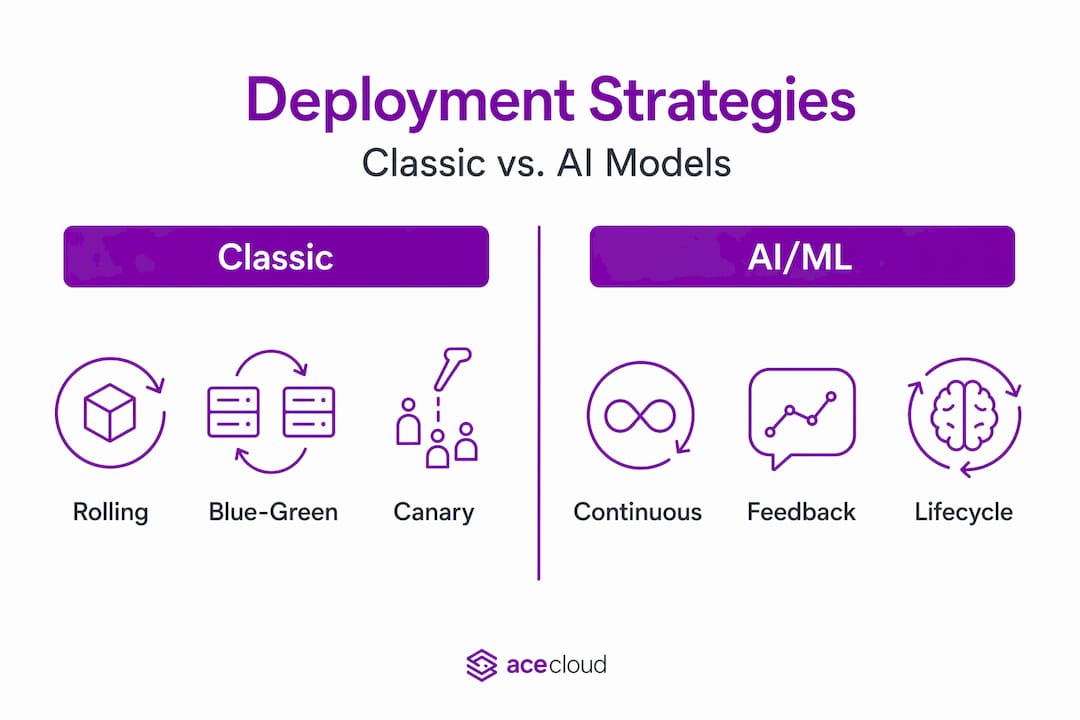
ML pipelines are cyclical, not linear. A model that performs well at launch degrades as input distributions shift over time. This means your deployment architecture must include continuous training (CT) alongside continuous deployment (CD). The feedback loop, where production predictions are evaluated against ground truth and used to retrigger training, is not optional. It is the mechanism that keeps the model accurate.
Deployment patterns for ML models in production:
- Shadow deployment: The new model runs alongside the production model, processing the same inputs without serving the outputs. You compare results before committing.
- A/B deployment: Two model versions serve different user segments with randomized assignment, enabling statistically valid performance comparison.
- Canary deployment: The new model receives a small traffic slice with real users, monitored for accuracy degradation, latency, and downstream effects.
- Real-time inference: The model serves predictions synchronously on request, requiring strict latency budgets and capacity planning.
The NIST AI Risk Management Framework structures AI deployment as a lifecycle with govern, map, measure, and manage functions. Governance baselines are set within the first 15 days; closed-loop risk management is finalized by day 90. This kind of structured lifecycle is exactly what systematic deployment provides for AI, and it is what separates teams doing controlled AI deployment from teams discovering model failures through customer complaints.
The integration quality of ML pipeline stages, not the sophistication of any individual component, determines production readiness. You can have the best model training setup in the world and still fail if your feature store, inference service, and monitoring layer are not coordinated. Assessing MLOps readiness across team structure, platform sophistication, and governance automation before scaling is how mature organizations avoid that failure mode.
Explore how scalable AI workflows connect pipeline stages into production-ready architectures that support these deployment patterns.
Risk management and deployment best practices
Risk management in systematic deployment is about making your failure modes predictable before they become incidents. Here are the steps that consistently separate high-performing deployment operations from reactive ones:
- Define rollback criteria in advance. Specify which metrics, at what thresholds, trigger a rollback. Document this before the deployment window opens.
- Separate database migrations from code releases. Apply schema changes using backward-compatible expansions first, then deploy code, then contract the schema in a later release.
- Manage session consistency across versions. In blue-green and rolling deployments, users may have active sessions spanning both versions. Design session storage to be version-agnostic.
- Match strategy to risk tolerance. Deployment success depends less on tool sophistication and more on choosing a strategy that fits your operational context. A canary deployment for a low-traffic internal tool adds overhead without proportional safety benefit.
- Treat each deployment as a learning event. Post-deployment reviews that capture what the metrics showed, not just whether the deployment succeeded, build organizational knowledge that compounds over time.
A poor deployment strategy does not just cause outages. It slows engineering culture, making teams reluctant to ship frequently because each release carries fear of failure. The inverse is also true: teams with strong deployment processes ship more often, with more confidence.
Pro Tip: Run a dry-run rollback before your next production deployment. If your team has never practiced a rollback under realistic conditions, the first real one will take three times as long as it should.
My take on where deployment strategy really breaks down
I've worked with enough infrastructure projects to say this directly: most deployment failures are not technical failures. They are coordination failures that a better process would have caught.
What I've seen repeatedly is teams that invest heavily in their CI pipeline and almost nothing in their deployment observability. The code gets tested, the pipeline is green, and then the deployment happens into a production environment that nobody is watching closely enough to know if the new version is actually performing as expected. The technical apparatus is there; the discipline around it is not.
The cultural impact of deployment confidence is real and measurable. A bad deployment strategy creates a dread of Fridays, delayed releases, and a team that negotiates release schedules around fear rather than value delivery. I've seen this dynamic freeze product velocity for quarters at a time.
What I've also learned is that operational AI fluency now requires systems thinking that goes beyond technical skills. Deployment is part of continual organizational capability building. The teams that get this right treat their deployment process as a product: something that gets iterated, measured, and improved over time, not set once and forgotten.
My advice: pick one deployment pattern, instrument it well, and master it before expanding to more complex strategies. Depth of execution beats breadth of tooling every time.
— Tyler
Build your deployment architecture with Starksglobalgroup
At Starksglobalgroup, we build structured automation architectures that treat deployment as a first-class engineering concern, not an afterthought. Our platform provides verified blueprints, tested tooling recommendations, and layered infrastructure designs that connect your CI/CD pipeline, observability stack, and rollback logic into a coherent system.

If you are ready to move from ad-hoc releases to a deployment architecture that scales with your operations, the AI Affiliate Blueprint gives you the frameworks and tool integrations to get there. For teams building out broader automation infrastructure, our tools and systems marketplace surfaces verified options across every layer of the deployment stack. We test what we recommend, and every resource is grounded in the same engineering principles covered in this article.
FAQ
What is systematic deployment in software engineering?
Systematic deployment is a structured, policy-gated process for releasing software in staged increments using automation and observability to validate each step before proceeding. It reduces downtime risk, enables fast rollbacks, and creates an auditable release history.
What are the main systematic deployment strategies?
The three primary strategies are rolling deployments, blue-green deployments, and canary deployments. Each controls risk differently: rolling updates instances gradually, blue-green switches full environments instantly, and canary exposes a small traffic slice first.
How do canary deployments reduce release risk?
Canary deployments route 1 to 5% of production traffic to the new version while monitoring for error rate spikes or latency degradation, allowing automated rollback before the full user base is affected.
How does systematic deployment apply to AI models?
AI models require continuous training loops and feedback mechanisms that standard software deployments do not. Patterns like shadow deployment, A/B testing, and canary releases allow teams to validate model accuracy and behavior in production before full rollout.
Why is database migration a risk in systematic deployment?
Schema changes coupled with code deployments can corrupt data if a rollback is needed. The expand-contract pattern separates schema changes from code releases and keeps schemas backward-compatible, making safe rollbacks possible without data loss.