

Operational inefficiency is not just a productivity problem. It is a direct threat to revenue, competitive positioning, and long-term growth. As organizations scale, process complexity multiplies, and the gaps between departments widen in ways that traditional management approaches struggle to close. AI-driven solutions now give business leaders a measurable edge, automating repetitive tasks, surfacing bottlenecks in real time, and enabling data-backed decisions at speed. This guide walks you through a structured, evidence-based approach to streamlining operations, from baseline assessment through continuous optimization, so you can build systems that scale reliably.
Table of Contents
- Assess your current operations: Setting the foundation
- Choose and integrate automation tools and AI solutions
- Implement changes: Steps to streamline operations successfully
- Monitor, measure, and optimize: Ensuring long-term gains
- Why integrating traditional frameworks with AI delivers lasting results
- Accelerate your operational excellence with expert solutions
- Frequently asked questions
Key Takeaways
| Point | Details |
|---|---|
| Assess before acting | Thorough operational assessment reveals hidden inefficiencies and guides targeted improvements. |
| Integrate AI strategically | Don’t just add AI—integrate it with proven frameworks like Six Sigma for robust, scalable change. |
| Monitor and refine continuously | Sustained gains require ongoing measurement, adjustment, and a culture of optimization. |
Assess your current operations: Setting the foundation
With the challenge laid out, the next step is establishing a clear understanding of where your current operations stand. Attempting to automate or optimize without this foundation is one of the most common and costly mistakes organizations make. You need verified data before you can build anything durable.
Why workflow mapping and baseline data matter
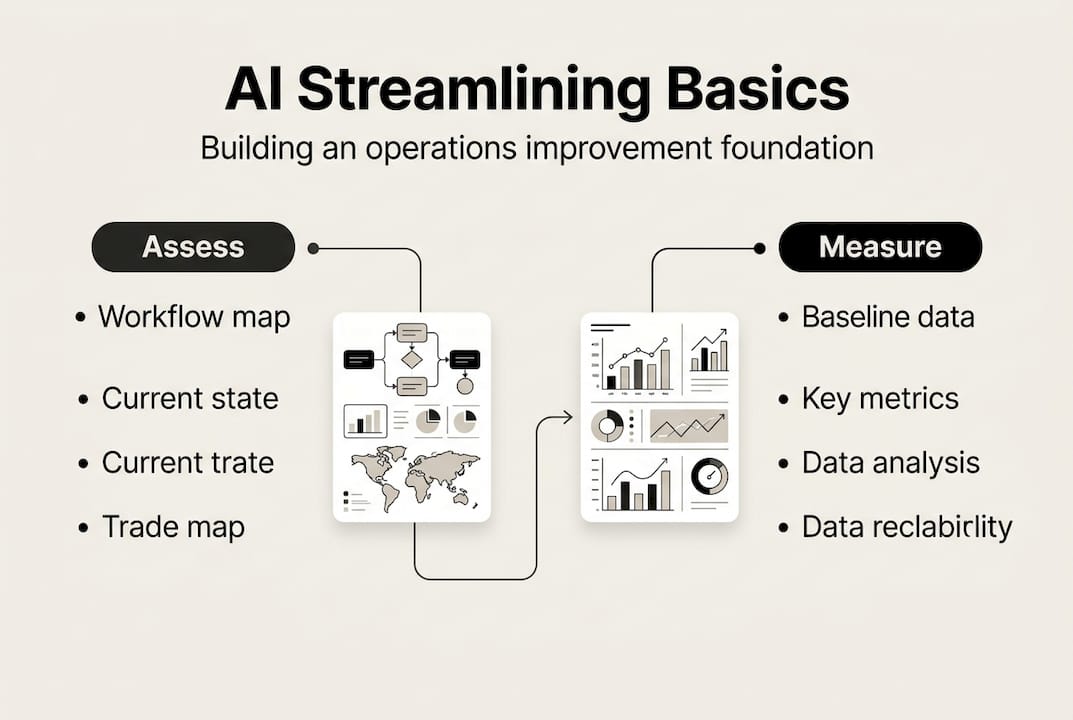
Workflow mapping gives you a visual, factual record of how work actually moves through your organization, not how you assume it does. Many executives are surprised to find that documented processes and real-world execution diverge significantly. Shadow workflows, informal workarounds, and undocumented approval chains are common findings. Without mapping, automation simply accelerates broken processes.
Collecting baseline data is equally critical. You need quantifiable starting points to measure improvement later. Without baselines, any gains you report are anecdotal.
Key performance metrics to track
Focus on metrics that directly reflect operational health:
- Cycle time: How long it takes to complete a process end to end
- Error rate: The frequency of defects, rework, or failed outputs per unit
- Resource utilization: The percentage of available capacity actually being used productively
- Throughput: The volume of work completed within a defined time period
- Cost per transaction: The total operational cost divided by the number of units processed
These five metrics give you a cross-functional view of where waste is concentrated and where automation will generate the fastest return.
Using Six Sigma for systematic assessment
Six Sigma provides a rigorous, data-driven framework for identifying and eliminating variation in processes. Its DMAIC methodology (Define, Measure, Analyze, Improve, Control) maps directly onto operational streamlining. The financial case is well established. Six Sigma programs deliver average savings of 1.7% of revenues with ROI exceeding $2 saved for every $1 invested. GE famously achieved $4.4 billion in savings on a $1.6 billion investment, a 2.6:1 return. These are not theoretical projections. They are empirical results from large-scale deployments.
| Metric | Before assessment | After Six Sigma baseline | Target improvement |
|---|---|---|---|
| Cycle time | Unknown | Measured and documented | 20 to 40% reduction |
| Error rate | Estimated | Statistically validated | Below 3.4 defects per million |
| Resource utilization | Assumed | Quantified by role and system | 80%+ productive utilization |
| Cost per transaction | Approximated | Calculated with full cost model | 15 to 30% reduction |
Building a cross-functional process improvement team
Assessment cannot be owned by a single department. Appoint a team that includes operations, IT, finance, and frontline managers. Each brings a different lens. IT will surface integration constraints. Finance will validate cost assumptions. Frontline managers will identify informal workarounds that never appear in documentation.
Pro Tip: Before investing in any automation tool, spend two weeks doing nothing but observing and mapping. The insights you gather will determine which tools you actually need and prevent expensive misalignments later.
For a structured approach to automation infrastructure strategies, it helps to understand how layered architectures support this kind of systematic assessment before any deployment begins.
Choose and integrate automation tools and AI solutions
After assessing your operations, the logical next step is to select technology that fits your unique environment. The market for AI and automation platforms is crowded, and choosing the wrong tool creates more disruption than it resolves.

Criteria for evaluating AI and automation software
Not every platform will fit your operational profile. Evaluate candidates against these criteria before committing:
- Compatibility: Does it integrate with your existing ERP, CRM, or data infrastructure without requiring a full system rebuild?
- Scalability: Can it handle 10x your current transaction volume without degrading performance?
- Ease of use: Will your operations team be able to configure and maintain it, or does it require constant vendor support?
- ROI expectations: What is the realistic payback period based on your baseline metrics and the vendor's documented case studies?
- Security and compliance: Does it meet your industry's regulatory requirements for data handling and auditability?
Comparing legacy, hybrid, and next-gen AI tools
| Tool category | Strengths | Limitations | Best fit |
|---|---|---|---|
| Legacy automation (RPA) | Stable, predictable, well-documented | Brittle, rule-based, slow to adapt | High-volume, structured, repetitive tasks |
| Hybrid platforms | Combines rules with machine learning | Requires careful configuration | Mixed structured and unstructured workflows |
| Next-gen AI platforms | Adaptive, learns from new data, handles complexity | Higher setup cost, needs guardrails | Complex, variable, decision-heavy processes |
The research is clear on this tension. Traditional methods excel in structured operations but scale slowly, while AI accelerates results but introduces risks around edge cases and failures when deployed without proper guardrails. The most resilient architecture integrates both approaches rather than replacing one with the other.
Ensuring smooth integration
Integration failure is the primary reason automation projects stall. Plan for it explicitly. Map every data handoff point between your new tool and existing systems. Test integrations in a sandbox environment before any production deployment. Establish rollback procedures so that a failed integration does not take down a live workflow.
Pitfalls to avoid
Deploying AI without defined guardrails is a significant operational risk. AI models can produce confident but incorrect outputs, particularly in edge cases they were not trained on. Establish human review checkpoints for any AI-driven decision that carries financial, legal, or customer-facing consequences. The integration of AI with Six Sigma discipline is one of the most effective ways to build those guardrails systematically.
Pro Tip: Request a live integration demo with your actual data environment, not a vendor's demo environment. The difference in performance is often significant and reveals integration challenges before you sign a contract.
Implement changes: Steps to streamline operations successfully
Once tools are selected and integrated, the focus shifts to the actual process of implementation. This is where well-planned projects often lose momentum. A structured rollout with clear milestones and stakeholder engagement is what separates successful deployments from expensive shelf-ware.
A step-by-step implementation roadmap
-
Define the pilot scope. Select one high-impact, well-documented process for your initial deployment. Avoid starting with your most complex or mission-critical workflow. A successful pilot builds organizational confidence and surfaces integration issues at low risk.
-
Train users before go-live. Automation tools only deliver value when the people using them understand both the mechanics and the purpose. Training should cover not just how to use the tool, but why the process is changing and what the expected outcomes are.
-
Run the pilot and document results. Measure against your baseline metrics from the assessment phase. Track cycle time, error rates, and resource utilization for at least four weeks before drawing conclusions.
-
Iterate based on findings. No first deployment is perfect. Use the pilot data to identify configuration gaps, integration friction, and user adoption issues. Fix them before scaling.
-
Scale in phases. Expand to additional processes in order of impact and readiness. Phased rollouts allow your team to absorb change without operational disruption.
-
Establish ongoing governance. Assign ownership for each automated workflow. Define who monitors performance, who approves changes, and how issues are escalated.
"The discipline of structured implementation is what converts a promising technology into a reliable operational asset. Speed matters, but sequence matters more."
Change management and communication
Resistance to operational change is predictable. Address it proactively. Communicate the rationale for each change before it happens, not after. Involve frontline managers in the design of new workflows so they become advocates rather than obstacles. Acknowledge that some roles will change and provide clear paths for skill development.
Realistic timelines matter here. Rushing implementation to meet an arbitrary deadline is one of the most reliable ways to generate expensive rework. Streamlining operational processes through phased deployment consistently outperforms big-bang rollouts in both adoption rates and measurable ROI.
The financial case for disciplined implementation is strong. Structured improvement programs generate average savings of 1.7% of revenues with ROI exceeding $2 for every $1 invested, but only when the implementation follows a structured, validated process rather than an ad hoc rollout.
Pro Tip: Identify two or three vocal skeptics in your organization and bring them into the pilot team. When they see results firsthand, they become your most credible internal advocates during the broader rollout.
Monitor, measure, and optimize: Ensuring long-term gains
With changes implemented, sustainable success means vigilant tracking and adaptation. Automation systems degrade over time if not actively maintained. Business conditions change, data patterns shift, and what worked at launch may underperform six months later.
How to track results effectively
Establish a measurement cadence from day one. Weekly operational dashboards should surface KPI movements in real time. Monthly reviews should assess financial impact against baseline projections. Quarterly deep dives should evaluate whether the automation architecture still fits the current operational environment.
Key metrics to track post-implementation:
- Process cycle time vs. baseline: Are you hitting your targeted reduction?
- Error rate trends: Is the AI model maintaining accuracy or drifting over time?
- Cost per transaction: Is the financial case holding up at scale?
- User adoption rate: Are team members actually using the system as designed?
- System uptime and reliability: Is the automation infrastructure performing at the service level required?
| KPI | Baseline | Month 3 target | Month 6 target | Review frequency |
|---|---|---|---|---|
| Cycle time | Documented | 20% reduction | 35% reduction | Weekly |
| Error rate | Measured | 15% reduction | 30% reduction | Weekly |
| Cost per transaction | Calculated | 10% reduction | 25% reduction | Monthly |
| User adoption | 0% | 70% | 90%+ | Monthly |
When and how to recalibrate AI models
AI models require retraining when their output accuracy drops below your defined threshold or when the underlying business process changes significantly. Set automated alerts for model performance degradation. Schedule quarterly reviews of training data to ensure it reflects current operational reality.
It is worth noting that Lean Six Sigma improvements in performance metrics do not automatically translate to end-outcome improvements without ongoing validation. This finding reinforces the need to track both process metrics and business outcomes simultaneously, not just one or the other.
Benchmarking and continuous improvement culture
Benchmarking against your own baselines is the minimum standard. Where possible, benchmark against industry peers to understand whether your gains are competitive. Continuous improvement in automation requires embedding this discipline into your operating rhythm, not treating it as a one-time project.
Build a culture where process improvement is an ongoing expectation, not an exceptional event. Teams that review and refine their workflows quarterly consistently outperform those that treat implementation as a finish line.
Why integrating traditional frameworks with AI delivers lasting results
We have observed a consistent pattern across organizations that pursue AI-driven operational improvements: the ones that achieve lasting gains are not the ones that moved fastest to adopt new technology. They are the ones that built disciplined process foundations first, then applied AI to amplify what already worked.
Many businesses leap directly to AI, bypassing the foundational discipline that Six Sigma and Lean methodologies provide. The result is automation that accelerates broken processes, producing errors faster and at greater scale. This is not a technology failure. It is an architecture failure.
The research supports a hybrid approach. Traditional and AI methods integrated together provide the structure that prevents AI-driven failures while delivering the speed that traditional methods alone cannot achieve. AI without structure is fragile. Structure without AI is slow. Together, they create operational resilience.
Our position is direct: structure first, then speed. Technology amplifies what already works. If your processes are poorly defined, AI will amplify the inconsistency. If your processes are well-structured and validated, AI will multiply the output. The practical wisdom here is not to choose between old and new methodologies but to use integrated automation strategies that combine the reliability of proven frameworks with the scalability of modern AI.
Accelerate your operational excellence with expert solutions
The roadmap in this guide gives you a structured path from assessment to continuous optimization. But knowing the steps and having the infrastructure to execute them reliably are two different things.
At Starks Global Group, we build automation platform for business architectures that integrate verified AI tools into cohesive, scalable systems. Our platform provides tested blueprints across tool, system, workflow, and deployment layers so you are not assembling a stack from scratch. Every recommended tool is independently verified before it appears in our architecture guides. If you are ready to move from strategy to execution with a system built for scale, explore our platform and see how structured automation infrastructure translates directly into operational results.
Frequently asked questions
What results can companies expect from Six Sigma or similar operational streamlining efforts?
Empirical data shows average savings of 1.7% of revenue and ROI of over $2 saved for every $1 spent, with leading implementations like GE achieving a 2.6:1 return on investment.
Does AI always outperform traditional methods for streamlining operations?
AI can accelerate results significantly, but traditional methods provide the structural reliability that AI alone lacks. An integrated approach combining both methodologies consistently delivers the most resilient and scalable outcomes.
What are the key risks when implementing AI-driven operations?
AI introduces edge case failures and unexpected errors when deployed without strong guardrails, human review checkpoints, and ongoing model performance monitoring built into the operational architecture.
How often should operational improvements be reassessed?
Best practice is to track KPIs weekly, review financial impact monthly, and conduct a full process and model reassessment quarterly to ensure your automation architecture continues to perform as your business environment evolves.