

Most business leaders assume infrastructure automation is a back-office IT concern, best left to engineers running scripts in the background. That assumption is costing organizations millions. IT teams spend up to 70% of their time on repetitive infrastructure tasks, including provisioning servers, managing configurations, and applying updates manually. Modern infrastructure automation, especially when powered by AI, converts that operational burden into a strategic engine for speed, cost reduction, and scalable growth. This article gives you the clarity, comparisons, and practical steps to act on it.
Table of Contents
- Defining infrastructure automation
- Why automation matters: Strategic business benefits
- Understanding the technology: IaC, GitOps, and AI-driven automation
- Addressing edge cases and pitfalls
- Putting infrastructure automation to work: Practical steps for leaders
- The uncomfortable truth about infrastructure automation: What leaders often miss
- Take your next step with AI-powered infrastructure automation
- Frequently asked questions
Key Takeaways
| Point | Details |
|---|---|
| Automation saves time | By automating IT processes, organizations free up hours for higher-value work. |
| AI accelerates migration | AI-driven tools cut migration costs and duration by up to 85 percent. |
| Watch for pitfalls | Leaders must manage state drift, errors, and tool complexity to achieve real results. |
| Leadership is essential | Successful automation demands alignment, learning, and ongoing oversight from business leaders. |
Defining infrastructure automation
Infrastructure automation is not just scripting. The scope is much broader and the business implications far more significant than most leaders realize.
Infrastructure automation is the use of software tools to automate IT infrastructure processes including provisioning, configuration, management, updates, deployment, and monitoring, reducing manual effort across the entire operational lifecycle. That last part matters. This is not a one-time setup task. It covers the full lifecycle of your technology environment.
When you automate infrastructure, you are replacing manual processes with repeatable, code-driven logic. Consider what this actually covers in a modern business environment:
- Provisioning: Automatically spinning up servers, databases, and network resources when demand increases
- Configuration management: Ensuring every system is set up identically and consistently, regardless of scale
- Updates and patching: Deploying security and software updates across hundreds of systems without manual intervention
- Monitoring and alerting: Continuously checking system health and triggering responses when anomalies appear
- Deployment pipelines: Pushing application code through testing, staging, and production environments in a controlled sequence
"Infrastructure automation is not just an IT efficiency tool. It is a transformation mechanism that reshapes how businesses deliver, scale, and protect their core technology operations." This distinction matters because it reframes the conversation from cost center to strategic capability.
For decision-makers exploring AI-powered infrastructure automation, the key takeaway here is that the scope of what you can automate is far larger than most organizations currently leverage. Most are only automating a fraction of what is possible, leaving significant efficiency gains on the table.
Why automation matters: Strategic business benefits
With the foundation established, it becomes clear why forward-thinking organizations are accelerating their automation investments. The returns are quantifiable and the risks of inaction are growing.
Infrastructure automation via IaC and orchestration drives operational efficiency, cost savings such as 400% ROI, scalability, and compliance, but requires investment in skills, tools, and processes to handle nuances like configuration drift. That 400% ROI figure is not a projection. It reflects real outcomes from organizations that have systematically replaced manual workflows with structured automation architectures.
Key value drivers
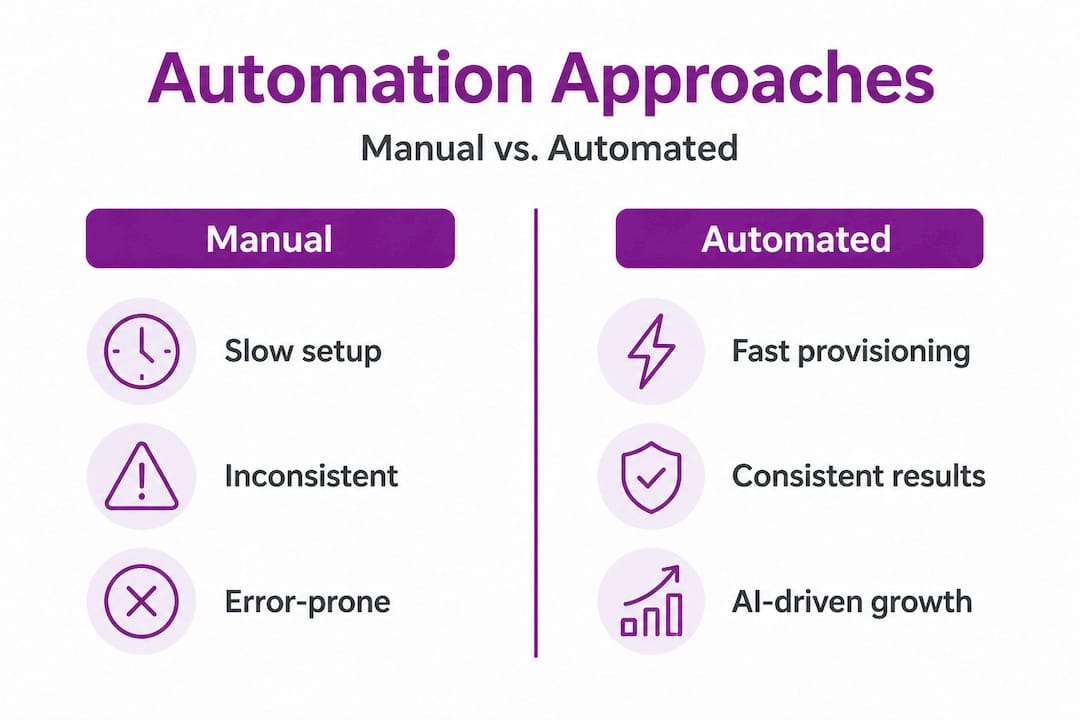
| Value driver | Manual approach | Automated approach |
|---|---|---|
| Provisioning speed | Hours to days | Minutes |
| Configuration consistency | Variable, error-prone | Identical, code-enforced |
| Compliance reporting | Manual audit cycles | Continuous, automated tracking |
| Scaling capacity | Requires manual intervention | Triggered automatically by demand |
| Error rate | High, human-dependent | Low, repeatable logic |
| Cost per operation | Increases with scale | Decreases with scale |
The numbers in that table tell a story that resonates with business leaders focused on growth. As your organization scales, manual infrastructure management becomes exponentially more expensive. Automation inverts that cost curve.
The most valuable outcomes organizations report from structured automation programs include:
- Reduced time-to-deployment from weeks to hours, enabling faster product releases
- Fewer production incidents caused by configuration errors or inconsistent environments
- Lower labor costs as engineers shift from repetitive tasks to higher-value work
- Stronger compliance posture through automated policy enforcement and audit trails
- Faster disaster recovery because infrastructure can be rebuilt from code rather than reconstructed manually
For teams evaluating automation platform solutions, these outcomes are not theoretical. They are delivered consistently when automation is built as a connected architecture rather than a collection of isolated scripts.
Understanding the technology: IaC, GitOps, and AI-driven automation
Now that the business case is solid, the next question is which technology approach fits your organization. There are four main paradigms worth understanding.
Infrastructure as Code (IaC) is the most established approach. Tools like Terraform and Ansible let teams define infrastructure in code files, making environments reproducible and version-controlled. It is faster and more consistent than manual management, but it does require engineering skill to implement and maintain.
Infrastructure from Code (IFC) takes this further by embedding infrastructure definitions directly in application code. Instead of managing separate configuration files, the infrastructure is inferred from the application itself, reducing state management overhead. This approach works well for teams that want tighter coupling between app logic and the infrastructure supporting it.
GitOps uses Git as the single source of truth for both application and infrastructure state. IaC defines the infrastructure while GitOps continuously reconciles the actual state of your environment against what is declared in the repository. If something drifts from the declared state, GitOps tooling automatically corrects it. This makes it especially powerful for compliance-sensitive environments.
AI-driven automation is the emerging frontier. AI-assisted platforms reduce migration costs by 80 to 85% and cut migration timeframes by over 90% compared to traditional approaches. AI assists with code generation, state reconciliation, anomaly detection, and increasingly, autonomous decision-making. Human oversight remains essential, but the volume of work AI can handle is growing rapidly.

Comparison of automation approaches
| Approach | Best for | Strengths | Watch out for |
|---|---|---|---|
| IaC (Terraform, Ansible) | Established engineering teams | Reproducible, version-controlled | Requires skill investment |
| Infrastructure from Code | App-centric teams | Reduced state overhead | Less separation of concerns |
| GitOps | Compliance-heavy environments | Continuous reconciliation | Git workflow discipline required |
| AI-driven automation | Scale and speed | Massive cost and time reduction | Needs human oversight |
Pro Tip: Do not choose an automation approach based on what is popular. Choose based on your team's current skill level and your organization's compliance requirements. A well-implemented IaC setup will outperform a poorly governed AI-driven platform every time.
For teams ready to explore AI infrastructure automation details, understanding these distinctions helps you make an informed investment rather than chasing the newest tool.
Addressing edge cases and pitfalls
Even well-designed automation programs encounter challenges. Understanding them in advance is how you avoid the failures that discourage organizations from investing further.
Infrastructure automation introduces specific edge cases including state management challenges such as drift, corruption, and locking; configuration drift from manual changes; error propagation across resources; tool complexity; non-idempotent scripts; monolithic modules; and secrets stored in state files. Each of these deserves attention.
Configuration drift is one of the most common and damaging pitfalls. It happens when someone manually modifies a live environment without updating the code definition. Over time, the actual infrastructure diverges from the declared state, creating invisible inconsistencies that are hard to debug and expensive to fix.
Error propagation is particularly dangerous in automated systems. A single misconfiguration in a shared module can cascade across dozens or hundreds of resources. In a manual setup, that error affects one system. In an automated one, it can affect your entire environment simultaneously.
State file security is an often overlooked risk. Tools like Terraform store the current state of your infrastructure in a file that, if not protected properly, can expose sensitive credentials and resource metadata.
Here is a structured approach to mitigating the most common pitfalls:
- Implement continuous reconciliation. Use GitOps tooling to automatically detect and correct drift before it compounds.
- Enforce code review for all infrastructure changes. No manual modifications to live environments without a corresponding code update.
- Modularize your automation code. Break large configurations into smaller, focused modules to limit the blast radius of errors.
- Encrypt and restrict access to state files. Store them in secure backends with access controls and audit logging.
- Test automation code in isolated environments before applying it to production. Treat infrastructure code with the same rigor as application code.
- Invest in team training. Many automation failures trace back to engineers using tools they do not fully understand.
"The organizations that succeed with infrastructure automation are not the ones with the best tools. They are the ones that invest in the processes and skills to use those tools correctly and consistently."
Pro Tip: Build a runbook for every automated workflow. Document what it does, what can go wrong, and how to roll back. This is especially important when onboarding new team members or responding to incidents under pressure.
For organizations focused on managing automation risks, these mitigation steps form the core of a resilient automation practice.
Putting infrastructure automation to work: Practical steps for leaders
Understanding the risks prepares you to act with confidence. Here is how to move from concept to execution in a structured way.
Successful automation programs require investment in skills, tools, and processes, not just technology adoption. Leaders who treat automation as a tool purchase rather than a capability build consistently underperform those who invest in the full system.
Follow these steps to launch a structured automation program:
- Audit your current infrastructure workload. Identify which tasks consume the most engineering time and which are the most error-prone. These are your highest-priority automation candidates.
- Define your automation architecture layers. Separate your tool layer (the software you use), your system layer (what gets automated), your workflow layer (how automation sequences operate), and your deployment layer (how automation reaches production).
- Select verified tools for each layer. Do not adopt tools based on vendor marketing. Test them against your actual workload and validate that they integrate with your existing systems.
- Start with a single, high-impact workflow. Pick one process, automate it fully, validate the outcome, and document the result. Use that success to build organizational confidence.
- Scale progressively. Once your first workflow is stable, expand to adjacent processes. Use the same architecture blueprint so your automation system grows as a connected whole.
- Measure and report outcomes. Tie automation results to business metrics, not just technical ones.
Track these metrics to measure automation success:
- Deployment frequency: How often are you shipping changes to production?
- Mean time to recovery (MTTR): How quickly can you restore service after an incident?
- Change failure rate: What percentage of changes cause a production issue?
- Infrastructure provisioning time: How long does it take to stand up a new environment?
- Compliance audit pass rate: Are automated environments meeting policy requirements consistently?
Pro Tip: Start small and build fast. One fully automated, well-documented workflow delivers more organizational learning than ten partially implemented ones. Use your automation adoption guide resources to accelerate the learning curve.
The uncomfortable truth about infrastructure automation: What leaders often miss
We have seen a consistent pattern across organizations of all sizes. The technology is rarely the limiting factor. Leadership alignment and team culture are.
Most automation initiatives stall because they are positioned as IT projects rather than business transformation programs. When only the engineering team is invested in the outcome, the rest of the organization continues generating manual work faster than automation can absorb it. Procurement still opens tickets for manual server requests. Finance still expects infrastructure costs to behave like they did five years ago. Operations still builds processes that depend on manual configuration.
The organizations that build lasting automation capability treat it as a cross-functional program with executive sponsorship, clear success metrics tied to business outcomes, and a structured learning plan for the teams involved. They also acknowledge something most vendors will not tell you: automation always needs oversight. No platform runs itself. AI tools can dramatically reduce the manual workload, but they introduce new failure modes that require skilled human judgment to manage.
There is also a persistent myth that automation eliminates the need for skilled engineers. The opposite is true. Automation elevates the skill requirement. The engineers maintaining an automated infrastructure need to understand code, system architecture, security, and the business logic driving each workflow. Teams that underinvest in reskilling consistently find their automation programs generating more problems than they solve.
The organizations winning with automation are not necessarily those with the largest budgets. They are the ones that invest in communication, learning, and process discipline alongside their technology stack. Explore our automation platform perspective for a deeper look at how structured architecture makes this scalable.
Take your next step with AI-powered infrastructure automation
If this article has clarified the scope, the opportunity, and the pitfalls of infrastructure automation, the logical next step is building it with a structured approach rather than starting from scratch.

At Starks Global Group, we have built a platform specifically designed for business leaders and technology teams who want to move from isolated tools to a connected automation infrastructure platform. Our architecture blueprints cover every layer, from tool selection through deployment logic, and every recommended tool is tested and verified before it is included. You get the clarity of a structured system and the confidence of working with solutions that are built to scale. Explore the platform today and see how purpose-built automation architecture drives real operational results.
Frequently asked questions
How does infrastructure automation reduce operational costs?
By automating repetitive tasks, organizations save labor costs and reduce costly errors, often realizing up to 400% ROI on their automation investments.
Which automation approach is best for enterprises?
Infrastructure as Code is widely used for its consistency and reproducibility, but AI-driven platforms reduce migration costs by 80 to 85%, making them increasingly attractive for large-scale environments.
What are common pitfalls in infrastructure automation?
Leaders must guard against configuration drift, tool complexity, and inadequate state management, all of which can cause failures that compound across automated systems.
Does infrastructure automation require manual oversight?
Yes. Even advanced AI platforms need human supervision because autonomous platforms still require human oversight to ensure accuracy, security, and correct handling of edge cases.