

Most mid-sized enterprises believe they have automation covered. They have robotic process automation (RPA) bots handling invoice processing, some scheduled scripts managing data transfers, and maybe a few workflow tools stitching together departmental tasks. But rule-based automation has a ceiling, and most businesses hit it without realizing it. The real shift happening in 2026 is the move to agentic AI, a fundamentally different class of automation that reasons, plans, and executes multi-step outcomes with minimal human intervention. This guide explains what that shift means for your operations, how to compare agentic AI against legacy systems, and how to build a practical roadmap toward scalable, outcome-focused automation.
Table of Contents
- What sets AI-driven automation apart in 2026?
- Agentic AI vs legacy RPA: Key differences for mid-sized enterprises
- High-impact automation use cases for mid-sized enterprises
- Governance and adoption challenges: Navigating the crossroads
- Practical steps to scaling agentic AI automation
- A fresh perspective: Why success with agentic AI depends on practical governance
- Connect with solutions: Power your automation journey
- Frequently asked questions
Key Takeaways
| Point | Details |
|---|---|
| Agentic AI leap | Agentic AI moves automation beyond simple tasks, enabling outcome-driven workflows with minimal oversight. |
| API-first scalability | Mid-sized enterprises should prioritize API-first platforms for robust integration and growth. |
| Governance is key | Clear governance and gradual adoption are crucial to successful automation system implementation. |
| Start high-impact | Begin with high-volume, clean-data workflows to realize fast, measurable automation ROI. |
| Support-driven success | Leverage expert support and proven solutions to scale agentic AI safely and efficiently. |
What sets AI-driven automation apart in 2026?
The term "agentic AI" refers to systems that do more than follow a script. These platforms reason through a goal, select the right tools, execute sequences of tasks, and adapt when conditions change. That is a significant departure from traditional RPA, which executes pre-defined rules on structured data and fails the moment an exception appears.
Agentic AI systems autonomously execute multi-step workflows, shifting from traditional RPA's rule-based automation. Where RPA asks "what is the next step in this script?", agentic AI asks "what is the best path to achieve this outcome?" That distinction changes everything about how you design, deploy, and scale automation across your organization.
For mid-sized enterprises, the practical implication is this: you no longer need to map every possible exception into a decision tree before deploying automation. Agentic systems handle ambiguity. They integrate with APIs, query data sources, make decisions, and escalate to humans only when genuinely necessary. This is what makes scalable automation architectures achievable for organizations that do not have the IT staff of a Fortune 500 company.
Key characteristics that define agentic AI automation:
- Goal-oriented execution: The system works toward an outcome, not just a sequence of steps.
- Tool integration: Agentic platforms connect natively with APIs, databases, and third-party services.
- Adaptive reasoning: When a workflow encounters an unexpected input, the system adjusts rather than breaks.
- Human-in-the-loop escalation: Exceptions are flagged for human review, keeping oversight structured and minimal.
- Continuous learning: Many agentic systems improve their decision logic over time based on outcomes.
"The shift from RPA to agentic AI is not an upgrade. It is a redesign of how automation relates to business outcomes. RPA automates tasks. Agentic AI automates results."
Now that the shift is clear, let's break down how these next-gen systems compare to legacy automation.
Agentic AI vs legacy RPA: Key differences for mid-sized enterprises
Understanding the structural differences between agentic AI and legacy RPA is essential before making any platform decision. The gap is wider than most leaders expect.
| Dimension | Legacy RPA | Agentic AI |
|---|---|---|
| Workflow type | Simple, repetitive, rule-based | Complex, multi-step, adaptive |
| Exception handling | Breaks or requires manual fix | Escalates intelligently to humans |
| Integration model | Screen scraping, brittle connectors | API-first, native integrations |
| Scalability | Limited, degrades with complexity | Designed for scale across departments |
| Governance | Difficult to audit and control | Built-in access controls and logging |
| Setup requirement | High upfront scripting effort | Lower scripting, higher configuration |
| Adaptability | None without reprogramming | Adapts based on context and data |
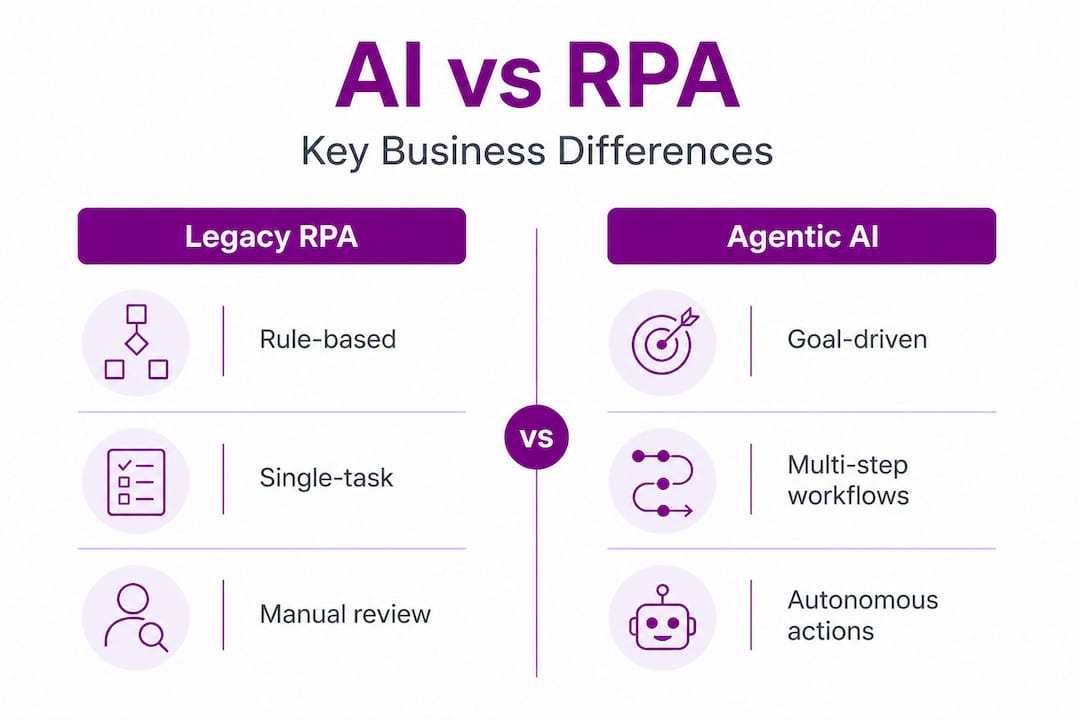
API-first agentic platforms like SS&C WorkHQ and Orcaworks deliver scalability and governance over legacy RPA. This matters because governance is not just a compliance checkbox. It is the operational foundation that lets you expand automation without losing control of your processes.
Legacy RPA systems were built for a world where business processes were stable and predictable. In 2026, that world no longer exists. Supply chains shift, customer expectations change, regulatory requirements evolve, and your automation infrastructure needs to keep pace. RPA cannot do that without constant manual intervention from developers.
Key advantages agentic AI delivers for mid-sized enterprises specifically:
- Reduced dependency on IT: Business teams can configure and adjust workflows without deep coding knowledge.
- Faster deployment cycles: API-first platforms integrate in days, not months.
- Lower total cost of ownership: Fewer breakages mean less maintenance overhead.
- Stronger audit trails: Built-in logging supports compliance and performance review.
- Cross-department scalability: One agentic platform can serve finance, HR, operations, and customer service simultaneously.
Pro Tip: Before evaluating any automation platform, audit your current RPA deployments and count how many require manual fixes each month. That number is your baseline cost of staying with legacy automation, and it is almost always higher than leaders expect.
Having outlined the comparative strengths, let's look at where agentic AI delivers the most impact for mid-sized businesses.
High-impact automation use cases for mid-sized enterprises
Knowing that agentic AI is more capable than RPA is useful. Knowing exactly where to deploy it first is what drives real returns. The highest-value targets share two traits: high transaction volume and relatively clean, structured data.
| Process area | Automation rate achievable | Key benefit |
|---|---|---|
| Accounts payable and invoicing | 70 to 85% | Reduced manual workload, faster payment cycles |
| Employee onboarding | 60 to 75% | Consistent experience, reduced HR overhead |
| Customer service routing | 65 to 80% | Faster resolution, lower support costs |
| Engineering workflow management | Up to 5x speed increase | Faster product cycles, reduced rework |
| Procurement and vendor management | 55 to 70% | Better compliance, reduced processing time |
Agentic AI excels in high-volume AP/invoicing, achieving a 70 to 85% automation rate, with industrial wins like Siemens Eigen's 5x faster engineering cycles. These are not theoretical projections. They are documented outcomes from organizations that made deliberate, structured deployment decisions.

The accounts payable use case is particularly instructive. A mid-sized manufacturer processing 3,000 invoices per month typically has a team of three to five people managing exceptions, approvals, and reconciliation. An agentic AI system can handle the full intake, matching, and routing process for the majority of those invoices, reducing the team's workload to reviewing edge cases only. That is not just efficiency. That is a structural change in how finance operations run.
Siemens Eigen's engineering workflow deployment shows what happens when agentic AI is applied to technical processes. By automating multi-step engineering documentation and validation cycles, their teams completed work five times faster than before. The system handled routine validation steps autonomously and flagged only genuine anomalies for human engineers.
Here is a practical sequence for identifying your highest-impact starting point:
- List your highest-volume processes across finance, operations, and HR. Volume is the primary indicator of automation return.
- Assess data quality for each process. Agentic AI performs best when input data is consistent and structured.
- Map exception frequency. Processes with fewer than 15% exception rates are ideal for initial deployment.
- Calculate current labor cost per process. This becomes your ROI baseline when you measure post-deployment efficiency.
- Identify integration requirements. Processes that connect to systems with available APIs are faster to automate and more stable in production.
With clear examples in hand, the next challenge is governance, balancing autonomy and control in automation deployments.
Governance and adoption challenges: Navigating the crossroads
Governance is where most automation initiatives either succeed or stall. The technology is ready. The governance frameworks, in many mid-sized enterprises, are not.
Governance and ROI block most businesses from full agentic adoption, leading to hybrid "agentish" strategies. This is not a failure. It is a realistic response to the complexity of deploying autonomous systems in regulated, risk-sensitive business environments.
The "agentish" model refers to deployments where some workflows are fully automated while others retain significant human involvement. This hybrid approach is not a compromise. For many mid-sized enterprises, it is the right architecture given current data quality, team readiness, and risk tolerance.
Key governance challenges to address before scaling:
- Access control: Define which systems and data the automation platform can access. Not every agent needs access to every data source.
- Exception escalation protocols: Build clear rules for when the system stops and routes to a human. Document these before deployment, not after.
- Audit logging: Every automated action should be logged with enough detail to reconstruct decisions during a compliance review.
- Change management: Your teams need to understand what the system does and does not do. Unexplained automation creates resistance and distrust.
- Performance thresholds: Set measurable benchmarks for accuracy, processing speed, and exception rates. Review them monthly during the first quarter of deployment.
Pro Tip: Treat your governance framework as a living document. Build it before your first pilot, update it after each deployment phase, and assign a named owner who is responsible for reviewing it quarterly. Automation without accountable governance is a liability, not an asset.
Having addressed adoption and governance, it is time to consider a practical roadmap for turning principles into results.
Practical steps to scaling agentic AI automation
Scaling agentic AI is not about deploying more tools. It is about building a structured architecture where each layer, tool, workflow, and deployment logic, supports the next. Here is a proven sequence for mid-sized enterprises moving from pilot to enterprise-wide deployment.
-
Select an API-first agentic platform with built-in governance tools. Evaluate platforms based on their integration library, audit capabilities, and exception handling architecture. Mid-sized enterprises should commence with API-first agentic platforms, robust governance, and pilot high-impact workflows. Avoid platforms that require heavy custom coding to connect to your existing systems.
-
Map your highest-volume, most repeatable workflows. Use the process audit from the previous section. Document the current state, including inputs, outputs, decision points, and exception types. This map becomes your deployment blueprint.
-
Build governance protocols before the first pilot goes live. Define access controls, escalation rules, logging requirements, and performance thresholds. Assign ownership. This is not optional, and it is not something to retrofit after deployment.
-
Run a structured pilot on one process. Choose a workflow with high volume, clean data, and low exception rates. Deploy, monitor for 30 days, and measure against your baseline. Document what worked and what required adjustment.
-
Review ROI and refine the architecture. After the pilot, calculate actual time savings, error reduction, and cost impact. Use this data to build the business case for expanding to additional workflows.
-
Expand to adjacent processes using the same governance framework. Do not start from scratch for each new deployment. Your governance protocols, integration patterns, and monitoring setup should transfer directly to new workflows.
-
Establish a continuous validation cycle. Agentic AI systems need regular performance reviews. Set quarterly checkpoints to assess accuracy, exception rates, and ROI. Adjust configurations as your business processes evolve.
A scalable automation platform is not built in a single sprint. It is assembled layer by layer, with each layer validated before the next is added. That engineering discipline is what separates sustainable automation programs from expensive experiments.
A fresh perspective: Why success with agentic AI depends on practical governance
Here is something the vendor community rarely says clearly: the technology is not the hard part. The hard part is building the organizational discipline to deploy it responsibly.
We see this consistently. Mid-sized enterprises invest in capable agentic platforms, run a successful pilot, and then stall when they try to scale. The bottleneck is almost never the software. It is the absence of a governance structure that can support autonomous systems operating across multiple departments simultaneously.
Governance and ROI blocks most businesses from full agentic adoption, and Nucleus Research sees optimism but caution is warranted. We agree with the caution. Not because agentic AI is risky by nature, but because autonomous systems amplify whatever governance culture already exists in your organization. Strong governance scales well. Weak governance scales into chaos.
The enterprises that succeed with agentic AI in 2026 share a specific pattern. They start with one high-impact process, build governance protocols that are more rigorous than the pilot strictly requires, and use the first deployment to train their teams on how to work alongside autonomous systems. They treat the pilot as an organizational learning exercise, not just a technology test.
The hybrid "agentish" model is not a failure state. For many mid-sized enterprises, it is the correct steady-state architecture for the next two to three years. Full autonomy across all workflows is a destination, not a starting point. Reaching it requires building automation governance strategies that your teams trust and your auditors can verify.
Resist the pressure to automate everything at once. The enterprises that move fastest in the long run are the ones that build the most solid foundations early.
Connect with solutions: Power your automation journey
If you are ready to move beyond rule-based automation and build a structured, scalable agentic AI architecture, Starks Global Group is built for exactly that transition.

We operate as an automation infrastructure platform that helps mid-sized enterprises design, deploy, and validate agentic AI systems using verified tools and engineering-grade blueprints. Our approach is not about recommending software in isolation. It is about building connected architectures where every tool, workflow, and deployment layer is tested and validated before it goes into production. Explore our platform to access structured automation blueprints, expert guidance, and a catalog of verified AI tools designed for real-world enterprise deployment.
Frequently asked questions
What is agentic AI and how does it differ from RPA?
Agentic AI autonomously plans and executes multi-step workflows using reasoning and tool integration, while RPA relies on rule-based, repetitive task automation that breaks when conditions change. Agentic AI systems autonomously execute multi-step workflows with reasoning and planning, making them fundamentally more adaptable than legacy RPA.
Which business processes benefit most from agentic AI automation?
High-volume workflows like accounts payable and engineering documentation cycles achieve the highest automation rates and efficiency gains. Agentic AI automates high-volume AP/invoicing at up to 85% and accelerates engineering cycles up to 5x faster than manual processes.
How can mid-sized enterprises ensure successful adoption of AI-driven automation?
Start with API-first agentic platforms that include governance tools, implement exception handling and access controls before your first pilot, and expand only after validating ROI. Mid-sized enterprises should commence with API-first agentic platforms, strong governance, and pilot high-impact workflows before scaling.
What are the main governance challenges with automation system adoption?
ROI uncertainty and risk management complexity can block full agentic automation adoption, pushing most organizations toward hybrid strategies with gradual rollout. Governance and ROI block most businesses from full agentic adoption, making structured hybrid deployment the practical path forward for most mid-sized enterprises.