

Reducing invoice processing costs from $3.10 to $0.42 per transaction while hitting 97% accuracy is not a future promise. It is a documented result from structured automation deployments already running at scale. Yet many business leaders still conflate rule-based robotic process automation (RPA) with open-ended AI agents, leading to costly mismatches between automation tools and operational needs. The distinction matters enormously for your bottom line, your compliance posture, and your ability to scale. This article cuts through that confusion and gives you a clear, evidence-backed blueprint for deploying structured automation where it delivers the most value.
Table of Contents
- Defining structured automation: What it is and why it matters
- Structured vs. unstructured automation: A practical comparison
- How structured automation delivers ROI: Real-world examples
- Key implementation strategies for structured automation success
- Why most business leaders misjudge automation's real value
- Connect structured automation to your organization's platform
- Frequently asked questions
Key Takeaways
| Point | Details |
|---|---|
| Structured automation excels | Rule-based processes see the highest efficiency and accuracy improvements with structured automation. |
| Higher ROI and savings | Real-world examples show organizations save millions with automated workflows and achieve rapid ROI. |
| Hybrid approaches scale | Combining RPA and AI enables scalable solutions for organizations with both structured and variable data. |
| Workflow redesign vital | Maximizing automation impact often requires thoughtful workflow redesign and task chaining. |
Defining structured automation: What it is and why it matters
Structured automation refers to the use of rule-based, repeatable processes applied to structured data, meaning data that lives in defined fields, tables, or predictable formats. Think invoice numbers, employee IDs, compliance forms, purchase orders, and financial records. When the input is consistent and the logic is fixed, structured automation executes with precision that is nearly impossible to match manually.
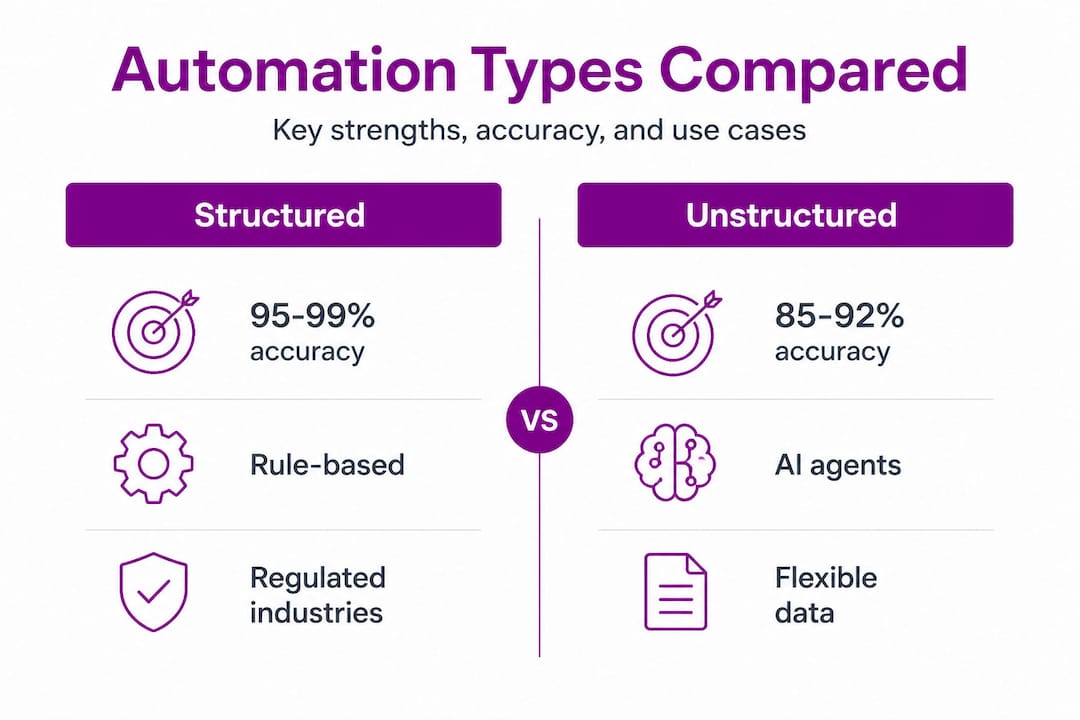
This is fundamentally different from unstructured automation, which relies on AI agents capable of interpreting variable inputs like natural language, images, or unpredictable document formats. AI agents are flexible, but that flexibility comes with a tradeoff. RPA achieves 95 to 99% accuracy on structured tasks, while AI agents typically land between 85 and 92% on the same categories of work. For compliance-heavy operations, that accuracy gap is not trivial. It can mean regulatory violations, audit failures, or costly rework.
Why this distinction matters for your organization:
- Compliance operations require consistent, auditable outputs. Structured automation creates traceable logs and repeatable results.
- High-volume transactional work such as payroll processing, data entry, and order management benefits from the speed and accuracy of rule-based systems.
- Cost control is far easier when automation logic is deterministic. You know exactly what the system will do and when.
- Integration stability is higher with structured systems because they interact with defined data fields rather than interpreting ambiguous inputs.
"Structured automation is not a limitation. It is a design choice that prioritizes precision over flexibility, and in high-stakes operational environments, precision wins every time."
Pro Tip: Before selecting any automation tool, map your highest-volume processes and categorize their inputs. If more than 80% of inputs follow a predictable format, you have a strong candidate for a structured automation platform rather than a general-purpose AI agent.
The engineering principle here is straightforward. You build automation layers to match the nature of the work. Applying an AI agent to a process that is already well-structured is like using a Swiss Army knife to drive a screw. It works, but it is inefficient, expensive, and less reliable than the right tool for the job.
Structured vs. unstructured automation: A practical comparison
Having defined structured automation, it is essential to compare it directly with unstructured alternatives to highlight practical business implications. The choice between these two approaches affects accuracy, total cost of ownership (TCO), and scalability in ways that compound over time.
| Dimension | Structured automation (RPA) | Unstructured automation (AI agents) |
|---|---|---|
| Accuracy on structured tasks | 95 to 99% | 85 to 92% |
| Input type | Defined fields, tables, forms | Variable, natural language, images |
| Best use case | High-volume, rule-based processes | Flexible, decision-heavy workflows |
| TCO over 3 years | $400k to $800k | $350k to $700k in mixed workflows |
| Compliance suitability | Very high | Moderate |
| Setup complexity | Moderate | High |
| Scalability | High for repetitive tasks | High for adaptive tasks |
The data tells a nuanced story. TCO is lower for AI in mixed workflows at $350k to $700k over three years compared to RPA at $400k to $800k, but RPA is the more cost-effective choice for pure structured, high-volume operations. Organizations that deploy AI agents on processes that are already well-structured often overspend on capability they do not need and sacrifice accuracy in the process.
Key takeaways from the comparison:
- Use structured automation when your process inputs are predictable and your accuracy requirements are above 95%.
- Use AI agents when you genuinely need flexibility, such as processing unstructured customer emails or interpreting varied document formats.
- Hybrid models, combining RPA for structured steps and AI for variable ones, often deliver the best overall performance and cost profile.
- Avoid the trap of deploying AI everywhere simply because it feels more advanced. The right architecture matches tool capability to task requirements.
For organizations operating in regulated industries like financial services, healthcare, or manufacturing, the automation in technology sector context makes structured automation even more valuable. Regulatory bodies expect consistent, auditable processes. Structured automation delivers exactly that.
Statistic callout: RPA achieves 95 to 99% accuracy on structured tasks versus 85 to 92% for AI agents on the same categories, a gap that directly translates to error rates, rework costs, and compliance risk at scale.
How structured automation delivers ROI: Real-world examples
After exploring theoretical differences, let us ground structured automation's business impact in credible company case studies and empirical ROI data. The numbers from organizations that have deployed these systems at scale are striking.

Documented results from major deployments:
| Organization | Metric | Before | After |
|---|---|---|---|
| Coca-Cola | Cost per invoice | $3.10 | $0.42 |
| Coca-Cola | Invoice accuracy | ~80% | 97% |
| Coca-Cola | Annual savings | Baseline | $3.2M |
| Siemens | Manual processing time | Baseline | Reduced by 65% |
| Industry average | Year 1 ROI | Baseline | 300 to 800% |
These are not projections. Coca-Cola's RPA deployment reduced invoice processing costs by 86% while simultaneously improving accuracy to 97%. Siemens achieved a 65% reduction in manual processing time through AI-assisted automation integrated into structured workflows. And across the industry, intelligent automation consistently delivers ROI between 300 and 800% within the first year of deployment.
What drives these results? Three factors stand out consistently.
- Volume amplification. Structured automation does not get tired, make typos, or need breaks. When you apply it to a process running thousands of transactions per day, even small per-transaction improvements compound into massive savings.
- Error elimination. Manual processes carry inherent error rates that trigger rework, customer complaints, and compliance issues. Structured automation removes the variability that causes those errors.
- Redeployment of human capital. When automation handles repetitive transactional work, your skilled staff can focus on higher-value activities that require judgment, creativity, and relationship management.
"The organizations achieving the highest ROI are not simply automating existing processes. They are redesigning those processes to be automation-ready before they deploy a single bot."
Pro Tip: Start your automation program with a pilot project on a single high-impact, high-volume process. Measure your baseline metrics carefully before deployment, then track accuracy, cost per transaction, and processing time for 90 days post-launch. This gives you a clean business case to justify broader rollout. Reviewing automation case studies from comparable organizations can help you set realistic benchmarks before you begin.
The pilot approach also reduces organizational risk. You build internal expertise, identify integration challenges, and demonstrate value to stakeholders before committing to enterprise-wide deployment. This is how serious builders approach automation architecture.
Key implementation strategies for structured automation success
Now that you see evidence of measurable impact, it is time to focus on practical steps for driving successful implementations. The gap between organizations that achieve 300% ROI and those that struggle to break even often comes down to implementation discipline, not technology selection.
Step-by-step implementation framework:
- Identify and prioritize processes. Focus on high-volume, rule-based operations with consistent data inputs. Invoice processing, compliance reporting, employee onboarding, and data reconciliation are strong starting points. Pilot on high-impact processes before scaling.
- Establish governance structures. Define ownership, accountability, and change management protocols before you deploy. Automation without governance creates technical debt and operational risk.
- Redesign workflows before automating. This is the step most organizations skip. Map your current process, identify unnecessary handoffs, and streamline the workflow so automation runs on clean logic. AI-friendly workflow design reduces errors and maximizes throughput.
- Deploy hybrid RPA plus AI models for scalability. Pure RPA handles your structured core. AI handles the variable edges. Together, they create a scalable architecture that adapts as your business grows.
- Validate continuously. Automation is not a set-and-forget deployment. Build monitoring into your architecture to catch drift, exceptions, and performance degradation early.
Best practices for governance and scalability:
- Assign a dedicated automation owner or center of excellence (CoE) to maintain standards across deployments.
- Document every workflow in detail before and after automation so your team can audit, update, and extend the system.
- Use version control for automation scripts and logic, treating them with the same rigor as software code.
- Build governance and hybrid RPA+AI frameworks from the start, especially for compliance-heavy operations where audit trails are non-negotiable.
For mid-sized to large organizations, the hybrid model is particularly powerful. You get the precision of structured automation on your highest-volume, most compliance-sensitive processes, and the flexibility of AI on the edges where data variability demands it. The architecture is layered, modular, and built for scale.
One often-overlooked implementation factor is task chaining, which means connecting multiple automated steps into a continuous workflow that minimizes human handoffs. Even if individual AI steps are not perfect, chaining them reduces the total number of intervention points and increases overall throughput. Redesigning workflows to support task chaining is one of the highest-leverage moves you can make before deployment. Explore structured automation guidance to see how layered architectures support this kind of workflow design at scale.
Why most business leaders misjudge automation's real value
Here is the uncomfortable truth we see repeatedly across organizations at every scale. Most leaders treat automation as a technology procurement decision. They evaluate vendors, select tools, and deploy bots on existing processes. Then they wonder why results fall short of the benchmarks they read about.
The real driver of automation ROI is not the software. It is the quality of the workflow the software runs on. Organizations that achieve 300 to 800% ROI are not simply buying better tools. They are investing in workflow redesign, change management, and architectural discipline before a single bot goes live.
We have seen organizations spend significantly on RPA licenses and achieve modest gains because they automated a broken process. The bot faithfully replicates every inefficiency, every unnecessary step, every redundant handoff. Speed increases, but so does the rate at which errors propagate.
The contrarian insight here is that your automation investment should be weighted heavily toward process design and change management, not just software licensing. The task chaining principle reinforces this. When you reduce handoffs and redesign workflows to be AI-friendly, you maximize value even in steps where automation underperforms. The architecture compensates for individual weaknesses through structural efficiency.
Pro Tip: Allocate at least 30 to 40% of your automation program budget to workflow redesign, training, and change management. The organizations that skip this step consistently underperform those that invest in it.
The leaders who extract the most value from automation think like engineers, not shoppers. They design systems, not just deployments. That mindset shift is what separates organizations that achieve transformational results from those that achieve incremental ones.
Connect structured automation to your organization's platform
The evidence is clear. Structured automation, when deployed on well-designed workflows with proper governance, delivers measurable, scalable, and repeatable results. The question is not whether to automate. It is whether your organization has the architecture to do it right.

At Starks Global Group, we build and document the infrastructure that makes automation work at scale. Our automation infrastructure platform provides verified blueprints, tested tool stacks, and layered deployment architectures designed for organizations that are serious about operational efficiency. Whether you are launching a pilot project, establishing a governance framework, or scaling a hybrid RPA plus AI system, we give you the structured resources to build it correctly from the ground up. Explore our platform to access the architectures, tools, and guidance your team needs to move from concept to production with confidence.
Frequently asked questions
What processes are ideal for structured automation?
High-volume, rule-based tasks with consistent data, like invoice processing and compliance operations, are best suited for structured automation because it excels in structured data and rule-based processes.
How does structured automation impact compliance?
Structured automation delivers higher accuracy and full auditability, which are critical for compliance-heavy operations where structured automation excels in maintaining consistent, traceable outputs.
What is the typical ROI for structured automation?
Organizations consistently report ROI of 300 to 800% within the first year of intelligent automation deployment, driven by cost reduction, accuracy gains, and redeployment of human capital.
Should mid-sized companies use hybrid RPA plus AI approaches?
Yes. Hybrid RPA plus AI models are strongly recommended for scalability, particularly when your operations involve both structured transactional data and variable inputs that require adaptive processing.