

System integration types: choosing the right path for scale
Choosing the wrong system integration approach is not just a technical misstep. It can derail automation initiatives, inflate operational costs, and create maintenance burdens that slow your entire business down. For organizations building AI-driven workflows, the stakes are real. Research shows that a well-implemented iPaaS integration platform can deliver 181% ROI and $2.2M in net present value over three years. That outcome depends entirely on selecting the right integration type for your specific environment. This article walks you through the key criteria, the main integration approaches, a direct comparison, and a clear framework for making the right decision.
Table of Contents
- Key criteria for selecting a system integration approach
- Point-to-point integration: Simplicity for limited scale
- Enterprise Service Bus (ESB): Hub-and-spoke for complex ecosystems%3A-hub-and-spoke-for-complex-ecosystems)
- iPaaS (Integration Platform as a Service): Cloud-first agility and scale%3A-cloud-first-agility-and-scale)
- Hybrid and modular patterns: Flexibility for evolving business needs
- Why integration success is more about mindset than technology
- Empower your business with future-proof integration
- Frequently asked questions
Key Takeaways
| Point | Details |
|---|---|
| Start with business needs | Align your integration strategy with clear, prioritized business goals for optimal results. |
| Cloud-first enables scale | iPaaS delivers the flexibility and ROI modern automation requires. |
| Hybrid is the new normal | Blend legacy, ESB, and cloud approaches to adapt as your architecture evolves. |
| Monitor and adapt continuously | Sustained value comes from ongoing improvements and proactive integration management. |
Key criteria for selecting a system integration approach
Before you evaluate specific integration types, you need to establish a clear picture of your operating environment and business objectives. Selecting the wrong approach because you skipped this step is one of the most common and costly mistakes we see in AI-driven automation projects.
Here are the core criteria to evaluate:
- Business objectives: Are you optimizing for efficiency, scalability, automation coverage, or all three? Your integration architecture must align with these goals from the start, not as an afterthought.
- Technical landscape: Are your systems cloud-native, SaaS-based, legacy on-premises, or a hybrid mix? Each environment has different demands on how integration layers are structured.
- Data flow complexity: How many systems need to exchange data? At what frequency? In what formats? High-volume, real-time data flows require fundamentally different integration designs than batch-based synchronization.
- Scalability requirements: Can your chosen integration approach grow with your business without requiring a full rebuild? Modular, loosely coupled designs age far better than tightly bound architectures.
- Security and compliance: Data governance, access controls, and audit trails must be built into the integration layer, not bolted on later. This is especially critical for regulated industries.
- Maintainability: Who will own this integration layer long-term? Complex architectures with no documentation or monitoring become liabilities, not assets.
Experts consistently recommend API-first strategies when designing integration architectures, and for good reason. As detailed in integration fundamentals, preferring iPaaS over ESB for cloud and SaaS environments, combined with modular architecture design, gives your team the flexibility to adapt without rebuilding from scratch. API-first design keeps your systems interoperable, extensible, and easier to test.
Pro Tip: Document your current system inventory before choosing an integration type. List every tool, data source, and workflow that needs to connect. This map reveals hidden complexity early and saves months of rework.
The criteria above form your integration blueprint's foundation. Every choice you make about integration type should be traceable back to these factors. Businesses that treat integration as a purely technical decision, without grounding it in operational strategy, often find themselves locked into rigid architectures that limit their automation potential.
Point-to-point integration: Simplicity for limited scale
Point-to-point integration is the most basic form of system connectivity. System A connects directly to System B through a custom-built link. That link handles data exchange between those two systems and only those two systems. There is no middleware, no central hub, and no abstraction layer. You build the connection, and it works.
This approach has genuine advantages in the right context:
- Speed of deployment: You can connect two systems quickly without needing a shared integration platform or middleware configuration.
- Low initial cost: For a single integration between two well-understood systems, the build cost is minimal compared to standing up a full integration platform.
- Simplicity: Less infrastructure means fewer moving parts, which translates to simpler troubleshooting when something breaks.
- Ideal for pilots: When you are testing a new automation workflow or validating a data feed before committing to a broader architecture, point-to-point is a reasonable starting point.
However, the limitations surface fast. If you have ten systems that all need to communicate with each other, point-to-point integration requires up to 45 separate connections. Add one more system, and you add ten more connections. The math becomes unmanageable quickly. As integration complexity grows, direct point-to-point approaches become inefficient and brittle at scale.
Real-world examples make this clear. A small e-commerce company connecting its Shopify store directly to QuickBooks might be fine with a point-to-point integration early on. But when they add a warehouse management system, a CRM, a marketing automation platform, and a returns management tool, that simple approach collapses under its own weight. Every new system demands new custom connections, each with its own logic, error handling, and maintenance overhead.
Pro Tip: Use point-to-point integrations only when you have a clear ceiling on system growth. If you can see your tech stack expanding within 12 months, start with a more scalable model from day one.
For AI-driven businesses building automation at scale, point-to-point is rarely the right long-term answer. It is a useful tactical tool, but not a strategic foundation. Treat it as a phase-zero approach while you build toward something more structured.
Enterprise Service Bus (ESB): Hub-and-spoke for complex ecosystems
The Enterprise Service Bus, or ESB, was designed to solve exactly the problem point-to-point creates. Instead of building direct links between every pair of systems, an ESB places a central hub at the core of your architecture. Every system connects to the hub, and the hub manages routing, transformation, and delivery of messages between systems.

Here is a direct comparison of ESB characteristics versus point-to-point:
| Feature | Point-to-point | ESB |
|---|---|---|
| Connection model | Direct, pairwise | Centralized hub |
| Scalability | Poor at scale | Moderate, structured |
| Protocol handling | Per-connection custom | Standardized via hub |
| Monitoring | Distributed, difficult | Centralized, easier |
| Best environment | Small, simple setups | Legacy and hybrid systems |
| Bottleneck risk | Low initially | High if hub is overloaded |
ESB strengths are real. It reduces spaghetti connections, standardizes message formats, supports protocol transformation (converting SOAP to REST, for example), and provides centralized monitoring. In large enterprises with many legacy systems that cannot be easily replaced, an ESB provides structure and governance that direct integrations cannot offer.
However, the ESB model has well-documented weaknesses. The hub itself can become a bottleneck and a single point of failure. ESB platforms are typically complex to configure and maintain, requiring specialized skills. Deployment cycles tend to be slow. And as noted in cloud integration guidance, ESBs are not recommended for cloud and SaaS-focused environments where agility and speed matter more than rigid centralization.
The best-fit scenario for ESB is an organization running a significant portfolio of on-premises legacy systems that must be maintained while the business gradually modernizes. Banking institutions, healthcare networks, and government agencies often fit this profile. ESB gives them integration governance without requiring immediate re-platforming of core systems.
For AI-driven automation initiatives built primarily on SaaS tools and cloud infrastructure, ESB is typically too rigid and too slow to keep pace with the deployment cycles required.
iPaaS (Integration Platform as a Service): Cloud-first agility and scale
iPaaS stands for Integration Platform as a Service. It is a cloud-native integration layer that provides pre-built connectors, low-code or no-code configuration tools, and scalable infrastructure for connecting SaaS applications, cloud services, APIs, and data sources without writing extensive custom code.
Here is how iPaaS compares to ESB on the dimensions that matter most for AI-driven businesses:
| Dimension | ESB | iPaaS |
|---|---|---|
| Deployment model | On-premises or hybrid | Cloud-native |
| Setup speed | Weeks to months | Days to weeks |
| Connector library | Limited, custom-built | Extensive, pre-built |
| Scalability | Infrastructure-dependent | Elastic, on-demand |
| Maintenance overhead | High | Low to moderate |
| API-first design | Optional | Core to the model |
Key outcome: Organizations implementing iPaaS report 181% ROI and $2.2M NPV over three years, with case studies showing 20 to 30% productivity increases and 60 to 73% reductions in manual labor.
Those numbers reflect what happens when integration infrastructure aligns with how modern businesses actually operate. Cloud-first architectures, AI automation pipelines, and SaaS-heavy tool stacks need an integration layer that moves at the same speed as the business.
iPaaS platforms deliver several core advantages:
- Pre-built connectors: Hundreds of out-of-the-box integrations with popular SaaS tools reduce build time dramatically.
- API-first design: Native support for REST APIs and webhooks makes it easy to connect AI tools, data pipelines, and automation workflows.
- Low operational overhead: Managed infrastructure means your team focuses on building workflows, not maintaining servers.
- Rapid iteration: New integrations can be deployed in days rather than months, supporting fast experimentation and automation scaling.
- Visibility and monitoring: Built-in dashboards track data flows, error rates, and integration health in real time.
For organizations exploring automation infrastructure benefits, iPaaS represents the most accessible path to scalable AI-driven integration. It removes the infrastructure burden and lets your team focus on workflow logic and business outcomes rather than plumbing.
Hybrid and modular patterns: Flexibility for evolving business needs
Most mature organizations do not live in a single integration paradigm. They have legacy systems that require ESB-style centralization, cloud tools that benefit from iPaaS connectors, and specialized services that need direct API calls. The hybrid and modular integration pattern acknowledges this reality and builds an architecture that deliberately combines approaches.
Here is a structured approach to designing hybrid integration architectures:
- Audit your current stack to identify which systems are legacy, which are cloud-native, and which are in transition. This prevents over-engineering or under-serving specific layers.
- Layer your integration tools by system type. Use ESB or integration middleware for legacy connectivity, iPaaS for SaaS and cloud services, and direct API calls for lightweight, high-frequency integrations.
- Implement an API gateway as a unified entry point for external-facing integrations. This adds security, rate limiting, and observability without centralizing all internal traffic through a single bottleneck.
- Adopt event-driven patterns where appropriate. Event-driven architectures using message queues or event streams decouple systems so that failures in one component do not cascade through the entire stack.
- Design for failure. Assume components will fail and build retry logic, circuit breakers, and fallback routes into every integration layer.
- Build continuous monitoring from day one. You cannot manage what you cannot see. Integration health dashboards, alerting, and logging are not optional in a hybrid architecture.
As expert guidance on scalable integration solutions consistently shows, hybrid and modular architectures are essential for scale, particularly when businesses must maintain operational continuity while modernizing their infrastructure layer by layer.
Modular microservices play a key role here. Rather than building monolithic integration logic, breaking integration functions into independently deployable services lets your team update, replace, or scale individual components without touching the entire system. This is the engineering foundation that supports long-term automation growth.
Why integration success is more about mindset than technology
We have seen businesses invest heavily in enterprise iPaaS platforms and still struggle to deliver working automation at scale. We have also seen smaller organizations with modest tooling build integration architectures that genuinely transform their operations. The difference is rarely the technology stack. It is the mindset behind how integration is treated as an ongoing business initiative.
Most integration projects fail not during initial deployment but during the maintenance and iteration phase. Systems change. Business requirements shift. New tools get added to the stack. Organizations that treat integration as a one-time project stop monitoring, stop documenting, and stop improving. Over time, the architecture degrades and technical debt accumulates until a major failure forces a costly rebuild.
High-performing organizations treat integration like a product. There is clear ownership, regular review cycles, and a commitment to continuous monitoring. They use automation platform insights to track performance metrics and feed real data back into architectural decisions. They do not assume the integration layer is working. They verify it.
The practical implication for your business is this: before selecting any integration type, establish who owns integration health, how integration performance will be measured, and what the process is for updating integrations when upstream systems change. Technology enables the architecture, but operational discipline sustains it.
Empower your business with future-proof integration
Understanding integration types is the first step. Building a structured, scalable architecture around them is where real operational impact happens. At Starks Global Group, we have built a platform specifically designed to help businesses move from isolated tools to connected, automated systems that perform at scale.
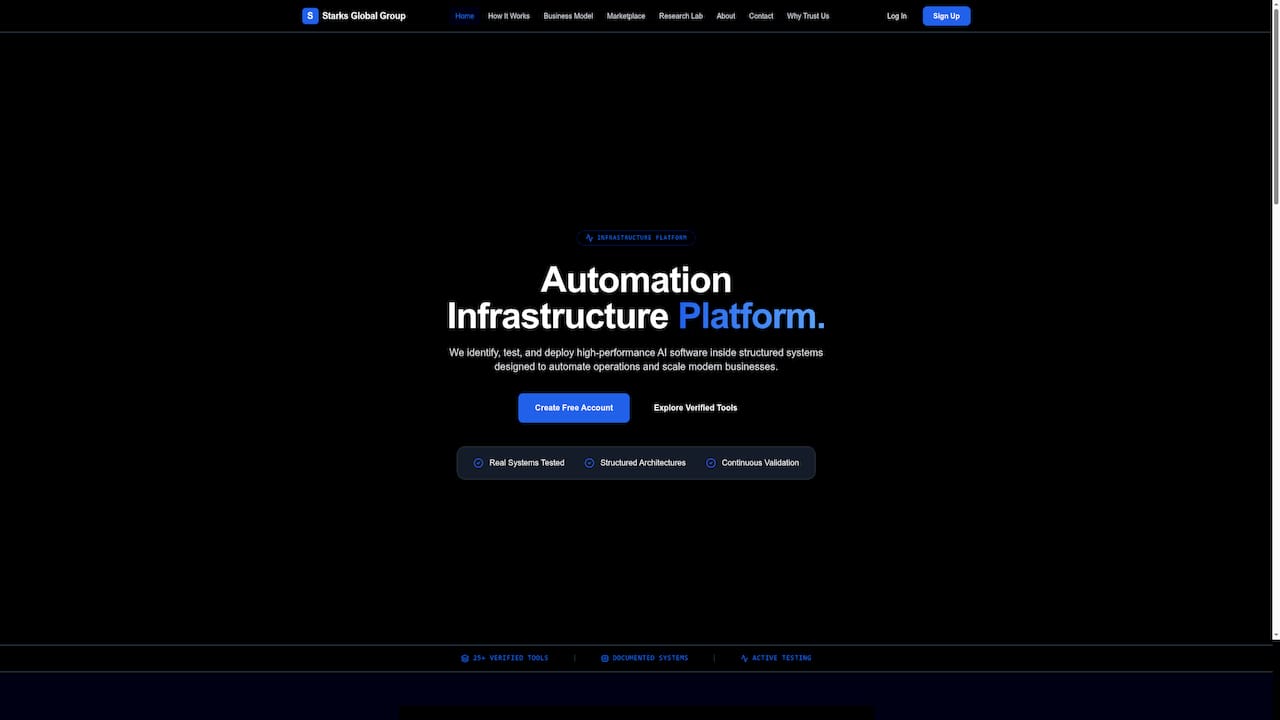
Our Starks Global Group automation platform provides verified blueprints, tested integration architectures, and layered infrastructure guides across tool, system, workflow, and deployment layers. Whether you are evaluating iPaaS options, designing a hybrid architecture, or building your first AI automation workflow, we provide the structured resources to make that process faster and more reliable. Explore our platform to see how verified integration frameworks can support your next automation initiative.
Frequently asked questions
What is the main difference between ESB and iPaaS?
ESB centralizes integration on-premises through a hub-and-spoke model, while iPaaS delivers cloud-first, elastic integration optimized for modern SaaS and distributed environments. As integration experts note, iPaaS is preferred for cloud-focused architectures, while ESB remains relevant for legacy and hybrid system environments.
When should a business choose a hybrid integration approach?
Hybrid integration is the right choice when your organization must connect legacy systems, cloud platforms, and modular services simultaneously, or when you are transitioning between architectures without disrupting current operations. Hybrid and modular patterns are specifically designed for this kind of layered, evolving complexity.
How can system integration drive operational efficiency?
Modern integration platforms deliver measurable gains, including 20 to 30% productivity boosts and up to 73% reductions in manual labor, by automating data flows and eliminating the repetitive handoffs that slow operations down.
What is the risk of relying purely on point-to-point integrations?
As your system count grows, point-to-point integration creates an exponentially increasing number of custom connections, each requiring individual maintenance, making the architecture fragile, expensive to update, and difficult to scale reliably.