

Most digital transformation projects don't fail because the software is bad. They fail because the software doesn't talk to each other. Approximately 70% of large-scale digital transformation programs collapse under the weight of complex, incompatible systems that were never properly connected. System integration is the discipline that prevents this collapse. It is not plumbing. It is not an IT afterthought. Understanding what system integration is, how it works, and why it determines the success of your entire technology investment is one of the most important things a business or technology leader can do right now.
Table of Contents
- Key Takeaways
- What is system integration and why it matters
- The real benefits of connecting your systems
- Common pitfalls and architectural patterns
- How to implement integration that actually holds
- My perspective on why integration keeps getting undervalued
- Build on a verified integration architecture
- FAQ
Key Takeaways
| Point | Details |
|---|---|
| System integration definition | It is the process of connecting separate software systems into a unified, functioning operational environment. |
| Integration drives real efficiency | Effective integration can reduce data processing time by up to 60%, eliminating manual reconciliation entirely. |
| Architecture choice matters | Point-to-point connections become unmanageable fast; hub-and-spoke models centralize logic and reduce fragility. |
| Testing must go beyond functions | System Integration Testing under realistic load catches failures that isolated unit tests never expose. |
| Budget integration properly | Most failed implementations trace back to under-resourcing the integration layer, not the core platform. |
What is system integration and why it matters
The system integration definition, stated plainly, is this: the process of linking separate software applications, databases, and hardware components so they function as a coordinated whole. You stop moving data by hand. You stop maintaining duplicate records in five different tools. Your CRM talks to your ERP. Your HRIS feeds payroll automatically. Your warehouse management system updates your finance platform in real time.
There is an important distinction between physical integration and functional integration. Physical integration connects the pipes, APIs, and data feeds between systems. Functional integration goes further. It means the connected systems share a common understanding of data, that an "order" in your CRM means the same thing in your warehouse system, and that workflows trigger correctly across boundaries. Most organizations achieve the first and mistake it for the second.
Modern businesses typically need to integrate several categories of systems, including:
- Enterprise Resource Planning (ERP) platforms managing financials, inventory, and supply chains
- Customer Relationship Management (CRM) systems tracking sales pipelines and customer interactions
- Human Resources Information Systems (HRIS) handling payroll, benefits, and workforce data
- E-commerce platforms that must sync orders, inventory, and fulfillment in real time
- Marketing automation tools feeding lead data back into the CRM and sales pipeline
The role of system integration is to act as the central nervous system of your entire digital architecture. Without it, you have a collection of expensive, isolated tools. With it, you have an operational engine.
The real benefits of connecting your systems
When people ask why system integration matters, the answer has both an operational and a strategic dimension. On the operational side, the gains are measurable and significant. Effective integration drives up to a 60% reduction in data processing time by eliminating the manual reconciliation work that buries finance and operations teams. Forecasting accuracy improves because decision-makers work from a single, current data set rather than stitching together three spreadsheets from three different departments.

On the strategic side, integration creates a single source of truth that automates workflows, reduces errors, and supports compliance. This matters enormously when you are scaling. A business running on disconnected systems hits a ceiling fast. Every new hire, new product line, or new market creates more manual work instead of more output.
The concrete benefits of well-implemented system integration include:
- Reduced labor costs from eliminating manual data entry and reconciliation
- Faster decision-making because accurate data is available in real time, not at end-of-month close
- Lower error rates since data is entered once and propagated automatically
- Stronger compliance posture through consistent, auditable data flows across regulated systems
- Scalable operations where adding new systems or business units does not require rebuilding all your processes from scratch
Pro Tip: Before evaluating any integration tool or platform, map every point where your team currently moves data manually between systems. That map is your integration backlog. Prioritize the flows with the highest frequency and the most downstream impact on revenue or compliance.
The benefits of system integration compound over time. Organizations that invest early in a structured integration layer outpace competitors who bolt connections together reactively.
Common pitfalls and architectural patterns
Understanding how system integration works at an architectural level separates organizations that build durable systems from those that rebuild the same connections every two years.
The most common starting point is point-to-point integration: you need your CRM to talk to your ERP, so you build a direct connection. Then you need your ERP to talk to your warehouse system. Then your e-commerce platform needs both. Each connection seems manageable in isolation. But the number of potential connections between systems grows as N*(N-1)/2. With 10 systems, that is 45 possible connections. With 20 systems, it is 190. Point-to-point integration causes exponential complexity as connections multiply, making the architecture fragile and nearly impossible to maintain.
The hub-and-spoke model
The architectural answer to point-to-point sprawl is a hub-and-spoke model, also called an integration layer. Instead of every system talking directly to every other system, all systems connect to a central hub. The hub contains a canonical data model, meaning a shared definition of what every entity like "customer," "order," or "product" means across your entire stack. Adapters and transformers at the edge of each system translate local data into that canonical format and back. Business logic and error handling live in the hub, not scattered across 45 custom scripts.
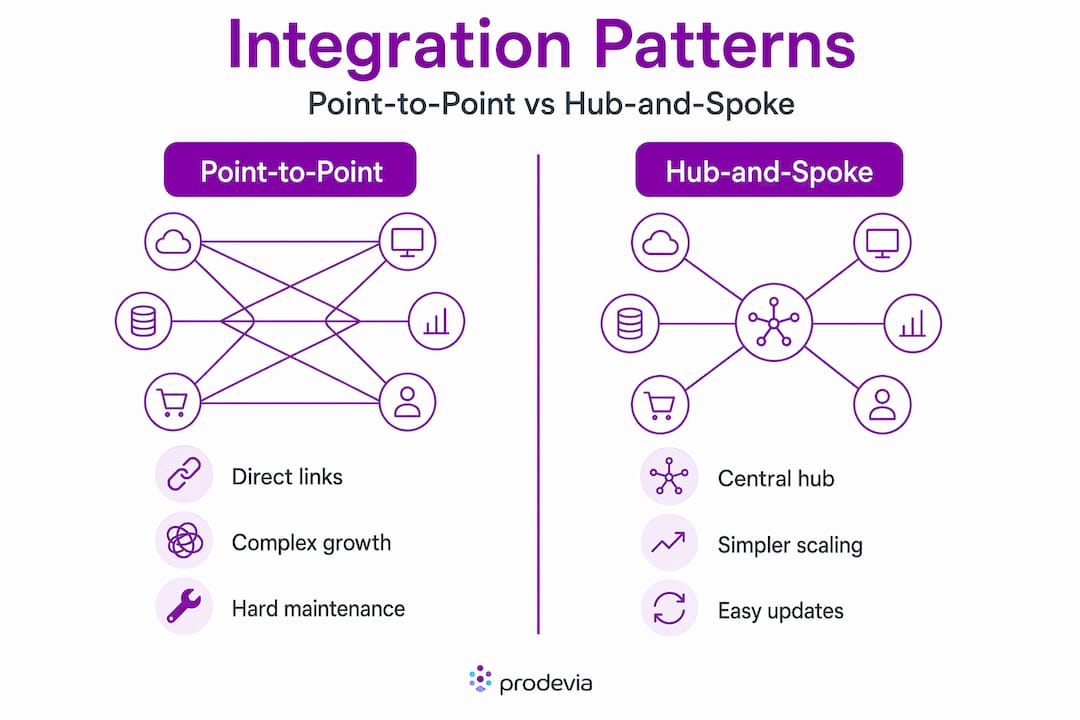
| Pattern | Connections needed | Maintenance burden | Scalability |
|---|---|---|---|
| Point-to-point | N*(N-1)/2 | High, grows exponentially | Poor |
| Hub-and-spoke | N connections total | Centralized and manageable | Strong |
Why integrations fail in practice
The organizational failure mode is predictable. Most organizations under-budget and delay integration work, assigning junior teams to integration tasks long after the core platform project has started. The platform goes live, the integrations appear to work in the demo environment, and within three months the connections are breaking silently, producing bad data, or simply not processing transactions. The core software gets blamed. The actual culprit was the neglected integration layer.
Integration often costs more than the software itself due to inconsistent data schemas and legacy systems. This is not an exaggeration. Global software license spending sits around $300 billion annually. Integration work worldwide costs several times that figure. Budgeting for software while treating integration as a minor line item is one of the most reliably expensive mistakes in enterprise technology.
Pro Tip: In any technology contract involving third-party integrations, negotiate clear service-level agreements for integration uptime, not just platform uptime. Own the accountability for integration health contractually, and assign a named internal owner for each integration before go-live.
How to implement integration that actually holds
Moving from understanding system integration concepts to executing a successful project requires a structured approach. The integration layer pattern reduces long-term costs and avoids operational failures when adopted early. Here is how to do that in practice.
-
Start integration work at project kickoff, not in the final phase. Integration design should begin alongside platform selection. Waiting until the core system is nearly live means you are designing connections under time pressure with incomplete knowledge of both systems.
-
Assign a dedicated integration owner. This person is accountable for integration architecture, testing, monitoring, and post-launch stability. Shared ownership across platform teams is not ownership. It is a gap waiting to cause an incident.
-
Choose your integration approach deliberately. iPaaS platforms like purpose-built middleware tools offer pre-built connectors, visual workflow builders, and managed infrastructure. Custom-built layers give you maximum control but require ongoing engineering investment. The right choice depends on your technical team's capacity and the complexity of your data models. Explore the right integration path for your scale before committing to a platform.
-
Build and enforce a canonical data model early. Define what "customer," "order," and "product" mean once, at the integration layer. Every system connecting to the hub must conform to that model through its adapter. This prevents the silent data corruption that typically surfaces six months after launch.
-
Execute System Integration Testing under realistic load. SIT focuses on inter-module communication and data integrity across system boundaries, sitting after unit testing but before user acceptance testing. Many integration failures only appear under production-level transaction volumes. Testing with synthetic data in a clean environment does not replicate real behavior. SIT must include performance metrics under realistic load to catch the failures that matter.
-
Plan for ongoing maintenance from day one. APIs change. Vendors release new versions. Business requirements evolve. Your integration layer needs a maintenance budget, a monitoring system, and a clear escalation path. Treat it like critical infrastructure because that is exactly what it is.
My perspective on why integration keeps getting undervalued
In my experience, the single biggest reason integration projects fail is not technical. It is political. Integration work is invisible when it works and catastrophic when it does not. That asymmetry makes it easy to cut from budgets and easy to assign to whoever has spare capacity, which is usually the newest member of the team.
What I've seen repeatedly is that the organizations treating integration as a strategic layer, not a technical cost center, consistently outperform those that treat it as plumbing. They move faster. They onboard new tools in days instead of months. They catch data problems before they become compliance problems.
My take on what is system integration technology comes down to this: it is your business's capacity to change. Every time you need to swap a vendor, add a channel, or respond to a regulatory shift, your integration architecture determines how fast and how cheaply you can do it. An organization with a well-designed integration layer has genuine operational agility. One running on point-to-point custom scripts is locked in, paying technical debt on every decision.
I would encourage any business leader reading this to review your current integration architecture the same way you would review your financial controls. Ask who owns it, where the documented responsibilities are, and what would happen if one connection failed silently for 30 days. If you cannot answer those questions quickly, the integration layer deserves your immediate attention. Automation system design grounded in proper integration principles is not a luxury for enterprise organizations. It is the foundation every serious builder needs.
— Tyler
Build on a verified integration architecture
If this article has clarified what system integration is and where your current architecture might have gaps, the next step is translating that understanding into a working system. Starksglobalgroup has built structured blueprints that take the integration concepts covered here and turn them into deployable architectures.

The AI Automation Agency System blueprint provides a layered automation architecture covering tool, system, workflow, and deployment layers, each designed to connect into a coherent operational engine rather than a collection of standalone tools. For organizations ready to build at scale, the Automation Infrastructure Platform provides the full enterprise-grade framework. Every system Starksglobalgroup recommends is tested and verified before it goes into a blueprint. You are building on architecture that has already been validated, not starting from scratch.
FAQ
What is system integration in simple terms?
System integration is the process of connecting separate software systems so they share data and trigger workflows automatically, without manual intervention. The goal is a unified operational environment where each system contributes to and receives from a shared data flow.
Why is system integration important for business operations?
System integration eliminates manual data handling, reduces errors, and enables real-time decision-making. Organizations with properly integrated systems can scale operations without proportionally increasing labor costs or compliance risk.
What is the difference between point-to-point and hub-and-spoke integration?
Point-to-point integration connects systems directly to each other, creating a number of connections that grows exponentially with each new system added. Hub-and-spoke integration routes all connections through a central layer with a canonical data model, keeping complexity manageable as your stack grows.
How does system integration testing work?
System Integration Testing checks how data and workflows behave across connected systems under realistic operating conditions. It sits between unit testing and user acceptance testing, specifically targeting inter-module communication and data integrity rather than individual feature behavior.
How much does system integration typically cost?
Integration work frequently exceeds the cost of the software licenses it connects, particularly when legacy systems and inconsistent data schemas are involved. Integration costs can run several times higher than the software spend itself, which is why treating it as a minor budget line item consistently leads to project failures.