

Most business leaders think about why audit automation systems exist in purely mechanical terms: eliminate manual data entry, cut paperwork, save time. That framing misses roughly 80% of what these systems actually deliver. Audit automation is not about replacing human auditors. It is about redirecting their attention from repetitive, low-judgment work toward the strategic risk analysis your organization actually needs. This article explains the real case for audit automation, covering accuracy gains, team culture, implementation architecture, and what forward-looking risk intelligence looks like in practice.
Table of Contents
- Key takeaways
- Why audit automation systems deliver real business value
- How automation reshapes audit team culture
- Implementing audit automation: tools, layers, and what to avoid
- Continuous auditing and the future of risk oversight
- My take on where most audit functions go wrong
- Build your audit automation architecture with Starksglobalgroup
- FAQ
Key takeaways
| Point | Details |
|---|---|
| Efficiency gains are measurable | Audit automation reduces time on repetitive tasks by 30 to 50 percent, cutting total audit cycle time significantly. |
| Accuracy improves through full-population testing | Automated systems test entire data populations, not samples, catching anomalies that manual sampling consistently misses. |
| Team engagement increases with automation | 38% of audit leaders report measurable engagement and well-being improvements when automation frees staff from low-value work. |
| Start mechanical before going AI | Building foundational task automation first creates the data hygiene and team readiness required for advanced AI to succeed. |
| Continuous oversight replaces periodic reporting | Real-time dashboards and automated controls shift audit from backward snapshots to proactive risk intelligence. |
Why audit automation systems deliver real business value
The efficiency argument for audit automation is well documented, and the numbers are worth stating precisely. Industry data shows that organizations reduce time on manual, document-heavy audit tasks by 30 to 50 percent, with some workflows seeing total audit time cuts of up to 40 percent. For a compliance team running quarterly financial audits, that time compression changes what is operationally possible.
The accuracy gains are equally significant. Manual data entry error rates in auditing range from 1 to 3 percent. That sounds small until you apply it to a dataset of 500,000 transactions. Automated OCR and matching technologies reduce these errors and, more importantly, enable something sampling-based approaches cannot: full-population testing. When you test the entire population of transactions rather than a statistical sample, you catch anomalies that samples are structurally designed to miss.
Cost savings scale accordingly. One organization using a unified audit automation platform saved $1 million by reducing false positive audit alerts by 98 percent and consolidating fragmented tools into a single architecture. That result did not come from cutting staff. It came from eliminating the noise that consumed analyst time and created investigation backlogs.
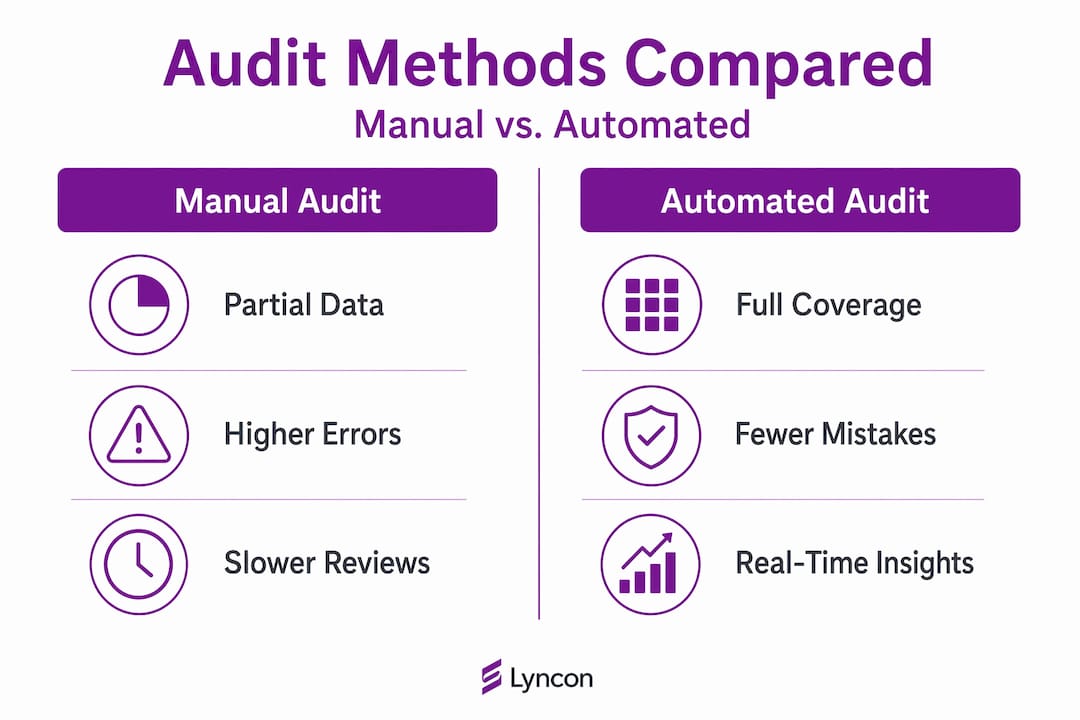
Here is how the core benefits compare across manual and automated audit approaches:
| Capability | Manual audit | Automated audit |
|---|---|---|
| Data coverage | Sampling (5 to 15% of population) | Full population testing |
| Error rate | 1 to 3% data entry errors | Near zero with verified OCR |
| Cycle time | Weeks to months | Days to weeks |
| False positive rate | High, based on sampling variance | Significantly reduced |
| Scalability | Limited by headcount | Scales with data volume |
Pro Tip: Start your automation investment with the most mechanical, rule-based tasks first. Document collection, data formatting, and reconciliation workflows are good candidates. These deliver fast ROI and build the team's confidence before you introduce more complex AI-driven capabilities.
The hidden ROI of automation compounds over audit cycles. Each automated workflow that runs cleanly is institutional knowledge encoded into a repeatable system, not locked inside a single auditor's head.
How automation reshapes audit team culture
There is a detail about audit automation that rarely appears in vendor materials: it makes audit teams want to stay. That is not an incidental benefit. Auditor turnover is an expensive, recurring problem for compliance functions, and its root cause is often the grinding, repetitive nature of manual audit work.

38% of internal audit leaders report that higher engagement and well-being, driven by automation shifting auditors toward strategic tasks, measurably improves organizational culture. When auditors spend their days on risk analysis, stakeholder advisory, and judgment-intensive decisions instead of formatting spreadsheets, the work becomes professionally meaningful again.
The organizational shift looks like this in practice:
- Auditors move from data collectors to data interpreters, spending time on what the numbers mean rather than gathering them.
- Junior staff develop analytical skills faster because they are exposed to risk reasoning earlier in their careers.
- Audit teams gain credibility with operational leaders because they show up with insights, not just findings.
- Retention improves because the work aligns with why most audit professionals entered the field.
Automation improves retention and motivation by freeing professionals from repetitive tasks and giving them access to advisory roles that match their training. That cultural shift has a compounding effect on institutional knowledge, team cohesion, and the quality of output that audit committees actually receive.
Pro Tip: When rolling out audit automation, involve your senior auditors in designing the automated workflows. Their process expertise shapes better systems, and their buy-in accelerates adoption across the team. Automation imposed from above without practitioner input tends to stall.
For compliance officers thinking about enterprise-scale culture shifts, audit automation is one of the highest-leverage interventions available. It changes what the team does every day, which changes how they develop, which changes what the function delivers.
Implementing audit automation: tools, layers, and what to avoid
Understanding why audit automation systems produce results requires knowing what they are actually built from. The technology stack typically involves three layers working together.
The first layer handles mechanical tasks: OCR for document extraction, automated matching of invoices to purchase orders, and rules-based flagging of transactions that fall outside defined parameters. This layer is well established, reliable, and the right place to start.
The second layer adds AI-augmented capabilities: anomaly detection across full transaction populations, pattern recognition in historical data, and risk scoring that adjusts based on incoming signals. This layer requires clean, structured data to function correctly. Without the mechanical layer working well first, AI-driven capabilities underperform.
The third layer is workflow and deployment logic: the architecture that connects tools, manages handoffs between automated and human review steps, and produces the documentation required for certification.
Here is a structured approach to implementation that we have seen work consistently:
- Map your existing audit processes in detail before selecting any tools. Identify which tasks are purely mechanical and which require judgment.
- Automate the mechanical layer first. Document collection, data normalization, and reconciliation are good starting points with fast, measurable ROI.
- Establish data quality standards before deploying AI anomaly detection. Garbage-in produces garbage-out at scale.
- Integrate systems through verified APIs rather than manual exports and imports. Data integrity between systems is the foundation of audit reliability.
- Deploy AI capabilities in phases, starting with low-stakes workflows where human review can catch errors before they compound.
- Build audit-ready documentation for every automated workflow so outputs meet certification and regulatory requirements.
Implementing AI-driven audit automation without solid foundational task automation in place frequently fails. The organizations that succeed build the mechanical layer first, create data hygiene as a byproduct, and then introduce AI capabilities into a stable architecture.
The most important caution: AI cannot audit itself. AI outputs are management representations, not independent audit evidence. Human oversight remains mandatory for certification and for maintaining the independent judgment that gives audits their legal and regulatory standing. Automation augments auditors. It does not replace the professional accountability that makes an audit valid.
Automation transparency is not optional when AI is involved in audit workflows. Every automated decision point needs a documented logic chain that a human reviewer can interrogate and that regulators can evaluate.
Pro Tip: Build a parallel-run period into your implementation plan. Run automated and manual processes simultaneously for at least one audit cycle. This lets you validate automated outputs against established results before you rely on them fully.
Continuous auditing and the future of risk oversight
The most forward-looking reason to understand why audit automation systems matter is what they enable at scale: continuous auditing instead of periodic reporting. Traditional audit cycles produce a snapshot of compliance and risk at a point in time. By the time the report reaches the audit committee, the conditions it describes may have changed materially.
Continuous monitoring changes that dynamic fundamentally. Real-time dashboards and automated controls reduce exposure windows for control failures by enabling faster remediation and embedding operational discipline directly into workflows. Issues surface within days rather than quarters.
The impact on risk management is structural:
- Control failures are identified and remediated before they compound into material misstatements.
- Anomaly alerts give compliance officers early warning on emerging risk patterns, not post-hoc documentation of problems that already occurred.
- Audit committees receive forward-looking risk intelligence instead of backward-facing compliance snapshots.
- Regulatory disclosure obligations become easier to meet because monitoring data is continuously collected and structured.
"Automation enables a shift from historical reporting to forward-looking risk intelligence that audit committees trust for faster decision-making."
Process mining and continuous control monitoring technologies provide the foundation for this shift, moving audit from reactive detection to proactive operational discipline. The organizations that build these capabilities now are the ones whose audit functions will be genuinely useful to leadership in 2026 and beyond, rather than functioning as backward-looking compliance checkboxes.
Audit automation advantages also extend to scalability. As organizations grow, their transaction volumes, regulatory complexity, and geographic spread all increase. A manual audit function does not scale without proportional headcount increases. An automated architecture scales with the data.
My take on where most audit functions go wrong
I have watched compliance teams invest in audit technology and get half the results they should. The pattern is consistent. They buy capable tools, deploy them on top of broken or inconsistent processes, and then blame the technology when outcomes disappoint.
In my experience, the organizations that get the most from audit automation are the ones that do the unglamorous work first: documenting their existing workflows precisely, cleaning up data structures, and getting stakeholder alignment before they touch a single tool. Automation is most successful when it is accompanied by disciplined process reform, not treated as a substitute for it.
The other mistake I see repeatedly is treating AI as a shortcut past mechanical automation. Teams want the anomaly detection and predictive risk capabilities, and they want them immediately. But those capabilities require clean, consistently structured data to function. Skipping the mechanical layer to get to the AI layer is like building the top floor of a structure before laying the foundation.
What actually works is less exciting to pitch but more reliable in practice: start small, validate every automated output against manual results, and expand only when the system has proven itself. The audit functions that take this approach build something durable. The ones that chase the most sophisticated tools first often spend two years troubleshooting instead of auditing.
Audit automation is one of the best investments a compliance function can make. But the investment has to be made in the right order, with the right expectations, and with human judgment kept firmly in the loop.
— Tyler
Build your audit automation architecture with Starksglobalgroup
At Starksglobalgroup, we build automation systems as connected architectures, not collections of standalone tools. The same engineering principles that apply to enterprise automation apply directly to audit workflows: verified tools, tested integrations, structured deployment logic, and documented outputs that hold up under scrutiny.

If you are ready to move from evaluating audit automation concepts to building a system that works in production, the AI Affiliate Blueprint gives you a structured starting point for integrating AI tools into audit-capable workflows. For a broader view of the tools and systems we have tested and verified, the automation marketplace covers the full stack. We do not recommend tools we have not run through our own validation process. That independence is what makes our recommendations worth acting on.
FAQ
What are the main benefits of audit automation?
Audit automation reduces time on repetitive tasks by 30 to 50 percent, lowers data entry error rates significantly compared to manual processes, and enables full-population testing instead of sampling. It also shifts audit team focus toward strategic risk analysis, which improves engagement and retention.
Why use audit technology instead of expanding the manual team?
Audit technology scales with data volume without requiring proportional headcount increases. A manual team's capacity is fixed. An automated architecture handles growing transaction volumes, multiple regulatory frameworks, and continuous monitoring simultaneously, at a fraction of the marginal cost of additional staff.
How does audit automation support continuous risk management?
Automated controls and real-time dashboards surface control failures within days rather than quarters, enabling faster remediation before issues become material. This shifts audit committees from reviewing backward compliance reports to receiving forward-looking risk intelligence they can act on immediately.
Can AI fully replace human auditors?
No. AI outputs are management representations, not independent audit evidence. Human oversight remains mandatory for certification and regulatory compliance. AI augments auditor capacity and precision, but the professional judgment and accountability that make an audit valid must remain with a qualified human reviewer.
What is the right order for implementing audit automation?
Start with mechanical task automation: document collection, data formatting, and reconciliation. Once those workflows are stable and producing clean data, introduce AI-driven anomaly detection and risk scoring. Skipping the foundational layer to deploy advanced AI first is the most common implementation failure in audit automation programs.