

Most AI deployments don't fail because the technology is wrong. They fail because there's no repeatable system behind them. AI software blueprints change that equation entirely. A blueprint is not a one-off design document or a vendor pitch deck. It's a structured, reusable framework that codifies governance, workflows, roles, and architecture so your organization can deploy AI at scale with consistency and accountability. This guide breaks down what blueprints are, how industry leaders architect them, and how you can apply these frameworks to build AI automation that actually holds up under real operational pressure.
Table of Contents
- What are AI software blueprints and why do they matter?
- Leading AI blueprint architectures and frameworks
- Key principles for building scalable AI automation with blueprints
- Applying AI software blueprints to enterprise automation workflows
- Why most AI blueprint projects stall and how to win with operational rigor
- Explore AI software blueprints with Starks Global Group's systems
- Frequently asked questions
Key Takeaways
| Point | Details |
|---|---|
| Blueprints standardize AI deployments | AI software blueprints provide structured frameworks that enable scalable and repeatable AI automation projects. |
| Maturity gates prevent risk | Implement staged pilot evaluations for user value, technical feasibility, and operational repeatability before scaling AI solutions. |
| Architectural modularity matters | Multi-agent and event-driven designs support robust, maintainable AI workflows that adapt to complex enterprise needs. |
| Governance roles are essential | Clear assignment of AI owner, data steward, platform owner, and business process owner roles ensures accountability and trust. |
| Operational metrics drive success | Define business, AI contribution, technical, and governance metrics to monitor performance and maintain control over AI systems. |
What are AI software blueprints and why do they matter?
An AI software blueprint is a formal, repeatable pattern for deploying artificial intelligence within an enterprise. Think of it the way a construction firm uses engineered drawings: every team member follows the same verified design, every layer has a defined purpose, and nothing gets built without a clear specification.
Enterprise AI blueprints define roles, maturity gates, and repeatable processes to scale AI with trust and operational repeatability. That single design decision separates organizations that scale AI from those that accumulate expensive pilots with no path forward.
Here is what a complete AI blueprint typically defines:
- AI owner: Accountable for value delivery and business outcomes
- Data steward: Manages data quality, access, and lineage
- Platform owner: Owns infrastructure, deployment, and tooling
- Business process owner: Aligns AI outputs with operational workflows
- Maturity gates: Checkpoints including pilot value proof, technical feasibility, and operational repeatability before any use case advances to full production
These elements are not bureaucratic overhead. They are the exact mechanisms that prevent shadow AI, where teams deploy unapproved models outside governance frameworks, creating compliance exposure and data liability. Without a blueprint, you end up with dozens of disconnected AI experiments instead of a functioning, scalable system.
Understanding the automation system fundamentals that support AI-driven growth gives you the foundation to apply these blueprints effectively across departments.
Leading AI blueprint architectures and frameworks
The market now includes well-validated AI blueprint architectures from major technology organizations. Each takes a different approach to the core challenge of deploying AI reliably at scale.
| Blueprint | Primary focus | Deployment model | Best for |
|---|---|---|---|
| NVIDIA AI-Q v2.0.0 | Multi-agent research orchestration | Docker / Kubernetes | Complex, tunable agent workflows |
| Microsoft Foundry AI templates | Rapid app deployment | Azure services | Fast time-to-production teams |
| Google ADK | Durable long-running agents | Event-driven webhooks | Human-in-the-loop workflows |
NVIDIA AI-Q Blueprint takes a modular multi-agent approach. The v2.0.0 release uses a YAML-configurable architecture deployable via Docker or Kubernetes in under 30 minutes. The key advantage is that operators can tune the entire workflow behavior through configuration files without touching the underlying code. That reduces engineering overhead significantly and makes it practical for teams without deep ML expertise to customize AI behavior for their specific data environments.

Microsoft Foundry AI templates address a different problem. Foundry templates enable rapid deployment of agentic applications with production readiness testing and modular Azure services already integrated. If your organization is already in the Azure ecosystem, these AI application templates remove weeks of integration work. The modular design means you can swap components as needs evolve without rebuilding from scratch.
Google ADK focuses on workflow durability. Long-running AI agents built with Google ADK use durable state machines and event-driven webhooks to manage persistent context, even when processes pause for human review or external approvals. This matters enormously in enterprise settings where a workflow might span hours or days.
Pro Tip: Match the blueprint to the workflow type, not just the tech stack. If your highest-value workflows involve multi-step human approvals, Google ADK's event-driven model prevents data loss and compute waste more effectively than a templated deployment approach.
You can see how these architectural patterns translate into deployable systems in our AI automation agency system and across our automation system design strategies.
Key principles for building scalable AI automation with blueprints
Choosing a blueprint architecture is only the first step. Deploying it well requires a set of operating principles that most teams skip in the excitement of getting something working.
Here are the five principles we consider non-negotiable:
-
Design with a layered control plane. Enterprise AI architecture requires investment in unified control planes covering security, FinOps, and model governance to turn pilots into sustained value. Without this layer, cost overruns and security gaps compound quickly at scale.
-
Write a lightweight charter for every AI use case. Charters with SLOs, monitoring requirements, and retirement criteria prevent shadow AI and establish operational accountability from day one. An SLO (service level objective) is simply a defined performance target, for example, "this invoice processing agent must complete 95% of tasks within 60 seconds."
-
Define clear ownership and governance roles. Every deployed AI system needs named owners for business outcomes, data quality, and infrastructure. Ambiguous ownership is the single fastest path to unmanaged model drift and compliance failure.
-
Build with composable, modular agents. Monolithic AI systems are hard to maintain and nearly impossible to upgrade without downtime. Modular agent design lets teams update a single function without touching the whole system.
-
Enforce staged maturity gates. Validate user value first, then technical feasibility, then operational repeatability. In that order. Jumping straight to scale without passing each gate is where most AI investments stall.
Pro Tip: Treating retirement criteria as an afterthought is a common and costly mistake. Define upfront when a model or agent will be decommissioned, what performance threshold triggers a review, and who makes that call. This prevents technical debt from accumulating silently.
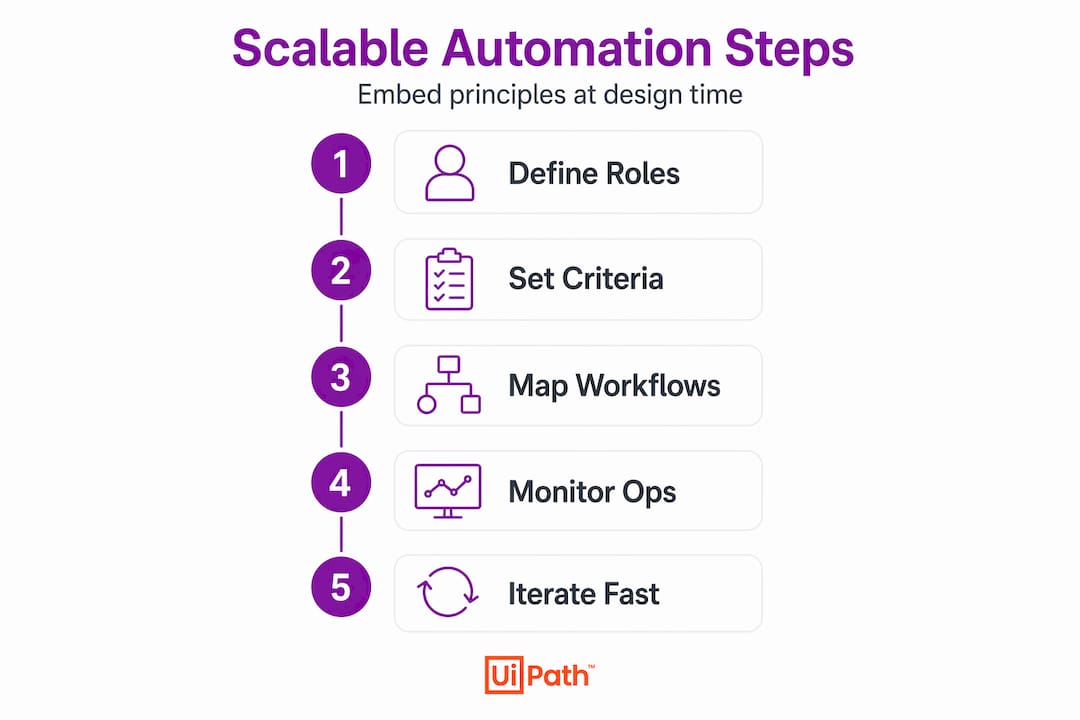
Building high-efficiency workflows with scalable AI depends on these principles being embedded at design time, not retrofitted later. Our system blueprints overview shows how we apply each layer in practice.
Applying AI software blueprints to enterprise automation workflows
With the right architecture and principles in place, the operational mechanics become much more manageable. Here is how well-designed AI system frameworks translate into real automation workflows.
Configuration-driven workflow tuning is one of the most underused capabilities in modern AI toolkits. NVIDIA AI-Q's YAML configurations let operators tune workflows and integrate enterprise data sources without code changes. In practice, this means a business analyst can adjust agent behavior for a new product line without waiting for an engineering sprint.
Event-driven workflow management solves the long-running process problem. Google ADK patterns use webhook-driven event resumption and multi-agent delegation specifically for workflows where human approval steps or external system delays are unavoidable. The workflow pauses at the event, holds its state securely, and resumes exactly where it stopped.
The following table maps common enterprise automation scenarios to the blueprint capabilities that address them:
| Enterprise scenario | Blueprint capability | Key benefit |
|---|---|---|
| Invoice processing with approval gates | Event-driven webhook resumption | No lost context on paused workflows |
| Customer support automation | Multi-agent delegation | Specialized sub-agents handle complex edge cases |
| Compliance document review | YAML config tuning | Adjust rules without redeployment |
| Sales pipeline qualification | Modular agent orchestration | Update scoring logic independently |
| Data ingestion from on-premises systems | Private data connectors | Governance and security maintained |
Additional capabilities that apply across blueprint types:
- Built-in evaluation tools benchmark factual accuracy and response quality continuously, not just at launch
- On-premises data connectors maintain privacy controls when integrating with internal systems
- Sub-agent delegation preserves reasoning quality over long workflows by keeping each agent focused on a narrow task
Explore how these mechanics operate inside fully deployed systems through our resources on scalable AI automation systems and our automation tools comparison.
Why most AI blueprint projects stall and how to win with operational rigor
Here is the uncomfortable pattern we see repeatedly: organizations invest in the right blueprint architecture, onboard the right tooling, and still see their AI initiatives stall within 12 months. The technology is rarely the problem.
What fails is the operating model. Teams treat AI as a series of projects instead of a continuously managed capability. When the initial pilot succeeds, pressure builds to scale immediately. Governance gets skipped. Metrics are never defined. Nobody owns model performance after launch.
Skipping maturity gates causes premature scaling failures, and operational repeatability is the critical factor that separates sustainable AI adoption from expensive dead ends. This is not theoretical. An enterprise that deploys 20 AI agents without passing each maturity gate is not 20 times more capable. It is 20 times more exposed.
The leaders who succeed treat every AI use case like a product with a lifecycle. There is a launch phase, an active operations phase, a performance review cycle, and a retirement process. Charters define what "good" looks like in measurable terms. Governance roles are named people, not abstract titles. And when a model starts drifting or underperforming against its SLOs, the retirement criteria trigger a structured response rather than a fire drill.
The most durable AI organizations we observe also build a culture of continuous evaluation. They do not assume a model that worked last quarter will work this quarter. Market conditions change. Data distributions shift. User behavior evolves. Embedding benchmark tools and audit schedules into the operational blueprint, not just the technical one, is what keeps AI systems trustworthy over time.
Learn more about building this type of sustainable infrastructure in our guide to scalable automation systems.
Explore AI software blueprints with Starks Global Group's systems
If you are ready to move from concept to deployed system, we have built the architecture to get you there without starting from scratch.

At Starks Global Group, our system blueprints are designed as fully connected architectures, not collections of stand-alone tools. Each blueprint includes verified components across tool, system, workflow, and deployment layers. The AI Automation Agency System blueprint gives you a production-ready multi-agent framework built on tested orchestration patterns, and the AI Chatbot Sales Closer blueprint delivers a proven conversational automation system for revenue-focused workflows. Every system we publish is tested before it is recommended, so you deploy with confidence, not guesswork.
Frequently asked questions
What exactly is an AI software blueprint?
An AI software blueprint is a structured framework that defines roles, workflows, governance, and architectures to deploy scalable, repeatable AI automation solutions in enterprises. Enterprise AI blueprints codify governance, roles, and processes for safe, scalable AI across the organization.
How do AI blueprints help with scaling AI projects?
They establish maturity gates, standard operating procedures, and clear ownership models to ensure pilots prove value and operational repeatability before scaling, reducing both risk and wasted effort. Maturity gates prevent premature scaling and confirm operational readiness for AI pilots moving to production.
Which companies provide leading AI software blueprint solutions?
NVIDIA with AI-Q Blueprint, Microsoft with Foundry AI templates, and Google with the Agent Development Kit offer proven AI blueprint architectures tailored to different enterprise needs. NVIDIA, Microsoft, and Google each take a distinct architectural approach to address multi-agent orchestration, rapid deployment, and durable long-running workflows.
What common mistakes should business leaders avoid when adopting AI blueprints?
Avoid rushing pilots to scale without operational repeatability proof, neglecting governance roles, or launching without continuous evaluation and monitoring frameworks. Skipping maturity gates and governance is the primary reason AI projects stall or fail at scale, not the underlying technology.