

Most enterprise leaders have invested in automation tools. They've run pilots, seen promising early results, and then watched those results stall before delivering real, organization-wide impact. 61.3% of enterprises say their automation tools are underutilized due to fragmented strategies and siloed implementation. The problem is rarely the software. It's the absence of a coherent architecture that connects tools into a functioning, governed system. This article breaks down what enterprise automation actually means, what makes it work at scale, and how to avoid the structural mistakes that keep most organizations stuck in pilot mode.
Table of Contents
- What is enterprise automation?
- Key components: Integration, AI, and governance
- How enterprise automation creates value
- Common pitfalls and how to avoid them
- Why end-to-end discipline beats quick wins in enterprise automation
- Accelerate your enterprise automation journey
- Frequently asked questions
Key Takeaways
| Point | Details |
|---|---|
| End-to-end automation | True enterprise automation orchestrates processes across the entire organization, not just isolated tasks. |
| Governance matters | Sustained success depends on governance, compliance, and phased rollouts—not just technology. |
| Integration is critical | Connecting systems and data is essential to move beyond pilots to scalable automation outcomes. |
| AI amplifies value | Modern automation leverages AI to handle variability and drive superior decision-making. |
| Quick wins are risky | Shortcuts may limit ROI; strategic, orchestrated automation delivers long-term value. |
What is enterprise automation?
Now that we've acknowledged the gap in results from basic tool adoption, it's essential to clarify what qualifies as enterprise automation.
Enterprise automation is not about replacing humans with bots or purchasing the most sophisticated software on the market. At its core, it is the practice of connecting, digitizing, and coordinating core business processes across an entire organization, from procurement and HR to finance and customer operations, into a unified, governed system.
This definition matters because it draws a sharp line between task automation and enterprise automation. Task automation handles a single, repetitive step, such as generating a weekly report or sending a notification email. Enterprise automation operates at a different level entirely. It orchestrates entire workflows, routes decisions intelligently, and produces measurable outcomes at scale.
"For enterprise leaders, 'enterprise automation' usually implies an architecture: orchestrate workflows across systems (integration + workflow engine), embed AI/decisioning where variability exists, and govern outcomes (monitoring, compliance/audit, human escalation)."
The pillars that define genuine enterprise automation are:
- Integration: Connecting disparate systems such as CRM, ERP, and supply chain platforms into a single operational layer so data flows without manual intervention.
- Workflow orchestration: Managing the sequence, timing, and routing of tasks across multiple systems and teams so processes execute predictably and efficiently.
- Intelligent decisioning (AI): Applying machine learning and rules engines to handle process variability, classify inputs, and make real-time decisions without human bottlenecks.
- Governance and monitoring: Maintaining audit trails, enforcing compliance requirements, and flagging anomalies so every automated action can be traced, reviewed, and corrected.
Understanding automation system fundamentals is the starting point for building this architecture correctly. As the data confirms, automation success is often constrained less by having tools and more by governance and orchestration. That distinction is what separates high-performing automation programs from collections of disconnected bots.
Key components: Integration, AI, and governance
With the definition outlined, let's break down the three pillars that make enterprise automation work in the real world.
1. Integration: The connective layer
Enterprise automation without integration is simply a faster version of the same siloed process. True integration means your CRM communicates with your ERP, your ERP feeds your financial planning system, and your customer-facing tools sync with back-office workflows in real time. Without this connective layer, automation efforts create speed in one silo while generating bottlenecks at every handoff point.

There are multiple approaches to achieving integration, from API-based connections to middleware platforms and event-driven architectures. Understanding system integration types helps leaders select the right approach for their existing technology stack rather than defaulting to the most popular option.
2. AI and intelligent decisioning
Most business processes contain variability. Documents arrive in different formats. Customers submit requests that don't fit a predefined category. Supplier data changes without notice. Rule-based automation breaks down precisely where this variability exists. AI fills this gap by learning from patterns, classifying inputs, and routing exceptions to the right human or system for resolution.
AI-driven process automation is most effective when embedded at the points of highest variability in a workflow, not applied broadly across every step. For example, AI can interpret unstructured invoice data and extract the fields needed for payment processing, but the approval and payment steps themselves may require straightforward rule-based logic. Knowing where to place AI and where not to is a critical design decision.
A practical AI workflow guide can help teams map process variability before deciding where AI intervention adds the most value.
3. Governance: The accountability layer
Governance is the component most organizations skip when they're eager to show automation results quickly. This is the most expensive shortcut they can take. Without governance, automated processes operate without oversight, produce outputs that can't be audited, and create compliance exposure that grows invisibly over time.
Effective governance includes defined ownership for each automated workflow, monitoring dashboards that surface anomalies, human escalation paths for exceptions, and regular review cycles to update automation logic as business conditions change.
The 2026 AI Automation Benchmark Report identifies key failure modes clearly: edge cases that break automation projects include changing user interfaces, process variability in inputs and documents, and failure to connect or govern data across systems. AI helps address variability, but governance and integration remain the critical foundations.
Pro Tip: Before deploying any automated workflow, document the failure modes. Define what happens when the automation encounters an input it wasn't designed to handle. A workflow without a documented failure path is a compliance risk, not a productivity gain.
How enterprise automation creates value
Understanding the pillars, what can organizations tangibly expect to gain from investing in enterprise automation?
The business case for enterprise automation is well-supported by current data. 73% of companies increased their automation spend, and nearly 40% report at least 25% cost reduction as a direct result. These aren't marginal gains. They represent structural shifts in how operating costs are allocated across the enterprise.
The value delivered by enterprise automation spans four distinct dimensions:
| Value Dimension | What It Delivers | Example Outcome |
|---|---|---|
| Cost reduction | Fewer manual touchpoints, lower error-correction costs | 25%+ reduction in processing costs |
| Speed | Faster cycle times from order to fulfillment or invoice to payment | 60% reduction in approval turnaround time |
| Compliance | Automated audit trails, real-time policy enforcement | Near-zero manual compliance gaps |
| Scalability | Handle higher transaction volumes without proportional headcount growth | 3x volume capacity without new hires |
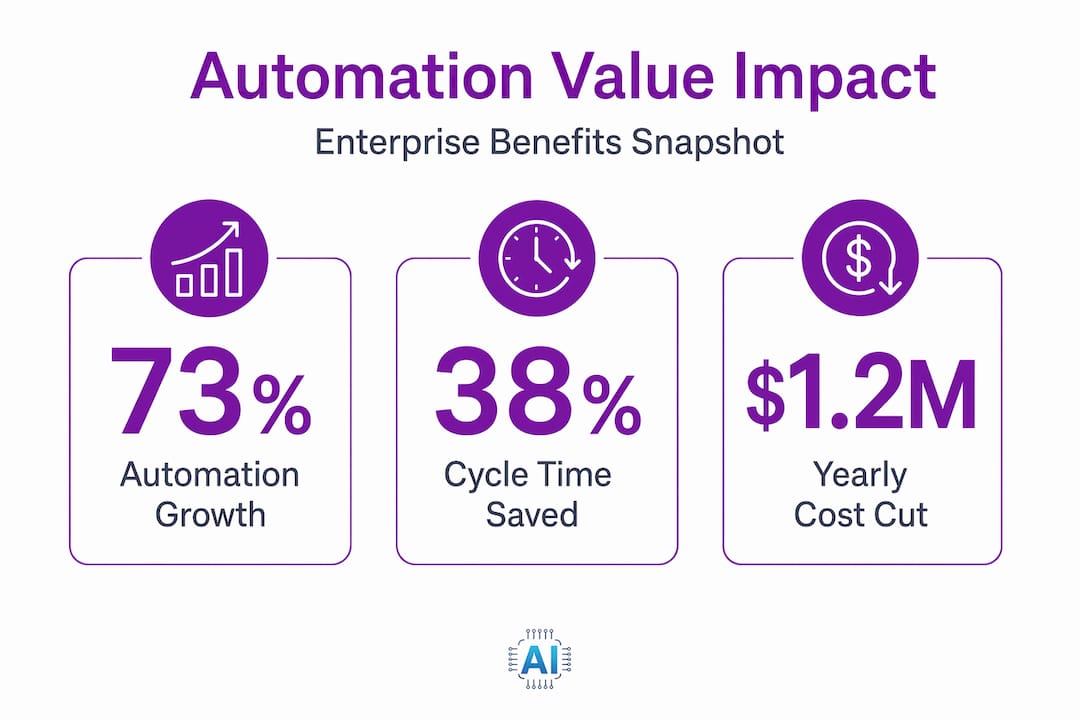
Beyond the numbers, enterprise automation creates compounding value. When a finance team automates invoice processing, it frees analysts to focus on variance analysis and forecasting. When procurement automation connects to supplier systems, it produces real-time visibility into supply constraints before they become delivery failures.
Additional benefits include:
- Consistent quality: Automated processes execute identically every time, eliminating the variability that comes from human fatigue or inconsistent training.
- Data leverage: Every automated step generates structured data that can be analyzed for further process improvement.
- Employee focus: When routine work is automated, skilled employees redirect their capacity toward decision-making, relationship management, and strategic tasks.
For leaders developing automation strategies for 2026, the priority should be identifying the processes where automation can deliver compounding value across multiple dimensions simultaneously, not just cost reduction in isolation. A useful resource for understanding this broader impact is this guide on using AI to grow business.
Common pitfalls and how to avoid them
Delivering results with automation means learning from others' mistakes. Here's how to avoid the most common issues enterprises face.
The data on automation failure is sobering. Fewer than 6% of organizations achieved end-to-end autonomous automation in any core process. The vast majority are operating collections of isolated automations that deliver local efficiency without enterprise-wide impact.
The most common pitfalls follow a predictable pattern:
- Deploying automation without a process audit. Automating a broken process produces broken results faster. Map the current process, identify inefficiencies, fix the logic, then automate.
- Launching too broadly, too fast. Organizations that attempt organization-wide deployment without phased governance expose themselves to compounding failures that are difficult to trace and costly to reverse.
- Neglecting change management. Automation affects how people work. Without structured change management, employees route around automated workflows, generating shadow processes that undermine the system.
- Building without monitoring. Automated workflows drift as underlying systems change. An invoice processing workflow built for one ERP version may break silently after a system update if there is no active monitoring in place.
- Treating governance as optional. Compliance and audit requirements don't disappear because a process is automated. If anything, they become more critical because automated errors replicate at scale before they're detected.
"A practical implementation nuance: treat automation rollout as a phased program with decision gates and governance, rather than attempting to deploy enterprise-wide in one leap (to manage risk and learn)."
A structured approach to automation system design strategies builds these decision gates into the deployment architecture from the start. This means each automation phase has defined success criteria, a review checkpoint, and a governance sign-off before expanding to the next layer.
A responsible automation checklist looks like this:
- Audit the process before automating it.
- Define the scope and boundaries of the first deployment phase.
- Set measurable success criteria for the pilot.
- Build monitoring dashboards before the workflow goes live.
- Document failure paths and human escalation procedures.
- Conduct a structured review at the end of each phase.
- Apply learnings before expanding to the next phase.
Pro Tip: Resist the pressure to show broad automation coverage quickly. A single, well-governed, end-to-end automated process delivers more reliable ROI than ten partially automated workflows with no oversight layer. Depth before breadth is the right design principle.
Reviewing current industry benchmarks from the AI automation benchmark data confirms that organizations following phased, governed approaches consistently outperform those pursuing rapid, broad deployments.
Why end-to-end discipline beats quick wins in enterprise automation
Having explored common pitfalls, let's offer a candid perspective on what actually makes automation succeed at enterprise scale.
We've seen this pattern repeatedly. An organization invests in a well-known automation platform, assigns a team to deploy use cases quickly, and measures success by the number of automations launched. Twelve months later, the audit reveals dozens of workflows running with no owner, three of which are producing incorrect outputs, and none of which connect to each other in any meaningful way.
This is the predictable outcome of optimizing for quick wins instead of end-to-end discipline.
The hard truth is that quick-fix automations feel productive. They generate visible activity. They're easy to demonstrate in executive reviews. But they create technical debt in the automation layer that is just as damaging as technical debt in software development. Every ungoverned bot is a liability. Every siloed workflow is a ceiling on what the enterprise can achieve.
The organizations that achieve compounding returns from automation are not the ones that deploy the most automations. They are the ones that build the most coherent automation architectures. They invest in integration before they invest in additional tools. They define governance structures before they scale deployments. They measure outcomes, not output.
Automation tools are underutilized due to fragmented strategies and siloed implementation. This is not a technology problem. It is a strategy and discipline problem. The technology available today is more than capable of delivering enterprise-wide automation at scale. The gap is in how organizations approach architecture and governance.
Our recommendation is direct: commit to the harder path. Build your automation architecture as a connected system from the first deployment. Invest in orchestration before you invest in additional capability. Treat governance as a design requirement, not an audit function. Leaders who adopt this discipline early are building scalable AI automation systems that compound in value over time, while their peers restart fragmented pilots year after year.
Accelerate your enterprise automation journey
For leaders ready to build on this foundation and accelerate their enterprise automation success, the right resources can make all the difference.
At Starks Global Group, we've built a platform specifically for organizations that are serious about moving beyond isolated automations into structured, scalable systems. Our resources are designed for decision-makers who want to deploy automation with engineering-grade discipline, not just run pilots.

Our enterprise automation blueprints provide detailed, layered architecture plans that cover integration, workflow orchestration, AI decisioning, and governance in a single connected structure. For teams looking to embed AI into their automation stack with a clear implementation path, our AI blueprint for automation offers a verified, step-by-step framework built on tested tools and proven deployment logic. Explore both resources and start building automation infrastructure that scales with your business.
Frequently asked questions
What is the difference between enterprise automation and RPA?
RPA (Robotic Process Automation) handles specific repetitive tasks, while enterprise automation integrates processes and systems across an entire organization for holistic value. As automation architecture frameworks confirm, true enterprise automation orchestrates workflows across systems, embeds AI where variability exists, and governs outcomes at every layer.
How do you measure success with enterprise automation?
Success is measured by outcomes like cost reduction, faster cycle times, improved compliance, and scalability, not just the number of bots launched. Nearly 40% of companies report at least 25% cost reduction from automation, which reflects the kind of outcome-level measurement that matters.
Why do most enterprise automation projects stall?
Most projects stall due to fragmented strategies, lack of integration, and poor governance, not technology limitations. Automation tools are underutilized specifically because organizations deploy them in silos without a coherent architecture connecting them.
What is a best practice for scaling automation in large organizations?
Treat automation rollout as a phased program with decision gates and governance to manage risk and learn from pilots. Phased deployment with structured review checkpoints consistently outperforms broad, rapid rollouts in both reliability and long-term ROI.