

Automation is often sold as a headcount reduction strategy, but that framing misses most of the real value. Organizations automate to improve operational efficiency and accuracy by reducing manual work, accelerating workflows, and minimizing errors. The leaders who capture the largest returns are not the ones cutting the most jobs. They are the ones rebuilding their operational architecture to be faster, more accurate, and structurally ready for growth. This guide covers exactly what drives automation ROI, where the biggest gains live, and what traps to avoid before you commit resources.
Table of Contents
- Why organizations automate: More than just saving time
- The business value of automation: Efficiency, accuracy, and ROI
- Scaling smart: How automation unlocks growth
- How not to automate: Common pitfalls and smarter strategies
- Action plan: Steps to maximize automation success
- Why the real value of automation lies beyond technology
- Unlock your automation advantage with proven blueprints
- Frequently asked questions
Key Takeaways
| Point | Details |
|---|---|
| Efficiency boost | Automation drastically cuts manual work and minimizes operational errors. |
| Scalability | Automated processes help your business handle growth without scaling up resources. |
| High ROI | Strategic automation delivers a rapid payback period and impressive long-term returns. |
| Pitfall avoidance | Optimizing workflows before automation prevents amplifying existing inefficiencies. |
| Human expertise | True success blends smart technology with organizational process knowledge. |
Why organizations automate: More than just saving time
The popular assumption is that automation means replacing workers with software to reduce costs. That is partially true, but it is a narrow lens. The actual drivers behind enterprise automation decisions go several layers deeper.
Operational efficiency is the most cited benefit, and for good reason. When you remove manual handoffs from a process, cycle time drops fast. A document approval workflow that takes three days with email chains can process in under an hour when the routing logic is coded into a structured system. That speed compounds across every transaction in the pipeline.
Accuracy and reliability are equally critical for medium to large enterprises. Human error in repetitive tasks is not a character flaw. It is an inevitable outcome of asking people to perform identical operations hundreds of times per day. Automated systems do not get fatigued. They apply the same logic to transaction number one and transaction ten thousand. Efficiency, accuracy, and scalability are core benefits of business process automation, and the accuracy piece is often what separates acceptable performance from genuine quality control.
Scalability is the benefit that most business leaders undervalue until they need it. When volume grows, manual processes require proportional headcount increases. Automated systems handle that volume growth without the same linear cost curve. Your infrastructure scales with the business, not against it.
Risk reduction and compliance round out the core drivers. Audit trails, timestamped actions, and enforced decision logic reduce regulatory exposure significantly. In industries like finance, healthcare, and logistics, this alone justifies the investment.
Key automation drivers at a glance:
- Faster cycle times across repeatable processes
- Consistent, error-free execution of rules-based tasks
- Scalable throughput without proportional resource increases
- Documented audit trails and enforced compliance logic
- Freed capacity for strategic, high-judgment work
Pairing AI-driven process automation with a well-mapped process architecture is where these benefits compound. Without that mapping, the gains stay shallow.
The business value of automation: Efficiency, accuracy, and ROI
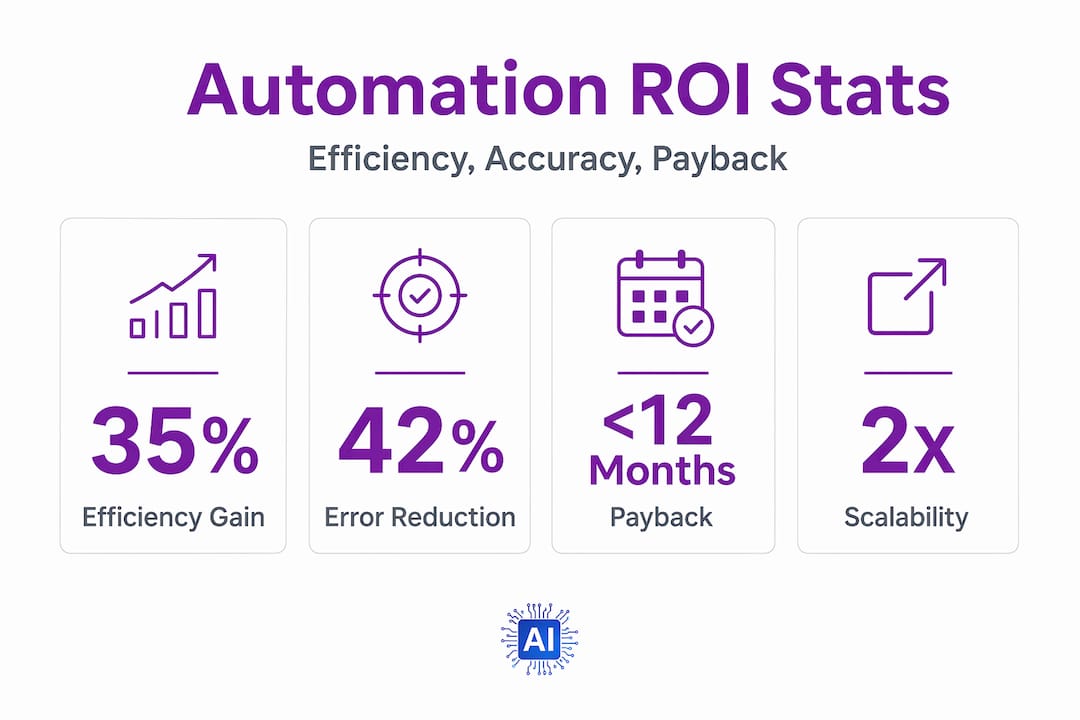
Numbers make the case more clearly than principles. A Workday-commissioned Forrester study found 35% efficiency gains, a 30% HR productivity boost, a payback period under six months, and a 242% three-year ROI when Adaptive Planning was deployed. These are not outlier figures from a best-case scenario. They reflect what structured automation delivers when the workflow foundation is solid before the technology is applied.
Here is a comparison of typical outcomes across core process categories:
| Process category | Without automation | With AI-driven automation |
|---|---|---|
| Invoice processing | 5-10 days, 3-5% error rate | Under 24 hours, under 0.5% error rate |
| HR onboarding | 7-14 days manual coordination | 1-3 days with automated task routing |
| Customer support routing | Manual triage, 4-8 hour response | Instant classification, under 1-hour response |
| Financial reporting | 3-5 days end-of-cycle close | Real-time dashboards with automated data feeds |
| Compliance documentation | Ad hoc, inconsistent | Standardized, timestamped, audit-ready |
These figures are representative of enterprise deployments where scalable AI automation systems were implemented with clear success metrics defined in advance.
Decision intelligence is where the ROI story gets more interesting. AI-powered systems do not just execute predefined rules. They can surface anomalies, flag exceptions, and feed structured data into planning cycles. Tools designed for AI for decision optimization embed analytics directly into workflow logic, enabling faster, more accurate planning without adding analyst headcount.
"Automation amplifies process value, but only if the workflow foundation is sound."
Pro Tip: Before selecting any automation tool, audit the target process first. Document every handoff, decision point, and exception path. If the process has unresolved ambiguities, automation will execute those ambiguities at scale. Fix the workflow logic, then apply the technology.
Understanding automation system fundamentals gives your team a structural framework for evaluating where to invest and in what order, rather than chasing tools based on vendor marketing.
Scaling smart: How automation unlocks growth
Growth creates operational pressure. Every new customer, transaction, or market entry adds load to your processes. Manual workflows bend under that pressure. They slow down, produce errors, and require constant management attention just to maintain baseline performance.
Automation enables scalability by handling higher workload and process volume without proportional increases in resources. This is not a theoretical benefit. Consider a mid-sized logistics operation processing 500 shipments per day with a team of 20 coordinators. At 1,500 shipments per day, that same manual process would require roughly 60 coordinators. With automated dispatch, routing, and exception handling, the same 20 people can manage 1,500 or more shipments with refined oversight rather than raw processing.

Manual vs AI-driven scaling: A direct comparison
| Scaling factor | Manual process | AI-driven automated process |
|---|---|---|
| Cost per unit as volume grows | Increases linearly | Decreases or stays flat |
| Error rate under high volume | Increases significantly | Remains consistent |
| Time to onboard new capacity | Weeks to months (hiring) | Hours to days (configuration) |
| Visibility into bottlenecks | Limited, reactive | Real-time, proactive |
| Resilience during demand spikes | Brittle, prone to backlog | Elastic, self-adjusting |
The benefits of scaling with automation are clear, but the implementation risks are real:
- Automation does not eliminate bottlenecks. It can relocate them.
- If you automate one step in a sequence and leave downstream steps manual, the bottleneck shifts downstream.
- Volume pressure on the un-automated steps increases, sometimes creating worse backlogs than before.
- Process mapping must cover the full sequence, not just the target step.
Pro Tip: When planning automation for a specific process step, map all downstream dependencies first. Confirm that downstream steps can absorb the increased throughput the automated step will generate. Scaling smartly means scaling the full architecture, not just a single layer.
Reviewing enterprise automation strategies built for medium to large operations gives you a clearer picture of how to structure a phased rollout without creating new operational fragility. When selecting the tools to support that rollout, it pays to compare top automation tools based on evidence rather than feature lists alone.
How not to automate: Common pitfalls and smarter strategies
The failure modes in automation projects are well-documented, and they repeat across industries. Understanding them in advance is one of the most practical investments a business leader can make before committing budget.
-
Automating a broken process. This is the most common and most costly mistake. AI can amplify bad or fragmented processes rather than fix them. If your current workflow has redundant steps, unclear ownership, or inconsistent inputs, automation will execute those flaws faster and at greater scale. The result is a high-speed, expensive version of the same problem.
-
Treating automation as a one-time project. Automation is infrastructure, not an event. Business processes evolve, regulations change, and data inputs shift. An automated workflow deployed without a maintenance and iteration plan will degrade over time. Build continuous validation into the architecture from day one.
-
Ignoring process knowledge transfer. Automation can move the bottleneck if other downstream steps are not sped up. Beyond the technical bottleneck issue, there is an institutional knowledge problem. When you automate a process that one or two experienced people managed manually, their contextual knowledge often disappears from the organization. Document that knowledge before it is removed from the daily workflow.
-
Chasing the wrong metrics. Measuring success by the number of automations deployed rather than by business outcomes leads to automation sprawl. Many organizations end up with dozens of disconnected bots and scripts that no one fully understands, producing marginal gains at significant maintenance cost.
-
Skipping stakeholder alignment. Automation affects roles, workflows, and team dynamics. Implementations that bypass cross-functional input frequently encounter resistance that slows adoption and reduces impact. The technical layer is rarely the limiting factor. The organizational layer usually is.
"Start from process reality. Map what actually happens, not what the documentation says should happen. Then optimize, then automate."
Applying AI implementation best practices within a structured deployment framework reduces the risk of each of these failure modes. And when streamlining with AI solutions, the sequence matters as much as the technology selection.
Action plan: Steps to maximize automation success
This is the framework we recommend for business leaders who want to build automation programs that deliver measurable, sustained results rather than short-term wins followed by stagnation.
-
Map your current workflows in operational detail. Do not rely on process documentation from three years ago. Walk through each process as it actually functions today. Identify every handoff, decision point, exception path, and manual intervention. This gives you an honest picture of what you are actually automating.
-
Identify true bottlenecks, not just visible pain points. The loudest complaints are not always the highest-value targets. Use data to identify where processing time, error rates, and rework are highest. These are your highest-ROI automation candidates.
-
Define success criteria before selecting tools. Set specific, measurable targets for each candidate process. Cycle time reduction, error rate targets, cost-per-transaction benchmarks. If you cannot define what success looks like, you cannot evaluate whether the automation worked.
-
Pilot with a contained, high-visibility process. Select a process that is important enough to demonstrate value but bounded enough to control. Run the automation in parallel with the manual process initially to validate accuracy and catch edge cases.
-
Measure, document, and iterate. Automation can move the bottleneck downstream when other steps are not addressed, so monitor the full sequence post-deployment. Capture what changed, what improved, and what new challenges emerged. Use those findings to plan the next phase.
-
Scale with a connected architecture, not isolated tools. Automation at scale requires a layered infrastructure where tools, systems, and workflows are integrated. Standalone bots solve individual problems. Connected architectures solve operational systems.
Pro Tip: Cross-functional buy-in is not optional. Include operations, IT, finance, and the teams directly affected by the process in every phase from mapping through deployment. Their input surfaces exceptions that technical teams miss, and their ownership accelerates adoption.
Structuring your program around structured automation for efficiency and scalability principles from the start prevents the ad hoc sprawl that limits long-term returns. For further guidance on applying AI strategically, using AI to grow business provides practical context on connecting technology investments to measurable business outcomes.
Why the real value of automation lies beyond technology
We have worked through the architecture of automation programs long enough to hold a clear opinion on this: the technology is rarely the limiting factor. The biggest wins we see come not from the sophistication of the tools but from the clarity leaders have about their own core processes.
Too many initiatives chase automation for its own sake. A new AI tool gets announced, leadership gets enthusiastic, and a project spins up before anyone has answered the foundational question: what exactly are we trying to make better, and why does it matter to the business? Without that clarity, even powerful tools produce underwhelming results.
Sustained impact comes from connecting technology with institutional knowledge and real-world operational feedback. The organizations that pull ahead are the ones treating automation as a living system, not a deployed asset. They instrument their workflows, monitor performance continuously, and adjust based on what the data shows rather than what the vendor promised.
Leaders who put people, process, and data at the center of their automation strategy gain more from every dollar of AI investment. They also avoid the organizational friction that derails technically sound projects. Tools can be replaced. Process clarity and team alignment take years to build.
Understanding AI automation system design strategies from an architectural perspective, rather than a tool-selection perspective, is what separates programs that compound in value from those that plateau after the initial gains.
Unlock your automation advantage with proven blueprints
If this article has clarified your thinking about where automation creates real value, the logical next step is moving from strategy to structured execution.

At Starks Global Group, we build and publish verified automation blueprints that give your team a concrete starting point rather than a blank slate. Our AI automation agency blueprint covers the full stack from tool selection and workflow design through deployment and monitoring, structured for medium to large enterprise environments. If you are ready to explore how a layered automation architecture fits your operational reality, visit the automation infrastructure platform and assess where your processes stand today.
Frequently asked questions
How does automation reduce errors in business processes?
Automation applies identical logic to every transaction without fatigue, removing the variability that causes human mistakes. Minimizing errors is one of the primary drivers and measurable benefits of business process automation.
Is automation only about cutting labor costs?
No. Automation delivers accuracy improvements, faster cycle times, scalable throughput, and lower risk exposure well beyond simple cost reduction. Efficiency, accuracy, and scalability are the core strategic drivers, not just headcount savings.
What is the ROI of automating business processes?
Structured automation can return value fast. A Forrester TEI study commissioned by Workday found a payback period under six months and a 242% ROI over three years when Adaptive Planning was deployed with a solid process foundation.
What is a common mistake in automation projects?
The most common mistake is automating a flawed process without fixing it first. AI amplifies bad processes rather than correcting them, so the defects execute faster and at greater scale than before.
How do you avoid bottlenecks when automating?
Map the complete workflow sequence before deploying automation, not just the target step. Automation shifts the bottleneck downstream when other steps are left at manual speed, so the full pipeline must be evaluated and prepared.