

Most enterprise leaders assume that making their AI systems "more transparent" automatically leads to better outcomes. Open the black box, show the logic, and trust improves. That assumption is wrong, and acting on it without a clear framework can create as many problems as it solves. Automation transparency means making automated systems understandable in terms of what they do, what data they use, how results are generated, and who is accountable. But understanding what it is only scratches the surface. How you implement it, when you disclose it, and to whom defines whether it actually drives enterprise efficiency or introduces new friction.
Table of Contents
- What is automation transparency? Defining the concept
- Enterprise lifecycle: Transparency beyond explainability
- Types and timing: Why transparency isn't one-size-fits-all
- Benefits and risks: Balancing user control and cognitive overload
- Implementing automation transparency: Practical steps for enterprise leaders
- A deeper perspective: Why automation transparency must be tailored
- Unlock next-level operational transparency with Starks Global Group
- Frequently asked questions
Key Takeaways
| Point | Details |
|---|---|
| Transparency definition | Automation transparency means making AI-driven system workings, logic, and accountability clear to stakeholders. |
| Lifecycle coverage | Effective transparency spans pre-deployment, runtime, and post-output governance—you need artifacts, audit logs, and escalation paths. |
| Type and timing matter | The format and timing of transparency must be matched to the workflow; not all forms improve trust or performance. |
| Benefits and risks | Transparency can strengthen trust and awareness but must avoid cognitive overload or false control. |
| Leadership action | Decide which transparency layers are needed for each role and maintain auditable systems for compliance and optimization. |
What is automation transparency? Defining the concept
Transparency in automation is not a feature you add at the end of a deployment. It is a structural property built into how a system operates, communicates, and gets governed. At its most practical level, automation transparency requires making AI systems comprehensible to those affected, covering system actions, data sources, decision logic, and accountability chains.
There are three foundational pillars that hold this concept together:
- Explainability: Can the system describe what it did and why? This is about translating machine logic into human-readable reasoning, whether a workflow routed a task in a particular direction or a model flagged a record for review.
- Interpretability: Can stakeholders understand the underlying patterns or rules the system uses? Interpretability goes deeper than explanation. It asks whether someone with domain expertise can validate the system's approach.
- Accountability: When a system makes a mistake or produces a harmful output, is there a clear chain of responsibility? Accountability structures define who answers for what.
These pillars are not optional extras. They are the load-bearing walls of any enterprise automation architecture. Without them, you cannot satisfy compliance auditors, manage operational risk, or build durable user trust.
"Transparency is not about full disclosure of every internal mechanism. It is about giving the right people the right information to make informed decisions and exercise appropriate oversight."
Understanding automation system fundamentals is the prerequisite for building systems that can actually deliver on this promise. Transparency that is poorly structured undermines confidence rather than strengthening it. This is why the engineering approach matters. When you design workflows with explainability baked in from the start, you avoid costly retrofitting later. Leaders serious about building high-efficiency workflows will find that transparency becomes a natural output of well-designed architecture rather than an add-on.
Enterprise lifecycle: Transparency beyond explainability
Transparency does not stop at deployment day. It is a continuous property that must operate across the full lifecycle of any automated system. Lifecycle transparency includes pre-deployment documentation, runtime logging, post-hoc explanations, and defined information flows for every class of stakeholder.
Here is a structured view of what that looks like across the enterprise lifecycle:
| Lifecycle stage | Transparency requirement | Artifact type |
|---|---|---|
| Pre-deployment | System purpose, data provenance, risk assessment | Model cards, data sheets |
| Runtime | Decision logging, error flagging, audit trails | Logs, dashboards |
| Post-deployment | Outcome explanations, performance audits | Explainability reports |
| Incident response | Root cause analysis, corrective action paths | Escalation records |
| Ongoing review | Governance audits, performance benchmarks | Compliance reports |
The practical implication here is significant. Most organizations focus heavily on the pre-deployment phase and then treat transparency as done once the system is live. That is a structural gap. Runtime logging and post-deployment audits are where real-world deviations get caught early.
Stakeholders across the organization need layered information, not identical information. Here is how to think about it:
- Operational staff need real-time clarity on what the system is doing and why it produced a specific output.
- Compliance and risk teams need audit trails, data provenance documentation, and clear escalation paths.
- Executive leadership needs summary-level governance reporting with clear risk indicators.
- End users or customers affected by automated decisions need accessible explanations they can act on.
- Technical teams need model-level documentation, feature importance data, and performance benchmarks.
Pro Tip: Build your transparency artifacts as living documents. Static documentation becomes misleading as systems evolve. Version control your model cards and update runtime logs continuously rather than auditing them quarterly.
The automation system design strategies that produce durable enterprise value always include escalation paths and contestability mechanisms. Stakeholders need the ability to challenge outputs and receive substantive responses. That requirement is not a legal nicety. It is a governance control. Leaders implementing AI-driven process automation must treat these mechanisms as core system components, not afterthoughts.

Types and timing: Why transparency isn't one-size-fits-all
Here is where the common assumption breaks down most visibly. Not all types of transparency produce the same results. In fact, some forms of transparency actively reduce trust and performance when deployed incorrectly.
Empirical research from automated decision aid studies shows a striking finding: instructions-based transparency delivered before a task improved user performance and compliance significantly, while confidence-display transparency (showing users how confident the system was in its output) failed to improve outcomes and actually reduced user trust in several test conditions.
This distinction matters enormously for enterprise deployments. Three broad types of transparency operate differently in practice:
- Instructional transparency: Tells users what the system is designed to do, its known limitations, and how to work with it effectively. This type tends to improve outcomes when delivered at the right moment.
- Confidence-based transparency: Surfaces system certainty scores or probability outputs. This can be counterproductive if users do not understand how to interpret those scores in context.
- Outcome-focused transparency: Explains why a specific decision or output was produced. This supports contestability and appeals processes, and it builds long-term trust when done well.
The comparison below illustrates where each type performs and where it creates problems:
| Transparency type | Best use case | Risk when misapplied |
|---|---|---|
| Instructional | Onboarding, high-stakes decisions | May be ignored if delivered too frequently |
| Confidence-based | Expert users with statistical literacy | Reduces trust in general users; creates false precision |
| Outcome-focused | Compliance, appeals, contestability | Can overwhelm with irrelevant detail |
Timing is equally critical. Transparency delivered before a task sets expectations and frameworks. Transparency delivered after a task supports learning and contestability. Transparency delivered during a task can disrupt focus and introduce hesitation, particularly in time-sensitive operational workflows. Validating automation systems should include testing not just whether the system produces correct outputs, but whether the transparency layer functions as intended across different user groups and workflow contexts.
Benefits and risks: Balancing user control and cognitive overload
When implemented correctly, automation transparency strengthens situation awareness. Users understand what the system is doing, they can identify when something looks wrong, and they remain meaningfully engaged rather than passively dependent. This is especially important in high-stakes workflows like financial approvals, HR decisions, or clinical data processing.
Research from the National Academies on human-AI teaming confirms that transparency can reduce out-of-the-loop risks when the content is well-calibrated. Poorly calibrated transparency, however, creates cognitive overload or a misleading sense of control that can be more dangerous than no transparency at all.
"Transparency that exceeds a user's ability to process it does not make them more informed. It makes them more confused, and confusion produces worse decisions than ignorance does."
There is also the problem of the illusion of control. Studies on automated systems show that detailed explanations improve user satisfaction and perceived control without actually giving users more real control over outcomes. When users feel in control but are not, they become less likely to question system outputs, which eliminates one of the core benefits transparency is supposed to deliver.
Key risks to manage in enterprise transparency implementations:
- Cognitive overload: Too much information presented to the wrong audience at the wrong time degrades decision quality.
- Automation complacency: Overly confident or overly detailed explanations can make users less vigilant rather than more.
- Illusion of control: Users who feel they understand a system may stop questioning it, reducing the human oversight that transparency was designed to support.
- Transparency theater: Documentation and reporting that exists to satisfy auditors but does not actually inform decision-making creates compliance risk without governance value.
Pro Tip: Test your transparency layers with representative user groups before full deployment. Measure not just comprehension but decision quality and error detection rates. If transparency is not improving those metrics, recalibrate before scaling.
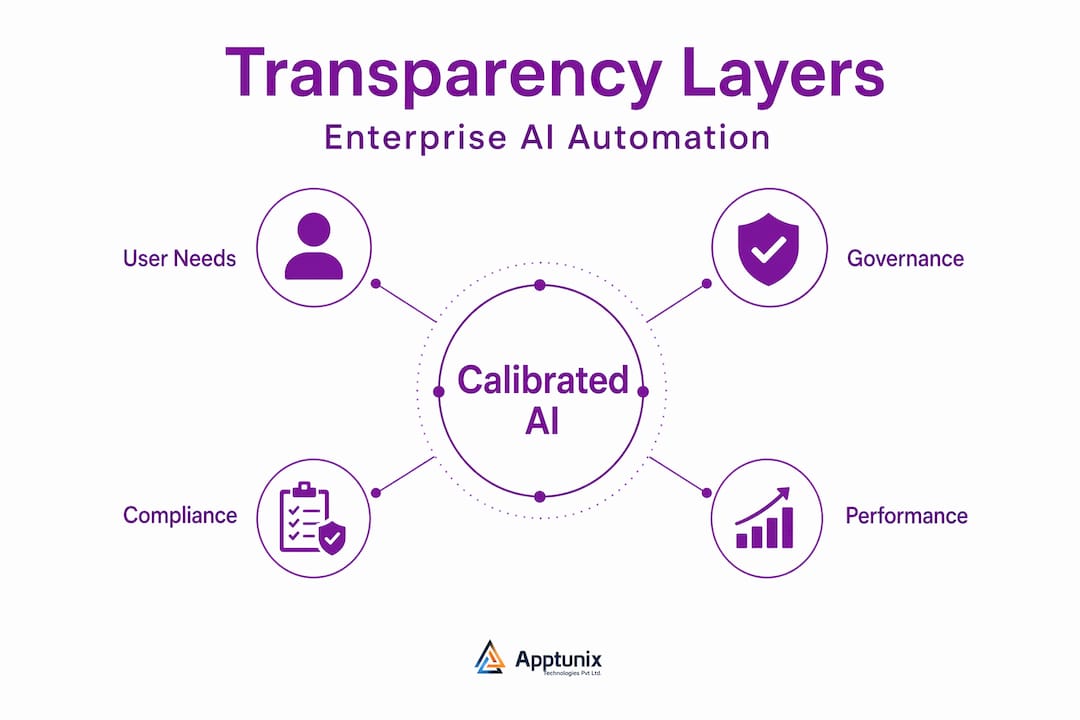
Effective enterprise transparency requires layering. Scalable AI automation systems achieve this through tiered disclosure, where different stakeholders access different depths of system information based on their role, technical literacy, and governance responsibility. The key automation system components that enable this include structured logging, role-based dashboards, and contextual explanation modules that surface relevant information without overwhelming the interface.
Implementing automation transparency: Practical steps for enterprise leaders
Moving from concept to execution requires a structured approach. Transparency is not a checklist item. It is an ongoing operational discipline. Leaders should treat transparency as both a process capability and a system capability, covering data provenance, decision rationale, limitation disclosure, and auditability across every workflow tier.
Here is a practical implementation sequence:
- Map your stakeholder matrix. Identify who interacts with each automated system, what decisions they make based on its outputs, and what transparency they need to exercise appropriate oversight. This mapping drives every subsequent design decision.
- Define disclosure layers. Determine what information each stakeholder class receives, in what format, and at what point in the workflow. Operational staff and compliance teams have fundamentally different needs.
- Build transparency artifacts into the system architecture. Model documentation, data provenance records, audit logs, and explanation modules are not retrospective reports. They are active system outputs that update continuously.
- Establish escalation and contestability paths. Every automated decision that affects a human or a business outcome needs a mechanism for review and challenge. Document those paths formally and test them regularly.
- Implement governance controls. Operational transparency must support risk tiering, accountability assignment, and audit tracking at the system level, not just the organizational policy level.
- Iterate based on feedback and workflow performance. Deploy transparency incrementally, measure its impact on user behavior and decision quality, and refine. Transparency requirements shift as systems evolve and user capabilities mature.
Pro Tip: Assign explicit ownership of transparency governance. Without a named accountable party, transparency artifacts become stale and governance controls atrophy. This is one of the most common failure points we observe in enterprise AI deployments.
Leaders focused on streamlining operations with AI will find that transparency infrastructure pays compounding returns. Systems that are well-documented and auditable are also easier to maintain, debug, and scale. The investment in governance artifacts is not administrative overhead. It is engineering discipline that reduces long-term technical debt. For teams building out enterprise automation strategies, transparency architecture should be scoped into every system design from day one.
A deeper perspective: Why automation transparency must be tailored
Most frameworks treat automation transparency as a universal standard. Define your explainability approach, build your documentation, deploy your audit logs, and consider the governance problem solved. We disagree with that approach, and the research backs us up.
The evidence is clear that transparency type, timing, and depth all interact with specific workflow contexts and user populations in ways that generic frameworks cannot anticipate. A confidence-display mechanism that confuses a general business user might be exactly what a data science team needs. An outcome-focused explanation that is perfectly calibrated for a compliance auditor may overwhelm a customer service agent who needs to act quickly.
The real lesson for enterprise leaders is this: transparency effectiveness must be validated in your own environment, not assumed from a vendor checklist or a regulatory template. Copy-paste transparency protocols are a liability, not a safeguard. What works in a financial services context may actively harm performance in a supply chain operations context.
Understanding automation system fundamentals is the foundation, but operational outcomes depend on thoughtful calibration that is specific to your architecture, your stakeholders, and your risk profile. We have seen organizations build technically sophisticated transparency layers that no one actually used because the design did not account for real workflow constraints. We have also seen simple, well-placed instructional disclosures dramatically improve both user compliance and system trust with minimal implementation cost.
The goal is not maximum transparency. The goal is calibrated transparency that produces measurable improvements in governance, trust, and operational performance. Those are different targets, and confusing them is the most expensive mistake enterprise leaders make in this space.
Unlock next-level operational transparency with Starks Global Group
Implementing automation transparency at enterprise scale requires more than good intentions. It requires verified systems, structured architectures, and blueprints you can actually build from.

At Starks Global Group, we design and validate automation infrastructure that operationalizes transparency from the ground up. Our AI automation agency blueprint gives your team a structured, layered architecture that includes governance controls, audit paths, and tiered disclosure mechanisms built into every workflow layer. Explore our tools and systems marketplace to find verified tools that support enterprise-grade transparency requirements. When you are ready to build scalable, auditable automation infrastructure, the Starks Global Group platform is engineered to take you there.
Frequently asked questions
How does automation transparency impact enterprise compliance?
Automation transparency enables enterprises to audit AI decisions and document system logic, which directly supports meeting regulatory requirements and structured risk management. Transparency is a governance property enabling accountability, audit, and ongoing compliance across the system lifecycle.
Can too much transparency create user confusion or overwhelm?
Excessive detail can cause cognitive overload and generate an illusion of control that actually undermines oversight quality. More detailed explanations improved perceived control without translating to actual control, and they introduced real overload risk in user testing.
What are the most critical transparency artifacts to maintain?
Core artifacts include model and data documentation, audit logs, and formal escalation paths that allow stakeholders to contest outputs and trace decisions. Transparency is operationalized through these auditable governance artifacts, which must be maintained continuously rather than generated reactively.
Which transparency approaches most improve user trust and performance?
Instructional and outcome-focused transparency delivered before tasks generally improves user compliance and builds durable trust in the system. Instructions-based transparency improved compliance and task performance, while confidence-display transparency produced no benefit and often reduced trust in empirical testing.
How do I decide who should see which transparency layer?
Segment your transparency layers by stakeholder role, with operational staff, auditors, and end-users each receiving information calibrated to their decision-making authority and governance responsibility. Defining who receives what information is a foundational transparency design requirement, not a post-deployment policy decision.