

Most automation projects fail quietly. Not with a dramatic crash, but with a slow accumulation of edge cases, data mismatches, and processes that break the moment conditions change. The reason is almost always architectural: the system was built as a single, linear flow instead of a structured set of coordinated layers. Understanding why layer automation systems matters is the difference between building something that works in a demo and building something that runs your business reliably at scale. If your organization is evaluating AI-driven automation, this guide explains exactly what layering achieves and why it belongs in your architecture from day one.
Table of Contents
- What multi-layer automation systems mean and why they matter
- Layered control architectures: ensuring safety, fault isolation, and scalability
- The orchestration layer: policy, safety, and AI control gateway
- Enhancing operational resilience with layered orchestration
- Engineering tradeoffs and best practices in layered automation design
- Why layering is the foundation of trusted, scalable AI-driven automation
- How Starks Global Group supports your layered automation journey
- Frequently asked questions
Key Takeaways
| Point | Details |
|---|---|
| Layered automation benefits | It creates stable, scalable, and safe AI-driven workflows by integrating multiple control layers beyond simple triggers. |
| Safety and fault isolation | Layered architectures isolate faults and enforce safety standards to maintain reliable operations even if some layers fail. |
| Orchestration is crucial | The orchestration layer acts as a safety and policy gateway validating AI decisions to prevent unsafe commands. |
| Operational resilience | Layered automation improves recovery times by logging decisions, enforcing constraints, and institutionalizing knowledge. |
| Engineering tradeoffs matter | Balancing latency, modularity, and verification complexity is key to effective layered automation design. |
What multi-layer automation systems mean and why they matter
Single-layer automation is essentially "if-this-then-that" logic applied to business processes. It works for simple, predictable tasks. But enterprise operations are neither simple nor predictable. Data arrives dirty. Exceptions stack up. Business rules evolve. A flat automation script cannot handle any of that gracefully.
Multi-layer automation orchestrates multiple levels simultaneously, including data quality, decision logic, process flow, control gates, and continuous optimization, to create workflows that are stable, traceable, and built for growth beyond what simple automations can achieve. Each layer has a specific job. The data quality layer catches bad inputs before they corrupt downstream steps. The decision logic layer applies rules. The process flow layer sequences actions. Control gates introduce human approval where risk warrants it. The optimization layer feeds performance signals back into the system.
The practical result is dramatically fewer errors and far less rework. Consider an enterprise procurement process. A single-layer automation might trigger a purchase order when inventory drops below a threshold. A multi-layer version would first validate supplier availability (data layer), check contract terms and spending authority (rules layer), route for approval if the order exceeds a set value (control gate), execute the transaction (process layer), and log the outcome for spend analysis (optimization layer). The difference between those two architectures is the difference between a process that mostly works and one you can actually trust.
Key reasons enterprises adopt multi-layer designs:
- Fault containment: Errors caught at one layer do not propagate to others
- Traceability: Every decision has a documented path through the layers
- Adaptability: Individual layers can be updated without rebuilding the entire workflow
- Governance: Control gates enforce approval requirements and regulatory rules
Understanding how infrastructure automation efficiency connects to architecture decisions is the first step toward building systems that scale.
Pro Tip: Map your current workflows by failure mode before designing layers. If you know where errors originate, you can position the right control layer directly upstream of the problem.
With the basic concept clear, let's explore how layered control architectures underpin this approach in complex systems.
Layered control architectures: ensuring safety, fault isolation, and scalability
In engineering terms, a layered control architecture separates system functions by time scale and abstraction level. Upper layers handle long-range planning and policy. Lower layers manage real-time execution. Each layer communicates with adjacent layers through defined interfaces, and nothing jumps the stack.

Layered control architectures enable fault isolation, meaning lower layers maintain safe fallback behaviors even when upper layers fail. This property is structurally impossible in flat architectures where a single failure can cascade through the entire system. That is not a minor technical benefit. For enterprises running AI-driven automation across operations, sales, or manufacturing, it means a model malfunction or a bad AI recommendation does not bring production to a halt.
The functional separation also supports compliance with safety standards such as IEC 61508, the international standard for functional safety of electrical and electronic systems. Regulators and auditors want to see documented evidence that safety-critical functions are isolated and verifiable. A layered architecture produces that evidence as a natural byproduct of its design.
Here is how the layers typically stack in an enterprise or industrial setting:
- Mission and planning layer: Sets objectives, schedules, and resource allocation based on business goals
- Coordination layer: Translates high-level plans into specific process sequences
- Execution layer: Manages individual task flows and triggers system actions
- Control layer: Handles real-time feedback loops and immediate process adjustments
- Sensor and data layer: Collects raw operational data and performs initial validation
Modular design also reduces integration risk. You can test each layer independently before connecting it to adjacent layers. You can upgrade the AI model in the coordination layer without touching the execution logic below it. Reviewing the automation system components that interact across these layers helps clarify where each piece fits in the architecture.
"A layered architecture is not just an organizational preference. It is an engineering constraint that makes complex systems verifiable and safe by design."
Understanding the architecture reveals why orchestration layers play a crucial role in regulating AI's interaction with operational technology.
The orchestration layer: policy, safety, and AI control gateway
The orchestration layer sits between AI systems and the control infrastructure that actually moves data, triggers processes, and interacts with physical systems. It is deterministic where AI is probabilistic. It enforces rules where AI makes predictions. That distinction is what makes AI adoption in operational settings trustworthy rather than risky.
The orchestration layer prevents unsafe commands, resolves conflicts between AI systems, and ensures operator transparency by validating AI suggestions against plant rules and machine state before any action is taken. Without this layer, an AI optimization model can push a process parameter beyond a safe limit simply because it learned that doing so improved a short-term metric. The orchestration layer catches that before it causes damage.
"An orchestration layer does not constrain AI. It gives AI the structured environment where it can operate productively without creating liability."
Full audit trails are another output of effective orchestration. Every AI recommendation, every approval decision, and every exception gets logged with context. That log is your compliance documentation, your incident investigation tool, and your system improvement input, all in one place.
Here is what a well-designed orchestration layer provides:
| Function | What it does | Why it matters |
|---|---|---|
| Policy enforcement | Validates AI outputs against defined rules | Prevents non-compliant actions |
| Conflict resolution | Arbitrates between competing AI recommendations | Avoids contradictory process states |
| Audit logging | Records all decisions with timestamps and context | Supports compliance and root cause analysis |
| Virtual commissioning | Tests AI updates in simulation before deployment | Prevents unsafe changes from going live |
| Human override management | Routes decisions to operators when confidence is low | Maintains human authority over critical actions |
Beyond safety, orchestration layers enhance operational resilience by replacing disjointed scripts with unified control frameworks. Understanding automation systems validation practices helps you design the audit and testing functions that make orchestration reliable over time.
Pro Tip: Treat virtual commissioning as a non-negotiable step before any AI model update goes live. The cost of a simulation run is always lower than the cost of an unplanned production stoppage.
Enhancing operational resilience with layered orchestration
Operational resilience is the ability to absorb disruption and recover quickly without losing control of critical processes. Layered orchestration is one of the most reliable ways to build it into an automation system from the start.
Layered orchestration replaces disconnected software with checks and balances that enforce safety constraints and produce audit logs, preventing AI from pushing systems beyond safe limits. That shift from disconnected scripts to an integrated control framework has measurable effects on recovery time. When something goes wrong, you have a full decision audit trail to diagnose exactly where the failure occurred and why.
Four specific resilience benefits layered orchestration delivers:
- Faster recovery: Audit trails reduce diagnosis time from hours to minutes because the decision history is already documented
- Policy enforcement: Defined constraints stop AI-driven optimization from trading safety for throughput
- Global state awareness: Orchestration layers track system-wide conditions so individual automations do not operate on stale or local data, preventing cascading failures
- Knowledge retention: Operational rules encoded in the orchestration layer persist through staff turnover, reducing dependence on individual expertise
The knowledge retention point is underappreciated. When experienced operators leave, they take process knowledge with them. Encoding that knowledge into an orchestration layer's rule set means the organization retains it regardless of personnel changes.
Key behaviors to build into your orchestration layer:
- Alert thresholds that trigger human review before an AI recommendation is executed
- Rollback procedures that automatically revert to a prior stable state when anomalies are detected
- Cross-system state checks that confirm upstream and downstream conditions before initiating a process step
Reviewing approaches to ai-driven process automation helps clarify where orchestration fits within a broader automation program.
Pro Tip: Document every business rule your team uses informally to make process decisions. Those rules belong in your orchestration layer, not in someone's head or a shared spreadsheet.
Engineering tradeoffs and best practices in layered automation design
Layering is not free. Every layer boundary introduces a potential latency point. Every additional layer adds a verification surface. These are real engineering tradeoffs, and managing them well is what separates a system that performs in production from one that performs only in design documents.
Layered architectures introduce latency at layer boundaries, requiring techniques like collapsed layers or bypass paths to meet real-time deadlines. Conflict arbitration and verification complexity must also be managed to maintain performance and coherence as system scale increases. The verification challenge grows combinatorially, meaning as you add layers, the number of interaction paths you need to test multiplies rapidly.
A practical comparison of design approaches:
| Design choice | Advantage | Risk to manage |
|---|---|---|
| Full layer separation | Maximum modularity and fault isolation | Higher latency between layers |
| Collapsed layers | Lower latency, simpler interfaces | Reduced modularity, harder to update |
| Bypass paths | Real-time performance for critical paths | Bypassed layers may miss policy checks |
| Priority voting arbitration | Resolves layer conflicts systematically | Requires careful priority calibration |
Best practices we recommend for layered automation design:
- Assign clear ownership to each layer so accountability for logic and maintenance is never ambiguous
- Conduct quarterly logic reviews to identify rules that have become outdated or contradictory
- Place human override checkpoints at high-risk process steps, not just at the top of the stack
- Start with three to four layers and add depth only when a specific control problem requires it
Numbered steps for initial implementation:
- Define the scope and risk profile of the automation target
- Design your data quality and validation layer first
- Build and test the decision logic layer independently
- Introduce the orchestration and control gate layer
- Connect the optimization feedback loop last, after the other layers are stable
Reviewing automation system design strategies and approaches to scalable automation systems gives you concrete starting points for your own architecture planning.
Pro Tip: Never add a layer to solve a people problem. Layers solve architectural and control problems. If the issue is unclear process ownership or inconsistent rule application, fix the governance first, then encode it in the architecture.
Having explored design considerations, let's conclude with an expert perspective on why layering is essential for trustworthy automation adoption.
Why layering is the foundation of trusted, scalable AI-driven automation
Here is the view we hold, formed from watching organizations attempt automation at scale: the enterprises that treat layering as an optional refinement consistently hit a ceiling. They automate well until complexity exposes the limits of flat architecture, and then they spend more time firefighting failures than they ever saved through automation. The ones that build layered systems from the start scale further, faster, and with far less operational disruption.
Layering reduces integration risk and empowers independent development, validation, and scaling, making automation upgrades safer and more manageable over time. That is not a claim about architectural elegance. It is a claim about operational continuity and the cost of technical debt.
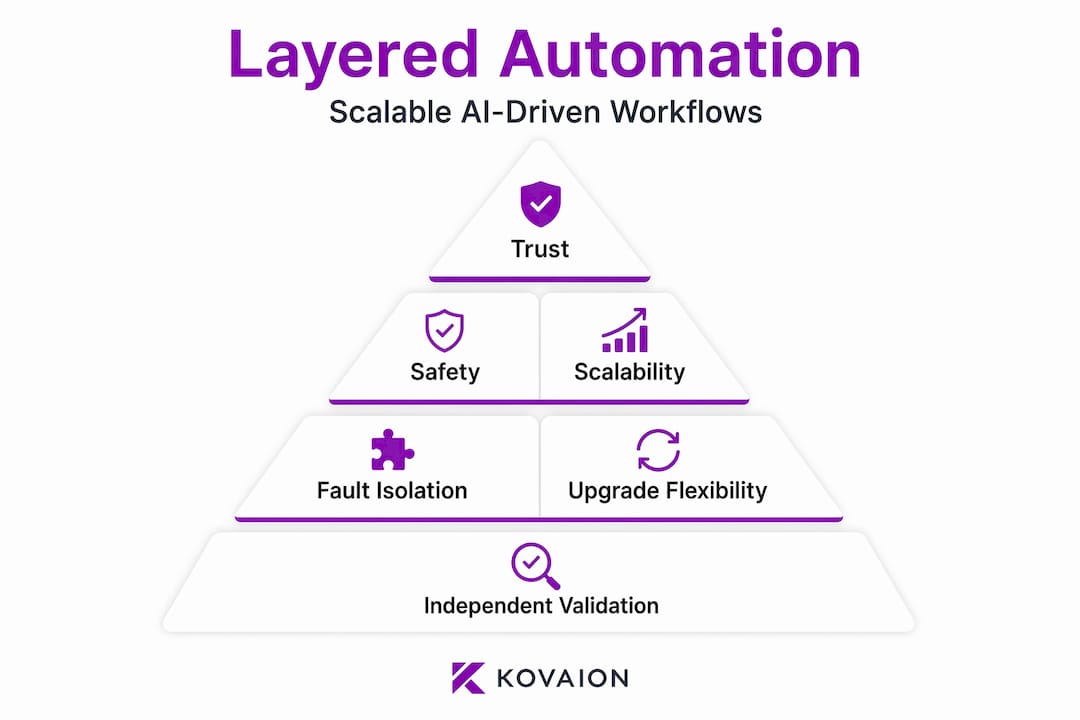
There is also a trust dimension that rarely gets discussed in technical planning sessions. AI-driven automation only generates sustained value if your operators, compliance teams, and leadership trust it enough to let it run. An orchestration layer safeguards AI operations, ensuring productivity gains do not compromise safety or operator authority. That protection is what builds the organizational confidence to expand AI adoption over time, rather than pulling it back after the first serious incident.
We also see layering as a strategic investment in organizational resilience. When regulations change, when business models shift, or when new AI capabilities become available, a layered architecture can absorb those changes in specific layers without requiring a full system rebuild. A flat system requires you to start over. A layered system requires you to update a module.
For business leaders, the right framing is not "how do we automate this process?" It is "how do we build an automation architecture that can carry this organization forward over the next five years?" Layering is the answer to that question. Reviewing enterprise automation strategies helps connect architectural decisions to long-range business planning.
How Starks Global Group supports your layered automation journey
Understanding layered automation architecture is one thing. Implementing it correctly across your operational workflows is another challenge entirely.

At Starks Global Group, we build and verify automation system blueprints that reflect the engineering principles covered in this guide. Our AI automation agency system blueprint provides a structured, multi-layer architecture you can adapt to your operational context, with control gates and approval layers built in. If your priority is revenue operations, our AI chatbot sales blueprint and sales automation system blueprint give you tested, layered frameworks for sales and customer engagement workflows. Every blueprint we publish is tested before it reaches you, because an untested architecture is not a blueprint. It is a guess.
Frequently asked questions
What is the main difference between single-layer and multi-layer automation systems?
Multi-layer automation integrates several control layers such as data validation, decision rules, approvals, and optimization to create more stable, traceable, and scalable processes, while single-layer systems rely on linear, brittle "if-this-then-that" logic that breaks under complexity.
How does layering improve safety in AI-driven automation?
Layering isolates faults so a failure in an upper layer does not compromise real-time control. Layered control architectures enable safe fallback behaviors at lower layers, ensuring operations stay within defined safety and policy constraints even when AI components malfunction.
Can layering increase automation complexity and latency?
Yes, each layer boundary can add communication latency, but engineering approaches like collapsing layers or bypass paths help maintain real-time performance while preserving the modularity and fault isolation that make layering valuable.
Why is an orchestration layer critical for AI adoption in industrial settings?
An orchestration layer validates AI outputs against operational rules and machine state before any command is executed. It ensures AI enhances operations without compromising safety or operator authority, which is the baseline condition for trustworthy AI deployment.
How can business leaders start implementing layered automation systems effectively?
Begin by evaluating process complexity and risk, then implement foundational layers like data quality and approval gates first. Start small but think in layers, with clean data inputs, clear decision rules, defined exception paths, and control checkpoints, then progressively add orchestration and optimization capabilities as the foundation stabilizes.